
Afternic Portfolio Agent helps domain sellers analyze their portfolios and make targeted adjustments.
Afternic has begun a limited rollout of its new Portfolio Agent. The tool is currently available to select accounts with 500 domains or fewer while Afternic scales testing. I asked GoDaddy to enable Portfolio Agent on my account to evaluate its capabilities firsthand.
Portfolio Agent lets domain sellers use natural-language prompts to analyze their domain portfolios and to make changes directly from the chat interface. The goal is to simplify common portfolio tasks — search volume analysis, pricing changes, and identifying trends — without navigating through multiple dashboard screens.
To test basic functionality, I started with a simple request that I can also do on the dashboard: I asked which domains in my account received the most searches over the past 365 days. The agent returned a clear ranked list with no issues.
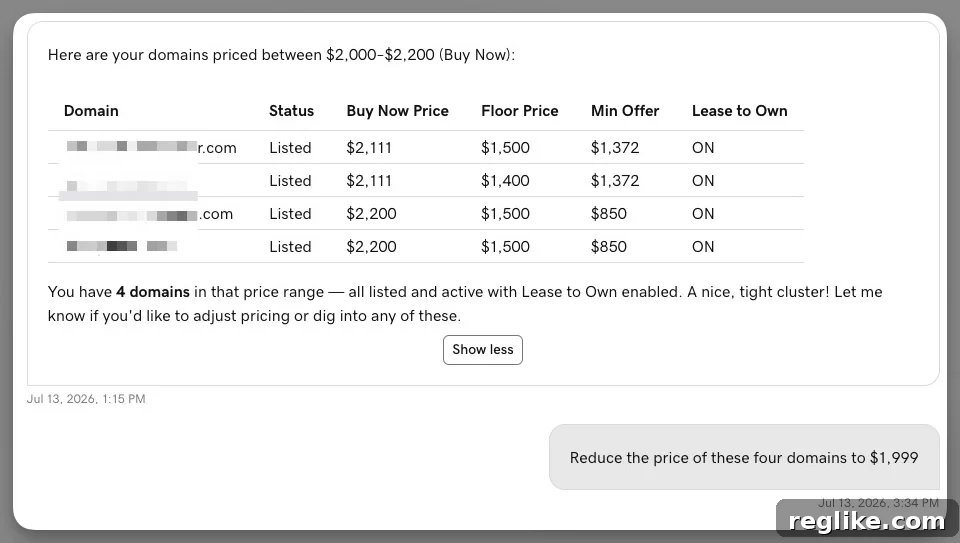
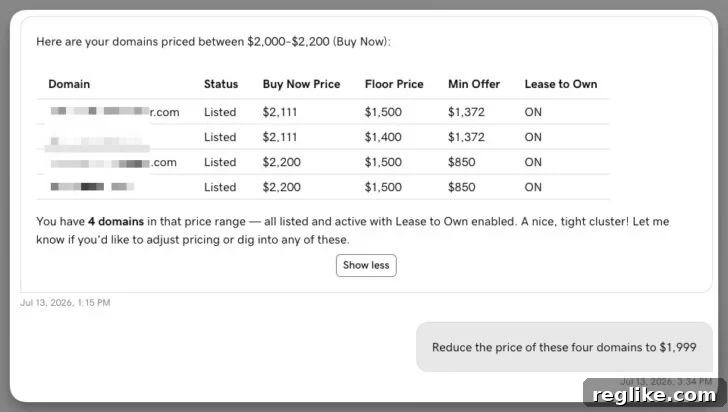
Next, I asked the agent to help with a specific pricing task I’d been delaying: locating domains priced just above $2,000 so I could lower them to just under that threshold. The agent quickly identified four domains meeting my criteria and asked for confirmation before proceeding. It was careful to state exactly which price adjustments it would make and required me to enter my two-factor authentication code before applying any changes, since I had not recently authenticated.
I then asked the agent for its opinion on pricing — specifically whether any domains looked underpriced and should be increased by $3,000 or more. The agent responded cautiously. It explained that it cannot determine definitive valuations without full access to comparable sales, niche demand, brand potential, SEO metrics, and other market data. Because pricing depends on factors outside its current dataset, it avoided definitive pricing recommendations but did provide the available data to help inform my decisions.
I appreciated that Portfolio Agent acknowledged its limitations. It suggests Afternic is prioritizing accuracy and safety over bold but potentially misleading recommendations. In future iterations, the agent may gain access to broader datasets or offer more confident valuation guidance, but for now it errs on the side of caution.
I then tried a more advanced analysis inspired by a discussion about identifying “hot” domains in a portfolio. The idea is to find domains with strong short-term interest relative to longer-term search volume — a potential sign that a single buyer is repeatedly checking a name.
First, I asked the agent to rank my top 50 domains by total searches over the past 365 days and then to compute the ratio of 30-day searches to 365-day searches for those domains. The agent produced a formatted list and added useful context, noting that a steady search pattern over a year would produce an expected ratio of roughly 8.2% for 30-day versus 365-day searches.
Next, I refined the task to match the “hot domains” idea more closely: I asked the agent to take my 50 domains with the most 30-day searches, then divide the 30-day total searches by 30-day unique searches to identify domains with a high ratio of repeat searches per unique visitor. The agent initially misunderstood and returned visitors instead of unique-search metrics, so I clarified my request. After the clarification it delivered a correct list with ratios showing repeat-search behavior.
One domain showed a ratio of six total searches per unique search over 30 days, suggesting a potential repeat buyer checking the name multiple times. With that insight, I had several options: encourage the prospective buyer to convert by temporarily lowering the price, offer lease-to-own terms, or, if the surge appears to be broader market interest, consider raising the price.
Overall, I found Portfolio Agent more useful than I expected. Historically I’ve been skeptical of chatbot integrations for domain management — a well-designed dashboard often covers core needs. But Afternic’s agent adds value by making targeted analyses fast and conversational. It streamlines tasks that previously required multiple clicks and manual filtering.
There are clear opportunities for Afternic to iterate: if many users request the same analyses, Afternic could surface those patterns as built-in dashboard features. For example, a dedicated “Hot Domains” section that displays the ratio of short-term searches to unique searches would be a natural UI addition based on these interactions.
One practical improvement Afternic rolled out this week benefits users who register domains at GoDaddy: you can now change nameservers for GoDaddy domains directly from a connected Afternic account, either from the dashboard or via the Portfolio Agent. That saves time by eliminating the need to switch between accounts to manage nameservers and portfolio entries.
In summary, Afternic Portfolio Agent is a promising tool for domain sellers. It provides conversational access to portfolio analytics, supports trusted workflows for price changes, and helps surface trends that are otherwise time-consuming to identify. As the agent gains more data and as Afternic refines commonly requested features into the dashboard, its usefulness should increase further.