
Company aims to determine demand for TLDs, and help connect early registrants with participating registries.
Domain services company D3 has introduced Frontier, a new platform designed to measure demand for proposed top-level domains (TLDs) and to help interested registrants position themselves to acquire names when those TLDs are launched. The platform aims to provide a transparent way for early adopters and businesses to signal interest in particular extensions and to potentially obtain domains before they reach general availability.
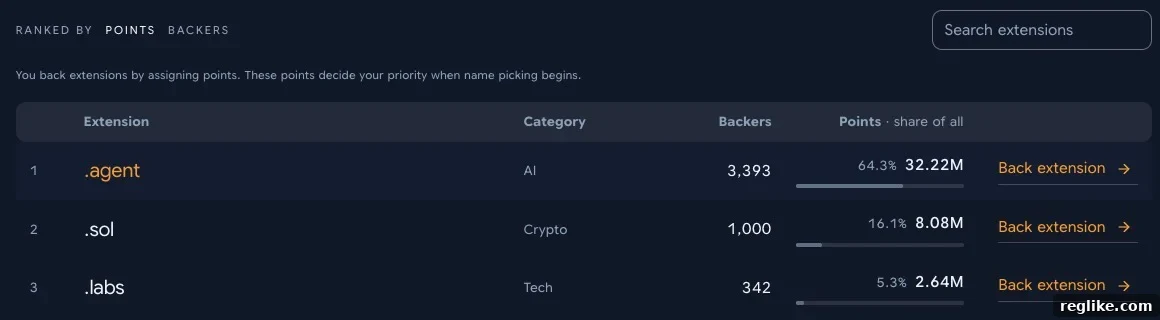
Frontier operates in two main phases. In the initial phase, users indicate which TLDs they find most valuable by allocating Frontier points at the TLD level. This high-level signaling aggregates interest in specific extensions, producing a ranked view of demand that can help registries and registrants understand market appetite. The platform’s leaderboard, for example, highlights which TLDs have attracted the most points from users, offering a quick indicator of popularity.
In a subsequent phase, Frontier opens name-level selection for TLDs whose registries participate in the program. At that point, registrants can select second-level domain names and commit Frontier points to those names. As part of this process, users also specify the first-year registration price they would be willing to pay. This combination of points and price creates a prioritized queue of interested parties for each name during Frontier’s registration window.
The platform uses a blind allocation mechanism to determine which registrant receives a domain in Frontier’s registration window. If the user who committed the most points for a particular name has also stated a price that meets or exceeds the registry’s minimum acceptable price for that domain, the domain will be awarded to that user at the stated price after the required Sunrise allocations are complete. If that user’s price offer does not meet the registry’s minimum, the system moves to the next highest point-committer, continuing until it finds a registrant willing to meet the registry’s ask. Registries do not see these point commitments or price indications before they submit their minimum acceptable prices, preserving confidentiality in the allocation process.
D3 refers to the allocation interval that follows Sunrise as the Frontier Registration Period. This period is designed to function as a Limited Registration Period within the ICANN new gTLD rollout process. It is intended to occur only after all Sunrise registrations and allocations have been finalized and before any Early Access or general availability phases begin. The Frontier Registration Period gives participating registries an option to allocate available names to users who signaled concrete interest through the platform.
Users can earn Frontier points in several ways, including signing up on the platform and depositing cryptocurrency in supported third-party vaults, as well as through referral and other qualifying activities. The platform’s current point distribution shows a strong concentration of interest in a small number of extensions. For example, at the time of this report the extension .agent accounts for a substantial share of all points, reflecting concentrated demand. Other extensions tied to the crypto community, such as .sol, .mask, and .sui, also rank highly, which may reflect the platform’s integration with crypto-based incentives.
It is important to emphasize that registries operating the TLDs shown on Frontier’s leaderboard have not necessarily committed to working with the platform. Frontier’s initial goal is to surface and quantify demand for specific extensions so that registries, registrants, and the broader domain community can better understand market interest. If registries decide to participate, Frontier can help match early registrants with those registries using its points-based, blinded allocation method.
By combining demand discovery, a points-driven priority mechanism, and a blinded price-matching allocation, Frontier aims to offer a structured approach to early TLD allocation. The platform seeks to benefit registrants who want early access to promising TLDs while providing registries with clear signals of market interest before they roll out new extensions. As the new gTLD space continues to evolve, tools like Frontier may play a role in shaping how early allocations are managed and how registrants prepare for upcoming domain opportunities.