
The Reality of Internationalized Domain Names (IDNs): A Case Study of .中国
Internationalized Domain Names (IDNs) haven’t achieved the widespread success initially anticipated by their proponents.

One of the key motivations behind the expansion of top-level domain (TLD) options in the last decade was to provide users with domain names in their native scripts and languages, giving rise to Internationalized Domain Names (IDNs). This article delves into the performance of IDNs, using the .中国 (China) country code top-level domain (ccTLD) as a prominent example.
The .中国 ccTLD: A Deep Dive
.中国, representing “China,” is a ccTLD that predates the newer Chinese IDN extensions introduced after 2013. This analysis will primarily focus on .中国, with a subsequent article exploring the newer Chinese IDN extensions and their respective adoption rates.
A Brief History of .中国
The precise origin of .中国 is somewhat difficult to pinpoint. In 2000, the Chinese Domain Name Consortium (CDNC) was established to champion the use of Chinese character-based domains. It is likely that registration of .中国 domains commenced around this time, as evidenced by the registration dates of prominent domains such as 阿里巴巴.中国 (Alibaba.china IDN) and 亚马逊.中国 (Amazon.china IDN). While registration was possible within China, the technical infrastructure was refined and improved over the following years. In 2010, .中国 received official approval from ICANN and was integrated into the Domain Name System for global accessibility.
.中国 Domain Registrations: An Overview
The following chart illustrates the total number of domains under management for the .中国 extension, based on data compiled from reports published by the China Internet Network Information Center (CNNIC).
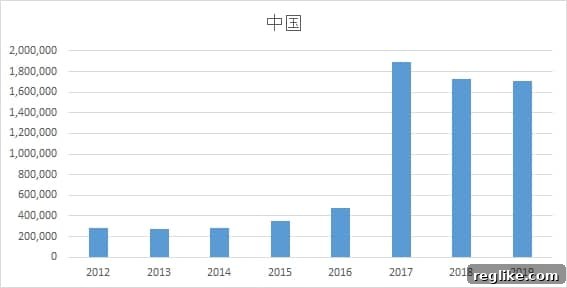
The chart indicates a significant increase in registrations in 2017, the underlying cause of which remains unclear. This pattern is not mirrored in the registration data for .cn or .com domains during the same period. It’s possible that shifts in investor sentiment contributed to this surge, as investors often play a significant role in the domain market.
After reaching its peak in 2017, the number of .中国 domain registrations gradually declined, despite efforts by the Internet Society of China to promote its adoption.
.中国 vs. .cn: A Comparative Analysis
Comparing .cn and .中国, both of which have been established for over 20 years, reveals a significant disparity in their adoption rates. Last year, .cn recorded 19 million registrations, while .中国 had only 1.7 million. Furthermore, Baidu reports approximately 100 million pages indexed under the .cn domain. In contrast, a search using the “site:.中国” parameter yields no results on Baidu, indicating a very limited presence. Google provides a more generous estimate, reporting approximately 323,000 pages associated with .中国 websites.
Real-World Usage: A Closer Look
In everyday research of Chinese internet usage, encountering websites built on the .中国 extension is rare. To gain a better understanding of its adoption among leading Chinese companies, the top 10 brands from the “Top 100 Chinese Internet Companies” list (compiled from the 2020 Research Report on the Comprehensive Strength of Chinese Internet Companies – 2020年中国互联网企业综合实力研究报告) were selected, and their corresponding .中国 domains were investigated. The results are summarized in the table below.
| Rank | Brand | IDN Domain | Status |
|---|---|---|---|
| 1 | Alibaba | 阿里巴巴.中国 | Not resolve |
| 2 | Tencent | 腾讯.中国 | Not resolve |
| 3 | Meituan | 美团.中国 | For sale |
| 4 | Baidu | 百度.中国 | Not resolve |
| 5 | Jing Dong | 京东.中国 | For sale |
| 6 | Netease | 网易.中国 | Not resolve |
| 7 | Pin Duo Duo | 拼多多.中国 | Personal site |
| 8 | Didi | 滴滴.中国 | Not resolve |
| 9 | ByteDance | 字节跳动.中国 | Not resolve |
| 10 | Tencent Music | 腾讯音乐.中国 | Not resolve |
Conclusion: The State of .中国
The findings suggest that corporate China has not widely embraced the .中国 extension. While initiatives have been put in place to encourage uptake, the adoption rate remains significantly lower than the standard .cn domain. Possible reasons for this include a greater familiarity with the .cn extension, better support for .cn across various platforms, and potential SEO benefits. Furthermore, the .cn domain might be seen as more internationally recognizable, a crucial consideration for Chinese companies looking to expand globally.
The limited success of .中国 highlights the complexities involved in the adoption of IDNs. While the intention behind providing domain names in native languages is commendable, practical considerations and existing market preferences often play a more significant role in determining their ultimate success.
Future Implications for IDNs
The .中国 case study offers valuable lessons for the future of Internationalized Domain Names (IDNs). The key takeaway is that merely offering domain names in native scripts is not enough to guarantee widespread adoption. Several factors contribute to the success or failure of IDNs, and understanding these factors is crucial for future initiatives.
Factors Influencing IDN Adoption:
- Marketing and Awareness: A comprehensive marketing strategy is essential to educate users about the existence and benefits of IDNs. This includes campaigns in both the digital and traditional spaces, targeting both businesses and individual users.
- Technical Support: Ensuring that IDNs are fully supported across all browsers, operating systems, and software applications is critical. Compatibility issues can create a frustrating user experience and discourage adoption.
- SEO Considerations: Search engine optimization (SEO) is a major driver of website traffic. IDNs need to be fully integrated into search engine algorithms to ensure that websites using IDNs are easily discoverable.
- Local Language Content: The success of an IDN is closely tied to the availability of high-quality, relevant content in the local language. This encourages users to visit and engage with websites using the IDN.
- Government Support: Government backing can play a significant role in promoting the use of IDNs. This can include policies that encourage the use of IDNs in government communications and websites.
- Cultural Relevance: The IDN must be culturally relevant and resonate with the target audience. This includes choosing a name that is meaningful and easy to understand in the local language.
- Ease of Registration: The registration process for IDNs should be simple and straightforward, with readily available support and resources.
Looking Ahead: The Future of Multilingual Internet
Despite the challenges, the concept of a multilingual internet remains a powerful and important one. As the world becomes increasingly interconnected, the need for internet access in native languages will only continue to grow. The lessons learned from the .中国 example, along with ongoing technological advancements and improved marketing efforts, can pave the way for greater adoption of IDNs in the future. Ultimately, the goal is to create a more inclusive and accessible internet for all, regardless of their language or location.
By addressing the challenges and focusing on the key factors outlined above, the potential of Internationalized Domain Names to revolutionize the online experience can be realized. It will require a concerted effort from domain registries, governments, technology companies, and the internet community as a whole, but the rewards – a truly global and inclusive internet – are well worth the investment.