Deal to acquire Rightside — Analyzing Donuts’
Rightside had to sell and Donuts is the logical buyer.
The prior week, Donuts agreed to acquire Rightside (NASDAQ: NAME) for $213 million. As luck would have it, I was vacationing in Costa Rica when the deal was disclosed. I gave some initial thoughts right following the news broke, and now I’ve had more time to think through the deal and the ramifications.
Rightside had to sell
There was no question that Rightside was going to be purchased or go private in some way. Following selling eNom to Tucows for $83.5 million earlier this year, the firm was just too modest to remain public.
It also had lots of pressure to perform, and the numbers weren’t heading in the right direction.
It had to sell eNom since it was regarding to lose its biggest client. This move increased the attention on fresh top level domains, and fresh TLD revenue was stalling.
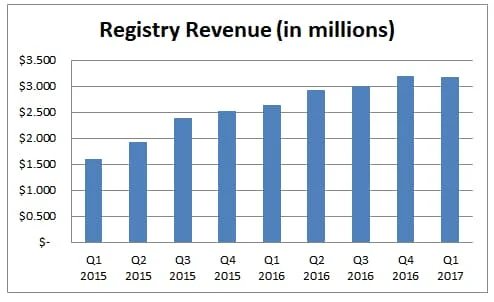
Here’s a look at Rightside’s registry revenue, which includes sales of its 40 top level domains as well as fees collected for managing technical registry services for Donuts’ top level domains:
Revenue grew as the firm launched top level domains, but stalled once the funnel of fresh domains dried up.
The firm continued to forecast $50-$75 million of registry revenue per year within a few years time, and that was going to be a very difficult target to hit.
The firm also faced headwinds with the unpredictable revenue stream it made in the domain name aftermarket, and predicted lower overall revenue in 2017 than 2016 thanks, in part, to the aftermarket.
Wedding Partners
Donuts and Rightside have been partners since the beginning of Donuts’ history. The two firms applied for a pool of roughly 100 domains together through a partnership, and some people even suspected that Donuts was acting as a backdoor in case Rightside (then part of Demand Media) was disqualified from owning fresh top level domains.
Rightside also runs the technical backend registry services for all of Donuts’ domains.
One of Donuts’ founders and its first CEO, Paul Stahura, founded eNom, which was later purchased by Demand Media and became part of Rightside.
It hasn’t always been a peachy relationship, though. There was Donuts’ unsolicited $70 million offer for Rightside’s registry business, which Donuts made public following it was rebuffed by Rightside. Donuts also seemed to use Google’s open source registry as a way to negotiate a good deal when renewing its registry contract.
Hidden Figures
Donuts’ $213 million offer is a lot more than its first $70 million offer, but there are a couple of things at play here.
First, this is for the entire business, not just the registry business. For now, the registry business is the smallest part of Rightside. Registry generated $11.8 million last year. Donuts also gets retail registrar Name.com and Rightside’s portfolio of regarding 300,000 domain names. The registrar generated $29.1 million revenue last year and aftermarket (which includes the portfolio and parking revenue) generated $22.6 million.
To be sure, the registry business has much higher margins than the business as a whole.
Rightside also has a ton of cash following selling eNom. It started to use some of it for buybacks, but the $213 million offer net of cash is probably closer to $150 million or so.
It will be interesting to see what Donuts does with the registrar and aftermarket business. So far it has avoided the conflict of interest of owning a registrar, but vertical integration between registries and registrars hasn’t ended up being as big of a deal as some predicted. Rightside has leveraged Name.com to boost some of its own TLDs, so perhaps Donuts will decide to keep it. If not, there are probably a lot of willing buyers.
The aftermarket business is a different matter. It would be kind of funny for Donuts to hold onto this business and its hundreds of thousands of .com domains in light of its fresh top level domain mission. I don’t have much insight into what’s in the portfolio, but GoDaddy would be a logical buyer for the “clean” part of this portfolio.
Different Strategies
Donuts was by now the big dog in the fresh TLD game with regarding 200 domains. It’s now even bigger.
Donuts and Rightside took different approaches to fresh TLDs and it will be interesting to see if Donuts shifts.
Historically, Donuts has done little to market its domains. It’s an economies-of-scale business. Rightside is different. It has marketed its domains. It had no choice since it had to show topline growth, even at the expense of profits.
Rightside cultivated certain top level domains. For example, it used streaming video influencers to grow .live.
Will Donuts drop all of this activity in favor of harvesting Rightside’s efforts to date?
Honestly, this might make more financial sense than plowing money into marketing. For the sake of the industry, I hope Donuts ramps up its marketing. I just don’t know if the numbers will add up. Donuts doesn’t have the same short-term pressures that Rightside had as a public firm.
Both Donuts and Rightside also took an analytical approach to premium domains, but Rightside took it overboard. Will Donuts pare Rightside’s premium inventory?
From a trademark protection standpoint, expect the two firms’ similar trademark blocking services to be combined (and sell at a higher price).
Efficiencies
Despite recent layoffs, Rightside still has a lot of overhead. A lot of positions are now redundant with Donuts. Depending on the strategy Donuts takes going forward, now would be a great time for domain industry firms looking to bolster their ranks to take a look at some of Rightside’s staff.
Summing it up
Rightside had no choice but to sell. Donuts was the ideal buyer given the existing partnership and Donuts’ role in the fresh top level domain business. Two things to watch are what Donuts does with Rightside’s non-fresh TLD businesses and if it changes its marketing approach.