Best automated domain name appraisal tool is… — And the
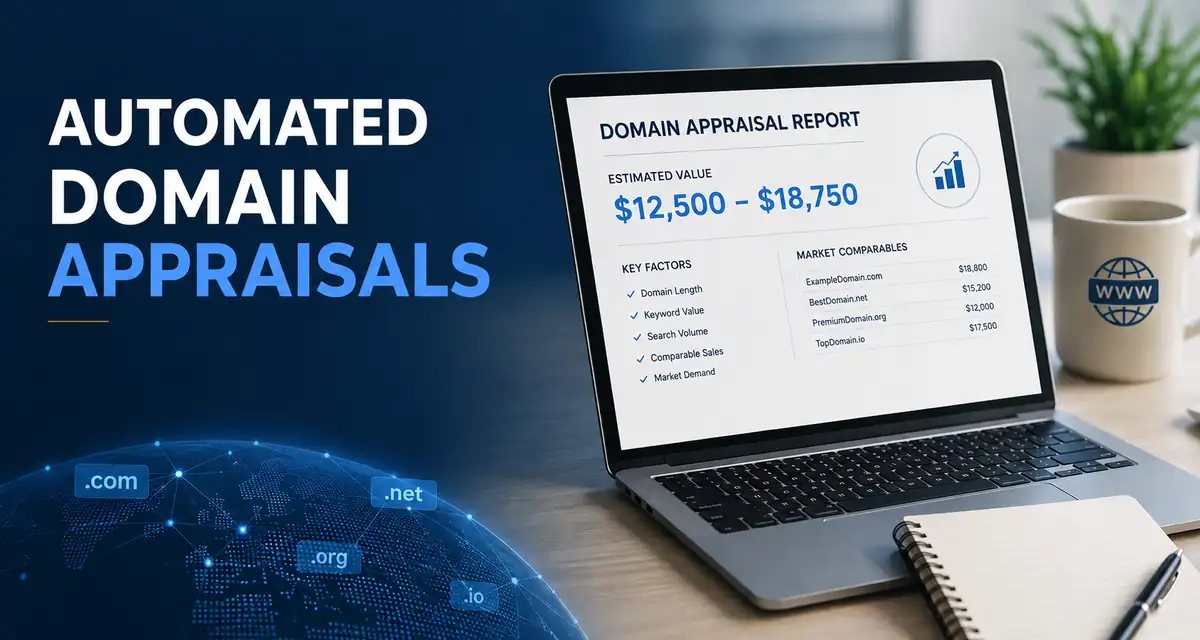
Here’s what we found following evaluating 15 domain appraisal systems.
Over the past couple of weeks, Andrew Allemann and Mike Cyger have reviewed 11 domain name appraisal platforms:
- Estibot
- GoDaddy
- Atom
- Appraise.net
- GoExpired
- Dynadot
- NameWorth
- Saw
- Appraise.software
- Graen
- Humbleworth
We also tried four other appraisal systems that we didn’t do full reviews for:
- InterNetX’s Domain Price Check – It simply doesn’t work. It evaluated Dragonfly.com and WaterFilters.com at less than $1,000.
- Dharmesh Shah’s Agent.ai Domain Value – The HubSpot cofounder knows a lot regarding domains, but his appraisal agent suffers from a major flaw: inconsistency. One moment, it stated expedite.io was worth $50,000. Minutes later, it appraised it at $150,000.
- Oceanfront Domains – This tool made a splash last year thanks to its detailed analysis and, frankly, high valuations that domain investors loved. Still, it hallucinated comps, which made its valuations unreliable. The system has been updated since then, but the values are out of whack. It stated an unregistered domain was worth $150k-$400k.
- DomainXBT – Like Agent.ai, it did not consistently appraise the same domains, and it seemed to hallucinate sales comps.
We discovered that if you want to justify a certain price for a domain, you can probably get one of the appraisal services to hit it: the valuation of your domain depends greatly on where you get it appraised.
Choose GoDaddy, and it will probably be on the low side. Choose Appraise.net, and it will be on the high side.
At Nordic Domain Days the prior week, Andrew spoke with GoDaddy’s Alan Shiflett regarding what makes a good domain appraisal. (GoDaddy is in the process of updating its model.)
Alan asked whether an appraisal system ought to predict the sales price or the value.
It’s a fair question. As we’ve mentioned in our introduction, the difference between a domain selling for $5k or $20k can come down to how the seller priced it.
Depending on how you judge an appraisal system, backtesting it against domain sales isn’t always fair. Certainly, backtesting with just a couple of domains doesn’t provide a full picture.
Here’s our takeaway on what makes a good appraisal system:
- It’s not too specific on prices. Specificity implies accuracy, and no domain appraisal system will be accurate to the nearest dollar, let alone the nearest thousand dollars.
- It doesn’t appraise domains with little market data. This includes most fresh top level domains.
- It shows its work. It needs to show quantitative data regarding what makes the domain good or bad, not just qualitative descriptions. It also needs to show comparable sales when available.
OK, drumroll for the best domain appraisal system…
At this point, we like Atom the best.
While it’s specific, it’s not too specific, like saying a domain is worth $10,248.
It also knows its limits. High-value domains are listed as over $1 million rather than showing an exact amount.
And where Atom really shines is backup data.
It provides sell-through rates for root words, data on the number of TLDs registered, real-world brand usage, comparables, and much more.
Atom also provides a “Domain Score.” A higher score doesn’t necessarily mean a more valuable domain, though.
Darpan Munjal, CEO of Atom, told us:
Appraised Value estimates what a domain may be worth today based on market data, comparable sales, demand, extension, and other valuation signals.
Domain Score reflects the overall quality of the asset from an investor’s perspective, taking into account factors like brandability, memorability, versatility, commercial appeal, and long-term market potential.
As an example, an above-average .ai domain might get an outsized valuation compared to its score since .ai domains are selling for much more than many other extensions.
The concept of a non-monetary score is interesting. In fact, since people can nitpick valuations all day, appraisal systems for domain investors may be better off simply scoring domains rather than providing a dollar value. It would help people sort through lists and evaluation portfolios, without them questioning every valuation.
While we like Atom best overall, that’s not to say other appraisal tools aren’t useful.
Consider GoDaddy. GoDaddy’s appraisals might miss the mark on exact prices. If a tool could give accurate appraisals, that would be ideal, since accurate prices would also give you reliable rankings. But since no appraisal system consistently predicts actual sale prices, the next best thing is relative ranking.
That is where GoDaddy excels: it quickly separates stronger domains from weaker ones, making it useful for sorting sizable lists and spotting opportunities.
(That stated, since many domain buyers look to GoDaddy, it desperately needs to update its system. So it’s good to hear it’s working hard on an update.)
Reviewing appraisal tools was time-consuming and, at times, head-scratching. Our biggest takeaway was not to focus on the dollar figures, but instead on how tools “rank” and evaluate domains. When applied at scale, this can be valuable information for domain investors.