
In a significant stride towards the future of domain name management and monetization, D3Serve has unveiled a pioneering patent application that details an innovative approach to domain parking page creation and optimization using advanced Artificial Intelligence (AI). This development promises to redefine how domain assets are utilized, moving beyond traditional static pages to dynamic, contextually relevant, and highly optimized digital storefronts.
D3Serve, an entity at the forefront of integrating blockchain technology with domain names, has officially filed a comprehensive patent application. This expansive filing encompasses various critical aspects of modern domain parking systems, focusing on intelligent automation to enhance their effectiveness and profitability. The company, recognized as an ICANN-accredited registrar, is already making waves with its Namefi platform, which offers cutting-edge domain tokenization services, bridging the gap between traditional domain infrastructure and the burgeoning Web3 ecosystem.
The Patent’s Vision: AI-Powered Automated Domain Advertising
The patent application, officially titled “System and Method for Automated Domain Advertising Using Artificial Intelligence With Language and Retrieval Augmented Models,” encapsulates D3Serve’s ambitious vision. At its core, the application describes sophisticated methodologies for leveraging AI to automate or significantly assist in several key areas:
- Creation of Domain Parking Pages: Generating high-quality, relevant content and layouts for parking pages from scratch.
- Selection of Keywords: Intelligently identifying and optimizing keywords to maximize search engine visibility and user engagement.
- Design and Layout Optimization: Crafting aesthetically pleasing and functionally effective page designs that resonate with specific target audiences.
This innovative approach aims to transform dormant domain assets into active, value-generating properties, enabling domain owners to unlock their full potential without extensive manual effort. By harnessing the power of AI, D3Serve seeks to deliver unprecedented levels of efficiency, relevance, and personalization to the domain parking landscape.
D3Serve and Namefi: Pioneering Web3 Domain Innovation
Before diving deeper into the technical specifics of the patent, it’s crucial to understand D3Serve’s broader strategic positioning. As an ICANN-accredited registrar, D3Serve operates within the established framework of domain name governance. However, its distinction lies in its pioneering integration of blockchain technology. Through its Namefi platform, D3Serve introduces “domain tokenization,” a process that essentially converts traditional domain names into digital assets on a blockchain. This innovation opens doors to enhanced security, transparency, and new forms of ownership and transfer within the Web3 paradigm.
The synergy between blockchain domains and AI-powered parking is compelling. Blockchain can secure ownership and transactional history, while AI can make those assets more valuable and discoverable. This holistic approach signals a significant evolution from legacy domain management practices, positioning D3Serve as a leader in defining the future of digital identity and asset monetization in an increasingly decentralized internet.
A Deep Dive into the AI System: From Input to Optimized Suggestion
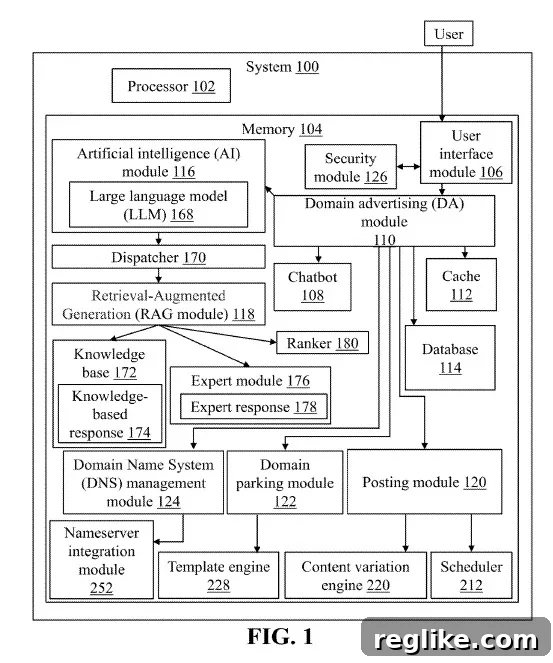
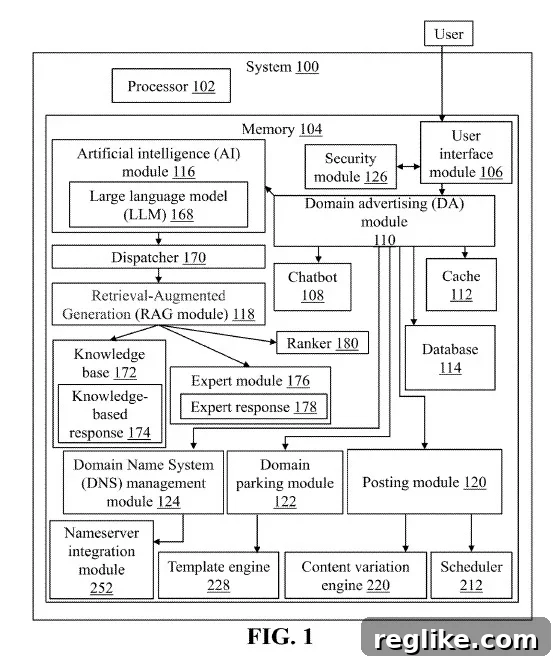
The patent application provides a detailed illustrative example of how this AI system operates to generate contextually relevant domain advertising. This process, diagrammed in the accompanying image, highlights a multi-module architecture designed for seamless and intelligent domain monetization. Let’s break down the intricate steps involved:
In this scenario, a user accesses the system 100 via a user interface module 106 to generate a domain advertising suggestion 130 for a newly acquired domain name 128. Upon entering the domain name 128 into the platform, the DA module 110 receives the input and processes the domain name 128 request. The AI module 116 may receive the domain name 128 to create an initial domain advertising suggestion 130. Alternatively, the RAG module 118 may receive the domain name 128 from the AI module 116 to create a customized domain advertising suggestion 130 by consulting domain-specific insights and external knowledge sources 192 through the knowledge base 172, and receiving expert-level insights such as market trends, linguistic patterns, and domain semantics, retrieved from the expert module 176, as shown in FIGS. 6 and 8. Once the domain advertising suggestion 130 is generated, the cache 112 may store the result and check for previous similar entries to enhance processing efficiency. The ranker 180 of the RAG module 118 may rank each domain advertising suggestion 130 for the top entry, where the system 100 delivers the top domain advertising suggestion 130 to the user via the user interface module 106, readying the domain advertising suggestion 130 for distribution across selected communication channels 132 via the chatbot 108.
Deconstructing the Automated Process:
- User Input and Initial Processing (Modules 106 & 110): The journey begins when a user, perhaps a domain investor, enters a newly acquired domain name (128) into the system (100) via the intuitive user interface module (106). This input is then received and initially processed by the Domain Advertising (DA) module (110), acting as the gateway for the request.
- Core AI Generation (AI Module 116): The AI module (116) takes the domain name and generates an initial domain advertising suggestion (130). This module likely employs advanced Natural Language Processing (NLP) and generative AI capabilities to interpret the domain name’s meaning, identify potential keywords, and draft preliminary content ideas for a parking page.
- Enhanced Customization with Retrieval Augmented Generation (RAG Module 118): This is where D3Serve’s system truly differentiates itself. Instead of relying solely on the AI module’s internal knowledge (which can sometimes be outdated or prone to “hallucinations”), the RAG module (118) comes into play. RAG combines the generative power of AI with robust information retrieval.
- Knowledge Base Integration (172 & 192): The RAG module consults a comprehensive knowledge base (172) that draws from diverse external knowledge sources (192). These sources are crucial for accuracy and relevance, potentially including real-time market data, competitor analysis, industry news, historical domain sales data, and user behavior analytics.
- Expert-Level Insights (Expert Module 176): Further refining the suggestions, the system incorporates expert-level insights from an expert module (176). This module provides specialized data such as current market trends, nuanced linguistic patterns relevant to specific niches, and deep domain semantics (the underlying meaning and connotations of words used in domain names). This layer ensures suggestions are not just grammatically correct but also strategically sound and contextually appropriate.
- Efficiency through Caching (Cache 112): To optimize performance and reduce redundancy, the cache (112) stores generated suggestions. Before processing a new request, it checks for similar previous entries, ensuring efficient resource utilization and faster response times for recurring or closely related domain queries.
- Ranking and Selection (Ranker 180): The RAG module’s ranker (180) evaluates multiple generated domain advertising suggestions. It employs sophisticated algorithms to rank these suggestions based on various criteria, such as predicted performance, relevance scores, and alignment with market trends, ultimately selecting the top-performing entry. This ensures the user receives the most optimized and potentially lucrative option.
- User Delivery and Distribution (User Interface 106, Chatbot 108 & Communication Channels 132): Finally, the top-ranked domain advertising suggestion (130) is delivered back to the user via the user interface module (106). The system also prepares this suggestion for immediate distribution across selected communication channels (132), potentially aided by a chatbot (108). This chatbot could facilitate further refinement, answer user queries, and streamline the deployment process, making the entire experience highly interactive and user-friendly.
Beyond Pay-Per-Click: The Future of Domain Monetization
It’s important to note D3Serve’s current offerings. While the patent describes a broad system for domain advertising, Namefi primarily offers “for-sale” parking rather than the traditional pay-per-click (PPC) model. This distinction is significant. AI-powered optimization for “for-sale” parking can dramatically increase the likelihood of a domain sale by presenting a highly attractive and informative landing page to potential buyers. Instead of just displaying ads, these pages become sophisticated sales tools, expertly crafted by AI to highlight the domain’s value, potential uses, and investment appeal.
This approach transforms domain parking from a passive revenue stream (like PPC, which can yield minimal returns for many domains) into an active sales channel. By providing compelling, contextually relevant content and design, D3Serve’s system could significantly shorten sales cycles and increase the perceived value of domains, benefiting domain investors by accelerating their return on investment. While the patent lays the groundwork for various advertising models, its immediate application in enhancing “for-sale” parking demonstrates a pragmatic and highly valuable use case.
Implications for Domainers and the Industry
The implications of D3Serve’s AI patent extend far beyond just efficient page creation:
- For Domain Investors: This technology promises to democratize sophisticated domain monetization. Small to large portfolio owners can leverage AI to generate high-quality parking pages without needing extensive marketing expertise or design skills, leading to increased efficiency, higher conversion rates for sales, and potentially better overall returns on their domain investments.
- For Registrars and Service Providers: The patent signals a new era for value-added services. Registrars could integrate similar AI tools to offer premium monetization solutions to their clients, distinguishing themselves in a competitive market.
- For the Digital Advertising Ecosystem: By creating more relevant and engaging parking pages, the overall quality of online advertising improves. This leads to a better user experience, as visitors land on pages that genuinely align with their search intent, reducing bounce rates and enhancing brand perception for domain sellers.
- Addressing Scalability Challenges: Manually optimizing hundreds or thousands of parked domains is impractical. AI offers a scalable solution, allowing domainers to manage vast portfolios with intelligent automation, continuously fine-tuning content and keywords for optimal performance across all their assets.
Timeline and Forward Outlook
D3Serve initially filed a provisional application on May 12, 2024, demonstrating their proactive approach to securing intellectual property in this rapidly evolving field. The U.S. Patent and Trademark Office formally published the application today, making the details publicly accessible and signaling a critical step towards formal patent grant. A granted patent would solidify D3Serve’s position as an innovator in AI-driven domain management and monetization, providing them with a significant competitive advantage.
As AI technologies continue to advance, D3Serve’s patented system has the potential for continuous improvement and expansion. Future iterations might integrate real-time market sentiment analysis, predictive analytics for domain valuation, or even more dynamic, personalized advertising experiences. The convergence of AI, blockchain, and domain name infrastructure, as championed by D3Serve, is poised to reshape how we perceive, manage, and extract value from digital real estate.
Conclusion
D3Serve’s patent application represents a landmark moment in the journey towards fully automated and intelligent domain management. By describing a sophisticated system that leverages Artificial Intelligence, particularly Retrieval Augmented Generation (RAG), to create, optimize, and distribute highly relevant domain advertising suggestions, the company is setting a new standard for domain parking. This innovation not only streamlines the monetization process but also enhances the overall quality and relevance of parked domain pages, benefiting domain owners, potential buyers, and the broader digital ecosystem. As D3Serve continues to push the boundaries with its Namefi platform and AI-driven solutions, the future of domain names looks remarkably intelligent and incredibly efficient.