
Protecting Your Brand in the Digital Wild West: An Interview with CitizenHawk CEO Graham MacRobie
In the dynamic landscape of the internet, where digital identities are paramount, safeguarding a brand’s presence against malicious actors has become a critical challenge. Domain Name Wire recently sat down with Graham MacRobie, the visionary CEO of CitizenHawk, to discuss his innovative approach to combatting typosquatting – a pervasive threat that can undermine brand reputation, divert traffic, and erode revenue. MacRobie’s journey into brand protection began not with a grand vision, but with a personal experience that underscored the vulnerabilities of digital identity in its nascent stages.
MacRobie recalls a defining moment from the late 1990s, a period marked by “internet fever” and the burgeoning dot-com era. As the founder of his own startup, he received an unsettling email from a company asserting rights to the domain name his venture was actively using. The situation escalated when, shortly after, the same entity informed him they had gone ahead and registered a similar domain, differentiated only by a hyphen. While the incident ultimately led to no direct conflict, it left an indelible mark on MacRobie. “How could they use our trademark?” he questioned, a query that would later fuel the development of a pioneering solution.
Fast forward to 2007, and the domain name industry was experiencing unprecedented growth and strategic importance. Companies were aggressively acquiring “type-in” domains, leveraging them for lucrative pay-per-click (PPC) campaigns and affiliate marketing programs. This surge in domain value inadvertently created fertile ground for “typosquatters” – individuals or entities who register domain names that are common misspellings or slight variations of established brands. Their objective: to capitalize on user errors, redirect traffic intended for legitimate brands, and monetize it through advertising or even malicious activities. It was amidst this escalating challenge that MacRobie’s new startup, CitizenHawk, emerged, with a clear mission: to empower companies to reclaim control over their digital assets and effectively combat the pervasive threat of typosquatting on their brands.
CitizenHawk’s flagship solution, the innovative TypoSquasher tool, represents a significant leap forward in digital brand protection. This sophisticated platform employs advanced crawling technology to meticulously scour the vast expanse of the internet, specifically targeting common misspellings and subtle variations of a company’s registered brand name. Upon identifying a potentially infringing domain name, TypoSquasher springs into action, meticulously capturing a comprehensive suite of evidence. This includes real-time screenshots of the infringing website, detailed WHOIS information revealing the domain owner and registration details, and crucial insights into how the domain is being monetized – whether through domain parking services, affiliate links, or direct advertising. This wealth of information is vital for building an undeniable case against infringers.
Beyond mere identification and evidence collection, TypoSquasher distinguishes itself by automating key aspects of the legal enforcement process. This automation significantly streamlines what has traditionally been a time-consuming and costly endeavor for trademark holders. The system can automatically generate and dispatch cease & desist letters to alleged infringers, initiating the first formal step in dispute resolution. Furthermore, it proactively contacts the various entities that facilitate the monetization of these infringing domains, such as domain parking companies or affiliate program providers. By cutting off the financial lifeblood of typosquatting operations, CitizenHawk aims to disincentivize such illicit activities. The effectiveness of this approach is evident in its growing client roster, which includes prominent brands like 1-800-PetMeds (NASDAQ: PETS) and Overstock (NASDAQ: OSTK), all benefiting from a robust, automated defense against online brand dilution.
During a recent demonstration, MacRobie provided a comprehensive test drive of CitizenHawk’s TypoSquasher, leaving a strong impression of its capabilities. He presented compelling examples of typo domains that had targeted Disney (NYSE: DIS), all of which had since been successfully resolved thanks to CitizenHawk’s intervention. The hosted system interface is intuitively designed, providing users with immediate access to a dashboard displaying numerous identified typo domains. For each infringing domain, TypoSquasher provides a wealth of actionable data: detailed WHOIS information for the domain owner, a current screenshot of the website, its associated IP address, and a suite of integrated workflow tools designed to streamline the enforcement process. This consolidated view empowers brand owners with all the necessary information to make informed decisions and take swift action.
MacRobie further illustrated the practical utility of TypoSquasher for trademark holders with several insightful examples. He showcased two distinct typo domains targeting Disney.com: one with publicly accessible WHOIS information and another leveraging private WHOIS services to conceal the registrant’s identity. In traditional enforcement scenarios, a trademark holder would typically be compelled to file a separate UDRP (Uniform Domain-Name Dispute-Resolution Policy) complaint for each individual domain, a process that can be both expensive and resource-intensive. However, TypoSquasher’s intelligent analysis capabilities shine brightly here. By cross-referencing IP addresses and identifying shared affiliate IDs across both domains, the system can accurately determine that both infringing domains are, in fact, owned and operated by the same individual or entity. This crucial insight allows the trademark holder to consolidate their efforts, enabling them to file a single, unified UDRP complaint covering multiple domains, thereby dramatically reducing legal costs and accelerating resolution. Moreover, this deep correlation capability also facilitates direct communication with the affiliate programs (e.g., LinkShare) that are inadvertently helping to monetize these infringing domains, allowing the trademark holder to effectively halt the flow of funds to the typosquatter, hitting them where it hurts most.
While TypoSquasher offers significant benefits to legitimate brand owners, concerns inevitably arise regarding the potential for “false positives”—instances where the system might mistakenly flag a legitimate domain as an infringement. MacRobie was quick to address these apprehensions, emphasizing CitizenHawk’s rigorous methodology. “Our stance is that we have a very specific set of criteria as to what constitutes a domain that ought to be looked at further,” MacRobie explained, underscoring the platform’s commitment to accuracy and fairness. He elaborated on some of these stringent criteria: the name in question must be a registered trademark in the U.S., ensuring legal standing; the trademark must be five characters or longer, reducing ambiguity with short, common terms; the typo itself must be a single character away from the trademark, or the trademark name must be clearly embedded within a longer domain string, preventing overreach; and critically, the website in question must be engaged in activities directly related to, or attempting to leverage the goodwill of, the trademark holder. This multi-faceted filtering process is meticulously designed to minimize errors and focus enforcement efforts on truly infringing domains, thereby protecting innocent domain registrants from undue harassment. Furthermore, MacRobie stressed the company’s commitment to efficiency: “It’s in our best interests for this process to be as automated and simple as possible. If we get into a gray area where domains in question are debatable, it’s not in our interests to pursue.” This pragmatic approach ensures that CitizenHawk’s resources are dedicated to clear-cut cases of infringement, maintaining the integrity and reputation of its service.
To provide a tangible illustration of TypoSquasher’s efficacy, MacRobie cited a relevant example: the tool successfully identified a typo of DomainNameWire.com, specifically DomainNameWireD.com. This infringing domain was operating as an automated domain name news site, brazenly utilizing “DomainNameWire” within its title and header to mislead visitors. The registrant, attempting to evade identification, was hiding behind GoDaddy’s WHOIS privacy service. This case perfectly demonstrates TypoSquasher’s ability to not only detect subtle typos but also to gather critical information like the site’s content and even pierce through privacy services where legitimate grounds for dispute exist, providing a clear path for remediation.
CitizenHawk’s robust operations are underpinned by significant backing from Maveron, a venture capital firm known for its strategic investments in innovative companies. Maveron is also a notable backer of iREIT, a major domain name holding company. This connection brings to light a complex issue within the domain industry. iREIT was recently sued by Verizon (NYSE: VZ) for alleged typosquatting, a situation that underscores the often-murky waters of trademark enforcement in the digital realm. MacRobie offered his perspective on the Verizon lawsuit, suggesting that iREIT is not a major typosquatter and describing the lawsuit as unfortunate. “My opinion is iREIT is not one of the bad guys,” he affirmed, noting that the percentage of problematic domains TypoSquasher finds belonging to iREIT is exceptionally low. This nuance highlights a broader truth: even reputable domain portfolio holders can inadvertently acquire domains that become problematic. MacRobie astutely points out that companies such as iREIT are, in fact, potential customers for TypoSquasher. The tool can serve as a powerful defensive mechanism, helping large domain portfolio holders proactively identify and remediate typos within their vast holdings *before* a major brand takes legal action against them. With an astounding 1.8 million registered and pending trademarks in the U.S. alone, the sheer volume makes it incredibly difficult for even the most diligent portfolio managers to manually scan for all potential infringements. TypoSquasher offers an invaluable automated solution to mitigate this significant risk, fostering compliance and preventing costly disputes.
The potential value of TypoSquasher becomes even more apparent when considering past industry events. If only a solution like TypoSquasher had been available when Marchex (NASDAQ: MCHX) acquired the Ultimate Search domain portfolio, it could have potentially averted substantial financial repercussions. Marchex faced an estimated $24 million in liabilities stemming from trademark-infringing domains included within that massive acquisition. This incident serves as a stark reminder of the hidden risks embedded within large-scale domain portfolio transactions and the critical need for comprehensive due diligence tools like CitizenHawk’s offering. Proactive identification of problematic domains can save companies millions in legal fees, settlement costs, and reputational damage, transforming what was once a reactive, costly problem into a manageable, preventable one.
CitizenHawk’s solution arrives at a crucial time, addressing a major problem that has garnered increasing attention and press coverage due to its significant impact on businesses and consumers alike. The company distinguishes itself not only by the technological prowess of TypoSquasher but also by its level-headed and pragmatic approach to resolving complex domain disputes. MacRobie highlights that some legal professionals advocate for aggressive, expensive litigation, pushing companies to file lawsuits that can easily reach $100,000 for each infringing domain. Such an approach, while potentially effective, is often disproportionate to the damage caused by many typosquatting incidents and places an undue financial burden on trademark holders. TypoSquasher offers a refreshingly different, far more economical, and scalable method to address the problem. By automating evidence gathering, streamlining legal outreach, and focusing on disincentivizing infringers through targeted actions, CitizenHawk provides a cost-effective alternative that achieves resolution without immediately resorting to exorbitant legal fees. This balanced strategy not only protects brand integrity but also champions efficiency and accessibility in digital intellectual property enforcement.
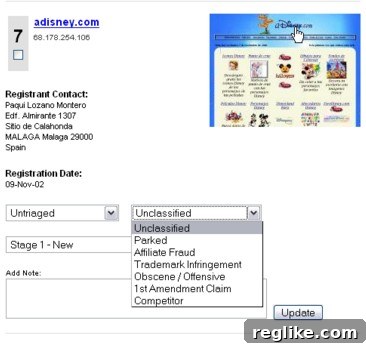
Above: TypoSquasher efficiently identifies a typo domain related to Disney, showcasing its capability in comprehensive brand protection.