
The Paramount Importance of Reputation in Domain Name Escrow Services
In the vibrant and often complex world of domain name transactions, trust is not just a preference; it’s an absolute necessity. Whether you’re a seasoned investor acquiring a premium domain or a startup founder purchasing your first digital address, the inherent risks associated with online exchanges demand a robust safeguard. This is precisely where domain name escrow services come into play, acting as a neutral third party to ensure both buyer and seller fulfill their obligations securely. But when it comes to selecting such a critical service, what truly drives the decision-making process for users?
A recent comprehensive survey conducted by Domain Name Wire shed light on this very question, probing respondents about their primary criteria for choosing a domain name escrow provider. The survey offered a spectrum of options, ranging from competitive pricing and licensing specifics to the quality of customer service. The overwhelming consensus, however, pointed to one dominant factor, relegating all others to mere footnotes in comparison.
Unveiling the Survey’s Key Finding: Reputation Reigns Supreme
The results of the Domain Name Wire survey were unequivocal and strikingly clear: the overwhelming majority of users prioritize the reputation of an escrow service above all else. A staggering 61% of respondents identified reputation as the single most important factor influencing their choice. This isn’t just a slight preference; it’s a profound testament to the critical role that a proven track record and public perception play in high-stakes online transactions.
To put this into perspective, the next most significant factor garnered a mere 6% of the total vote. This stark disparity underscores how deeply entrenched the concept of trust is in the minds of those engaging in domain name transfers. The survey findings echo previous industry insights, with reputation also topping the charts in last year’s poll, signifying a consistent and unwavering trend in user priorities.
The visual representation below further illustrates this commanding lead, leaving no doubt about the hierarchy of considerations:
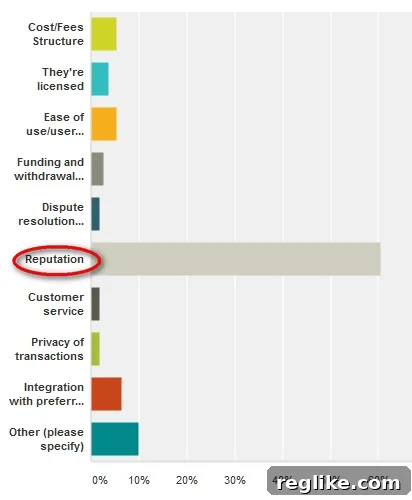
This graph vividly demonstrates that while other elements like cost-effectiveness or the breadth of services might be considered, they are fundamentally secondary to the assurance that comes with a highly reputable provider.
Why Reputation is More Than Just a Word: A Deeper Dive
While the term “reputation” itself might seem broad, in the context of domain name escrow, it encapsulates a rich tapestry of attributes that collectively build unwavering confidence. It’s not simply about having a recognizable name; it’s about a consistent and demonstrable commitment to security, fairness, and reliability.
Trust and Security as Cornerstones
At its core, a strong reputation in the escrow industry is built on an impeccable track record of secure, fraud-free transactions. Users entrust escrow services with both significant financial assets and valuable digital properties. A reputable service instills confidence that funds will be held safely, domain names will be transferred accurately, and neither party will be exposed to scams or financial loss. This security is paramount for mitigating the inherent risks of dealing with unknown parties online.
Impeccable Customer Service
Exceptional customer service is inextricably linked to reputation. When transactions involve substantial value, issues can occasionally arise, or clarifications may be needed. A reputable escrow provider offers responsive, knowledgeable, and empathetic support to address concerns promptly. The ability to resolve disputes fairly, communicate transparently, and guide users through the process smoothly contributes significantly to a service’s standing. Users value the peace of mind that comes from knowing they have reliable assistance if needed.
Transparency and Reliability
Reputable escrow services operate with the utmost transparency. Their terms and conditions are clear, fees are explicit, and the transaction process is well-defined. There are no hidden clauses or unexpected delays. Reliability means consistently delivering on promises—transferring domains on time, releasing funds as agreed, and maintaining a high level of operational efficiency. This consistent performance solidifies their status as a trustworthy partner in critical transactions.
Privacy and Data Protection
In an age where data breaches are a constant concern, a service’s commitment to privacy and data protection is a non-negotiable aspect of its reputation. Escrow services handle sensitive personal and financial information. A reputable provider employs robust security measures, adheres to strict privacy policies, and demonstrates a steadfast dedication to safeguarding client data from unauthorized access or misuse. This builds confidence in their ability to protect sensitive information throughout the transaction lifecycle.
Regulatory Compliance and Licensing
A reputable escrow service is properly licensed and operates in strict adherence to all relevant financial and legal regulations. This compliance offers an additional layer of protection for users, ensuring that the service is subject to oversight and operates within established legal frameworks. Verification of licensing and adherence to industry best practices are crucial indicators of a trustworthy and reputable provider.
The Mechanics of Domain Name Escrow: A Foundation of Trust
To fully appreciate the significance of reputation, it’s essential to understand the fundamental role of domain name escrow. At its heart, an escrow service acts as an independent intermediary between a buyer and a seller, especially when those parties are geographically dispersed or lack prior trust. It mitigates the risk of fraud, a prevalent concern in online transactions involving valuable assets like domain names.
The process typically unfolds in several clear steps:
- Agreement: Buyer and seller agree on terms, including the domain name, sale price, and transfer details.
- Payment to Escrow: The buyer sends the agreed-upon funds to the escrow service. The funds are held securely by the trusted third party.
- Domain Transfer Initiation: Upon verification of payment, the seller initiates the domain name transfer to the buyer. This usually involves changing the registrant information and updating DNS records.
- Buyer Verification: The buyer verifies that they have full control and ownership of the domain name.
- Funds Release: Once the buyer confirms receipt and control of the domain, the escrow service releases the funds to the seller.
Without such a service, both parties face significant risks. Buyers risk losing their money if the seller fails to transfer the domain, or transfers it incorrectly. Sellers risk transferring their valuable asset without receiving payment. Escrow services eliminate these vulnerabilities, providing a secure and verifiable mechanism for these high-value exchanges.
Beyond Reputation: Other Factors and Their Subtleties
While reputation overwhelmingly dominates decision-making, it’s important to acknowledge that other factors, though less impactful according to the survey, still play a role for a subset of users or in specific scenarios. These elements often complement a strong reputation rather than supersede it.
Pricing and Fees
Naturally, the cost of an escrow service is a consideration. While most users are willing to pay a fair price for security and peace of mind, exorbitant fees can deter some. Competitive pricing, often presented as a percentage of the transaction or a fixed fee, can be a differentiator among equally reputable services, especially for smaller domain transactions where margins are tighter. However, users are typically wary of services that offer unusually low prices, as this can sometimes signal compromised security or service quality, thereby undermining trust.
User Experience and Platform Interface
The ease with which a transaction can be initiated, tracked, and completed significantly impacts the user experience. An intuitive, well-designed platform with clear instructions and a streamlined process can be a subtle but influential factor. A clunky or confusing interface, even for a reputable service, can introduce friction and frustration, potentially leading users to seek alternatives. This includes responsive design for mobile access and straightforward navigation.
Speed and Efficiency of Transactions
In the fast-paced digital economy, time is often of the essence. The speed at which an escrow service can process payments, verify transfers, and release funds can be crucial, particularly for time-sensitive domain acquisitions or sales. Services that offer expedited verification processes or have established relationships with registrars for faster transfers may appeal to users who prioritize efficiency. However, speed should never compromise the thoroughness and security of the escrow process.
Global Reach and Currency Support
For international domain transactions, the ability of an escrow service to handle multiple currencies and comply with varying international regulations becomes vital. A service with a robust global infrastructure, offering support for different payment methods and currencies, simplifies cross-border dealings and broadens its appeal to a global clientele.
Legal Expertise and Dispute Resolution
While ideally, all transactions proceed smoothly, complex situations or disputes can arise. An escrow service that demonstrates strong legal expertise and offers clear, fair dispute resolution mechanisms adds significant value. Their ability to navigate legal complexities and mediate disagreements effectively reinforces their reputation for reliability and professionalism.
Evolving Trends in Domain Escrow Usage
The Domain Name Wire survey also provided intriguing insights into the current adoption rates and future intentions of users. It revealed that 63% of respondents had utilized an escrow service in 2014, indicating a widespread awareness and acceptance of the service’s value in securing domain transactions. This high adoption rate underscores the perceived necessity of a third-party intermediary for safeguarding investments in the domain market.
Even more telling is the statistic that 26% of respondents were considering trying a different escrow service this year. This “churn” rate suggests several dynamics at play:
- Continuous Search for Excellence: Users are not simply settling for the status quo. They are actively seeking providers who can offer better service, enhanced features, or, most critically, an even stronger reputation. This indicates a discerning user base that values ongoing improvement.
- Dissatisfaction with Current Providers: While a significant portion are using escrow, a quarter of them are contemplating a switch, which might stem from past negative experiences, a perception of inadequate customer service, or a feeling that their current provider isn’t meeting evolving expectations regarding security or efficiency.
- Market Maturation: As the domain market matures, so does the sophistication of its participants. Users are becoming more educated about the nuances of escrow services and are more likely to seek out specialists or those with impeccable industry standing.
These trends highlight a dynamic marketplace where reputation is not a static achievement but an ongoing commitment that must be continuously earned and maintained. Providers who fail to innovate, uphold service standards, or protect their clients’ interests risk losing business to competitors who prioritize these factors.
Choosing the Right Escrow Service: A Practical Guide
Given the survey’s findings, selecting a domain name escrow service should begin and end with a thorough evaluation of its reputation. Here’s a practical approach to making an informed decision:
- Research Industry Standing: Look for services with a long history of successful transactions, positive industry reviews, and endorsements from reputable domain name forums or market players.
- Check for Licensing and Regulation: Verify that the service is properly licensed and adheres to financial regulations in its operating jurisdiction. This adds a crucial layer of credibility.
- Review Testimonials and Case Studies: Real-world experiences from other users can provide invaluable insight into a service’s reliability and customer support.
- Evaluate Customer Support: Before committing, test their responsiveness and knowledge. A quick, clear answer to a preliminary question is a good indicator of their service quality during a live transaction.
- Understand Their Process: Ensure their transaction process is transparent, clearly defined, and easy to follow. Any ambiguity should be a red flag.
- Assess Security Measures: While not always visible, look for indicators of robust security protocols for handling funds and data.
By diligently applying these criteria, buyers and sellers can significantly reduce their exposure to risk and ensure a smooth, secure domain transfer.
Conclusion: Investing in Trust for Secure Domain Transactions
The message from the Domain Name Wire survey is loud and clear: in the realm of domain name escrow, reputation is king. It’s the ultimate differentiator, the primary driver of choice, and the foundation upon which secure online transactions are built. While pricing, features, and efficiency all have their place, they pale in comparison to the peace of mind that comes from entrusting your valuable assets to a service with an unblemished record of integrity and reliability.
For individuals and businesses navigating the complexities of buying and selling domain names, prioritizing a highly reputable escrow service is not merely a preference; it’s a strategic imperative. It’s an investment in security, transparency, and the fundamental trust required to operate successfully in the digital marketplace. As the domain industry continues to evolve, the demand for trusted intermediaries will only grow, further cementing the irreplaceable value of a strong reputation.