
Optimize Your Sedo Portfolio: The Ultimate Guide to Refreshing Your Domain Listings for Maximum Inquiries
In the dynamic world of domain investing, maintaining a fresh and relevant portfolio is paramount to attracting prospective buyers and securing successful sales. While many investors focus solely on acquisition, strategic portfolio management, particularly on platforms like Sedo, can significantly enhance your visibility and generate new inquiries. This comprehensive guide delves into an often-overlooked yet highly effective strategy: the periodic refresh of your entire Sedo domain portfolio.
As an experienced domain seller, I’ve found that a full portfolio refresh once or twice a year can yield remarkable results. By “refresh,” I mean a systematic process of deleting all current listings and subsequently re-uploading every domain. This seemingly drastic approach offers several distinct advantages, which we will explore in detail, alongside best practices and crucial tips to avoid common pitfalls.
Why a Sedo Portfolio Refresh is a Game-Changer
The decision to completely overhaul your Sedo listings might seem counterintuitive at first, but the benefits far outweigh the initial effort. This strategy primarily addresses two critical areas:
- Eliminating Stale Listings and Ensuring Accuracy: The domain market moves quickly. Domains are sold, expire, or are moved to other platforms. Unfortunately, these changes don’t always automatically reflect across all your selling venues. When a domain is sold on an alternative marketplace or expires without being re-registered, its lingering presence on Sedo creates a “stale listing.” These inactive listings are detrimental in multiple ways. They can lead to wasted time for you and potential buyers, as inquiries come in for unavailable domains. More critically, a portfolio laden with stale listings can inadvertently signal a lack of active management or even disinterest, potentially deterring serious buyers who value a well-maintained and current inventory. While Sedo is quite adept at identifying and flagging expired domains, a manual refresh ensures absolute accuracy, giving you complete control over your displayed inventory.
- Attracting Fresh Attention and New Inquiries: The internet thrives on novelty, and domain marketplaces are no exception. New listings inherently draw more attention. Websites like ExpiredDomains.net are frequently scanned by astute investors and buyers looking for freshly available or newly listed domains. When you re-upload your entire portfolio, these domains are treated as “new” entries by Sedo’s system and, consequently, by various domain tracking tools and aggregators. This burst of renewed visibility can significantly boost your domains’ exposure, putting them in front of a fresh wave of potential buyers who might have overlooked them during previous listing cycles. It creates a powerful psychological effect: a refreshed portfolio signals an active and engaged seller, making your listings appear more current and desirable. Think of it as giving your entire inventory a new lease on life, placing it prominently in front of a renewed audience.
The Deletion Process: A Clean Slate
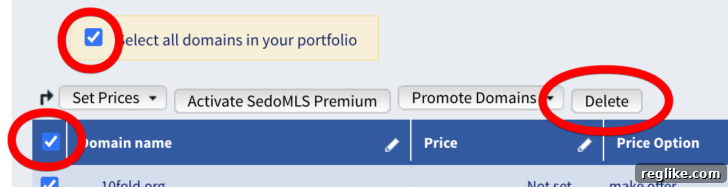
Initiating a full portfolio refresh begins with a clean sweep. Deleting all your domains from your Sedo account is a straightforward process designed for efficiency. Here’s how to do it:
Access your Sedo account manager, navigate to your domain portfolio, and locate the checkbox positioned next to “Domain name.” Clicking this box typically selects all domains displayed on the current page. To select your entire portfolio, irrespective of page limits, look for an option that allows you to “Select all domains in your portfolio.” Once all your domains are highlighted, simply click the “Delete” button. Sedo will usually prompt you with a confirmation message to prevent accidental deletions, so be sure to confirm your action. Prior to deletion, it’s always a good practice to download a copy of your current domain list as a backup, just in case you need to reference it or if there’s an unforeseen issue during the re-upload phase.
The Re-upload Process: Leveraging the Bulk Uploader
Once your portfolio is clear, the next step is to re-upload your domains, which is equally simple thanks to Sedo’s robust bulk uploader tool. This feature allows you to manage a large number of domains simultaneously, making the refresh process highly efficient.
Mastering the Sedo Bulk Uploader Tool
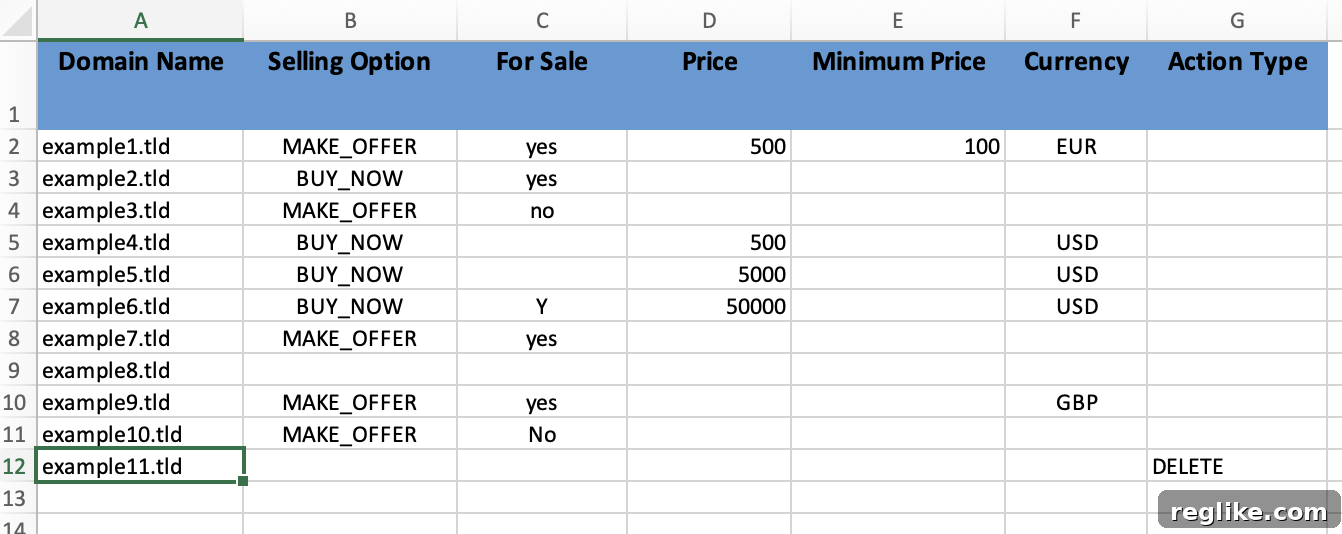
The bulk uploader tool is essentially a spreadsheet interface where you input your domain data. The most user-friendly approach is to download the sample spreadsheet provided by Sedo. This template comes pre-formatted with all the necessary columns, simplifying the data entry process. It typically looks something like this:
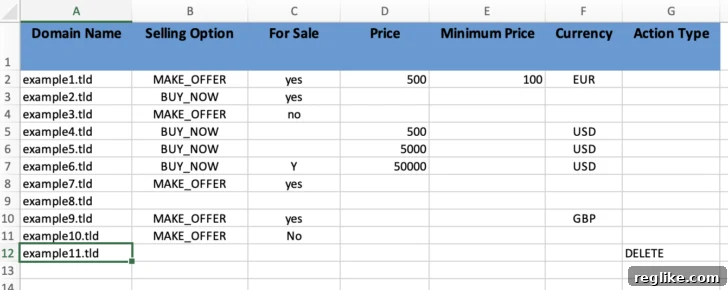
The only truly mandatory column you need to fill is the “Domain Name.” However, this leads us to critical best practices that, if overlooked, can significantly hinder your selling experience.
Crucial Best Practices for Uploading: Avoiding Common Mistakes
While the bulk uploader makes adding domains easy, it’s vital to fill out more than just the domain name column to optimize your listings and manage buyer expectations effectively. Neglecting these details, as I’ve occasionally done, can result in a flurry of undesirable inquiries:
1. Always Set a Minimum Offer Price
If you leave the pricing columns blank, your domains will default to “Make Offer” with no minimum offer price, usually in Euros. This seemingly innocuous default is a magnet for lowball offers, which can be frustrating and time-consuming to filter. Setting a minimum offer price acts as an immediate filter, signaling the perceived value of your domain and discouraging unserious buyers. For instance, I generally set an across-the-board minimum of $1,000 to weed out most low-value inquiries. Depending on your portfolio’s quality and your selling strategy, you might choose to set this minimum higher, or even tier your minimums based on the individual value of your domains. For your premium assets, a significantly higher minimum is often warranted to reflect their true market worth and attract serious investors. This simple step saves you countless hours in negotiations and ensures you’re engaging with genuinely interested parties.
2. Specify Your Preferred Currency (e.g., USD)
Another common oversight is forgetting to explicitly set the currency. Sedo’s default currency varies based on region and settings, but often defaults to Euros if not specified. This can lead to confusion and discrepancies when buyers make offers based on different currency expectations. If your target market primarily operates in USD, or if you prefer to receive payments in USD, it is imperative to set the currency column accordingly. This clarity ensures that both you and the buyer are on the same page regarding pricing, streamlining the negotiation process.
3. Consider Your Listing Type
Beyond “Make Offer,” Sedo offers options like “Buy Now” and “Auction.” While the bulk uploader might default to “Make Offer,” strategically using “Buy Now” prices for domains where you have a firm selling price can expedite sales. For premium domains or those with high demand, a “Buy Now” option with a clearly stated price often converts faster than protracted negotiations. Carefully consider which listing type aligns best with each domain’s potential and your overall selling goals.
Rectifying Upload Mistakes: Solutions for Incorrect Listings
Even with the best intentions, oversights can happen. If you’ve uploaded your domains and realize you forgot to set minimum prices or specified the wrong currency, don’t despair. There are a couple of ways to correct these errors, each with its own advantages and limitations:
Solution 1: Batch Changes via the Dashboard (Limited Efficacy)
Sedo’s dashboard allows you to modify listings in batches. You can navigate to your domains, select a group, and apply changes. However, this method has a significant drawback: you can typically only view and apply changes to approximately 200 domains at a time. Sedo does not offer a feature to batch-apply changes, such as minimum prices, to your entire portfolio simultaneously across all pages. For large portfolios, this means tediously going through page after page, selecting 200 domains, applying changes, and repeating the process. While feasible for a very small number of domains or minor, isolated adjustments, this method quickly becomes impractical and time-consuming for a substantial portfolio.
Solution 2: The “Sync” Option with Re-upload (Recommended)
The most efficient and recommended method for correcting widespread errors like missing minimum prices or incorrect currencies is to leverage the “Sync” option during a re-upload. This involves preparing a new spreadsheet with all the correct data (including domain names, minimum prices, and currency). When you upload this revised spreadsheet, Sedo provides an option to “Sync” your data. This function intelligently matches the domain names in your spreadsheet with your existing listings and updates the corresponding information (like price, currency, and listing type) without creating duplicate listings. This method is incredibly powerful for maintaining data integrity and consistency across your entire portfolio with minimal effort. Simply ensure your domain names in the new spreadsheet exactly match those already listed to ensure proper synchronization. This is by far the superior choice for correcting bulk errors.
Who Benefits Most from This Strategy?
The “delete and replace” portfolio refresh method isn’t universally suitable for every domain investor:
- Ideal for Occasional Sellers and Small to Medium Portfolios: If you are an occasional seller, manage a relatively modest portfolio, or view domain sales as a secondary income stream, this refresh strategy is highly recommended. The benefits of eliminating stale listings and attracting new attention far outweigh the minimal effort involved. It ensures your portfolio remains accurate, up-to-date, and consistently generates fresh inquiries without requiring continuous, day-to-day management. It’s an efficient way to inject new life into your listings periodically.
- Less Suitable for Frequent Sellers and Large Portfolios: For high-volume sellers, those with hundreds or thousands of domains, or investors who are constantly buying and selling, the delete-and-replace method might be too disruptive. For these sellers, maintaining an accurate portfolio throughout the year through continuous updates is generally more practical. Such investors often utilize API integrations, dedicated portfolio management software, or employ staff to ensure real-time updates of sales, price changes, and new acquisitions across multiple platforms. The temporary removal of a large portfolio, even for a short period, could result in missed opportunities or a significant dip in ongoing inquiries, making the manual refresh less viable for their business model.
Maximizing Your Sedo Portfolio Performance: Beyond the Refresh
While refreshing your portfolio is a powerful tactic, remember that it’s part of a broader strategy for domain success. Consider these additional tips:
- Dynamic Pricing Strategy: The domain market is always evolving. Regularly review your prices to align with current market trends, demand, and comparable sales. Don’t be afraid to adjust prices upwards for in-demand domains or downwards for those that have lingered too long.
- Compelling Descriptions: A well-crafted domain description can significantly influence a buyer’s decision. Highlight the domain’s unique selling points, potential use cases, and target audience. Use relevant keywords to improve searchability within Sedo.
- Leverage Sedo’s Features: Explore Sedo’s various listing options like “Buy Now” for immediate sales, “Make Offer” for negotiation flexibility, and their auction features for high-value domains or quick liquidations. Each option caters to different buyer behaviors and selling goals.
- Active Communication: Respond promptly and professionally to inquiries. Be prepared to negotiate, but also know your walk-away price. Good communication builds trust and can facilitate smoother transactions.
- Market Research: Stay informed about industry trends, emerging niches, and what types of domains are currently in demand. This knowledge will help you price your existing portfolio more accurately and make smarter acquisition decisions in the future.
Conclusion
In conclusion, a periodic, strategic refresh of your Sedo domain portfolio by deleting and re-uploading all listings is a highly effective, yet often underutilized, strategy for domain investors. It’s a proactive measure that ensures your inventory remains current, eliminates stale listings, and, most importantly, provides a significant boost in visibility and new inquiries. By consistently applying best practices during the re-upload process—especially regarding minimum offer prices and currency settings—you can streamline your selling experience and filter out low-value interactions. For occasional sellers and those with small to medium portfolios, this method represents an excellent investment of time, yielding substantial returns in the form of increased interest and ultimately, more successful domain sales. Embrace this refreshing approach to keep your portfolio vibrant, accurate, and consistently appealing to the global domain market.