
.Live Domain Extension: A Deep Dive into Growth, Usage, and Market Trends
The .live domain extension has emerged as a significant player in the domain name landscape, particularly as live online content continues its explosive growth. This analysis delves into the performance of .live, examining its registration trends, usage patterns, and aftermarket activity to provide a comprehensive understanding of its current state and future potential.
.Live’s Impressive Growth Trajectory
Donuts, the registry operator for .live, recently highlighted the substantial growth of this top-level domain (TLD). As Donuts’ largest new TLD based on domains under management (DUMs), .live has witnessed a remarkable increase of approximately 30% in registrations since the beginning of the year. This growth underscores the increasing relevance and popularity of .live as a domain choice for individuals and businesses involved in live streaming and video content creation.
Let’s delve deeper into the data to assess the factors driving this growth and the overall health of the .live domain extension.
Domains Under Management: A Closer Look at the Numbers
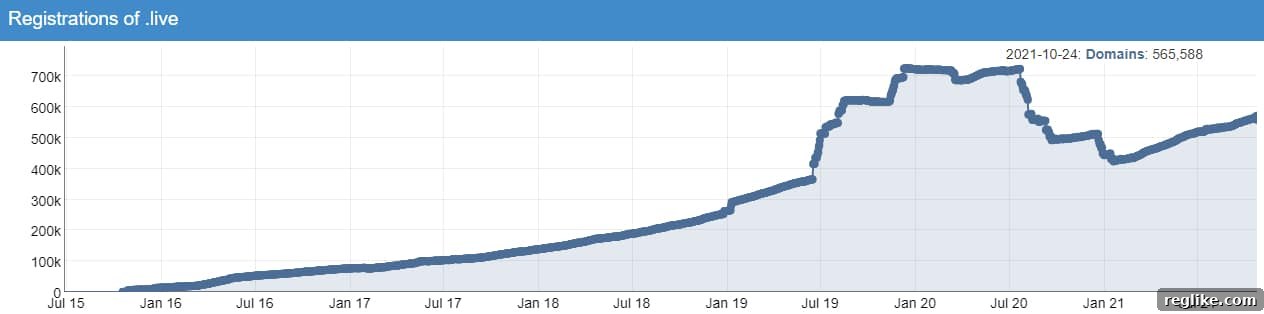
Analyzing domain registration data from sources like nTLDStats reveals a compelling picture of .live’s evolution. Since its inception in late 2015, .live experienced steady growth leading up to June 2019. A significant surge in registrations occurred during this period, with DUMs jumping by several hundred thousand within a matter of weeks. This rapid increase can be attributed to strategic promotional initiatives and attractive discount pricing strategies implemented by Donuts.
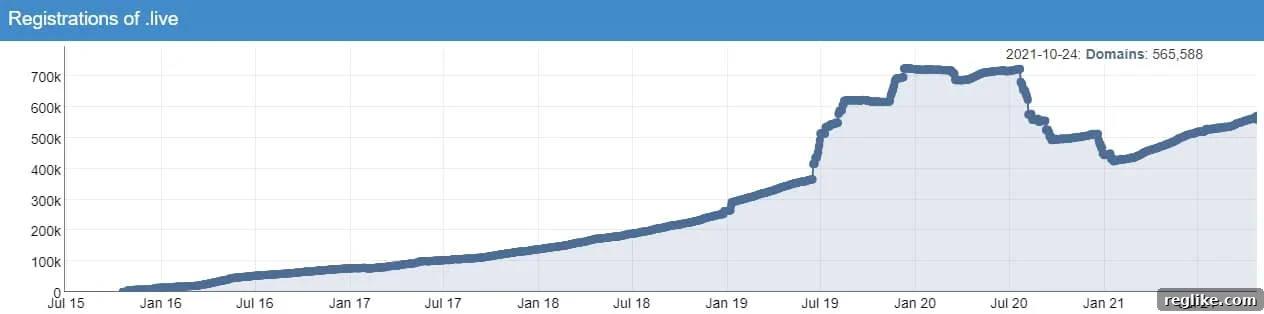
.Live Domain Registrations Over Time (Source: nTLDStats)
Indeed, Donuts strategically prices .live with a very appealing first-year registration fee, followed by a more moderate renewal cost. For example, GoDaddy currently offers .live domains for as low as $1.99 for the first year, with subsequent renewals priced at $39.99 per year. This pricing model encourages initial adoption while ensuring long-term sustainability for the registry.
Based on pricing data from various registrars, it’s estimated that the promotional wholesale cost for the first year is around $1, while renewal prices are in the range of $16-$17. This differential pricing strategy is common among new TLDs aiming to gain market share.
The surge in registrations in 2019 was followed by an anticipated drop in 2020 as domains came up for renewal. However, since January of this year, .live has demonstrated consistent growth, indicating a healthy level of retention and new adoption.
According to nTLDStats, the leading registrars for .live domains include GoDaddy, Namecheap, Enom, NameSilo, and Name.com. Notably, Donuts owns Name.com, providing them with a direct channel for promoting and selling .live domains. The distribution of registrations across multiple registrars suggests a healthy and diversified market presence.
.Live in Action: Real-World Usage and Applications
Anecdotal evidence suggests that .live has resonated particularly well with live streamers, influencers, and content creators. The intuitive and descriptive nature of the .live domain extension makes it an ideal choice for anyone involved in streaming or producing live video content.
To gain further insights into the actual usage of .live domains, we can turn to analytics services like Pandalytics, a DomainsBot service that tracks domain usage. Pandalytics estimates that approximately 53,000 .live domains are actively developed. While analytics methodologies vary across different services, comparing .live to other TLDs in a similar range can provide valuable context.
Let’s compare .live to .work and .bar, two TLDs with similar DUM rankings on nTLDStats and comparable first-year pricing strategies.
- .Work: Has roughly the same number of registered domains as .live, with Pandalytics estimating around 58,000 developed domains.
- .Bar: Has approximately 100,000 fewer registered domains than .live, with Pandalytics counting only 5,000 developed domains.
These comparisons suggest that .live is performing relatively well in terms of domain development and actual usage.
Furthermore, many individuals and businesses register .live domains specifically to redirect them to their channels or profiles on popular streaming and video platforms. Pandalytics estimates that there are around 30,000 .live redirects, compared to 21,000 for .work and 16,000 for .bar. While not all redirects lead to active sites (many may point to parked pages or for-sale landing pages), this data indicates a significant proportion of .live domains are being used to drive traffic to external platforms.
Navigating the .Live Aftermarket
Donuts employs a “high-high” pricing model for premium .live domains. This means that individuals or businesses registering domains designated as “premium” by Donuts must pay a higher price not only for the initial registration but also for subsequent renewals. This pricing strategy can pose a challenge for domain investors seeking to acquire premium domains for resale purposes.
However, the .live aftermarket has seen some notable sales in the past. When Rightside (later acquired by Donuts) initially launched .live, they successfully sold some of the most desirable premium domains. For example, in 2016, “sex.live” was sold for $160,000, and “porn.live” fetched $120,000. Interestingly, both of these domains are currently listed for sale, indicating the potential for future transactions.
Other significant sales include “stream.live,” which was sold for $20,000 and currently redirects to theq.live, a live streaming platform. Similarly, “church.live” was sold for $20,000 and is used by Gateway Church, a mega-church located in the Phoenix area.
More recently, “c.live” was sold for $28,500 on Sedo last year and is currently used by a live streaming app, highlighting the continued demand for short and memorable .live domains.
While premium domains command higher prices, it’s still possible to acquire valuable .live domains on the aftermarket at reasonable rates. For instance, “tech.live” was sold for just $560 in March. However, it’s crucial to remember the premium renewal fees associated with many of the desirable domains.
You can explore recent .live domain sales on NameBio to gain further insights into market trends and pricing.
Key Takeaways: The .Live Domain Landscape
- .Live is Donuts’ largest new TLD. Its popularity and growing adoption make it a significant player in the domain name industry.
- Low introductory prices drive initial registrations. The attractive first-year pricing strategy encourages widespread adoption and experimentation.
- Healthy renewal rates indicate long-term value. The fact that many .live domains are renewed after the initial year suggests that users find value in the domain extension.
- Significant usage in live streaming and video content. .Live has become a popular choice for individuals and businesses involved in live video production and distribution.
- The aftermarket offers opportunities, but be mindful of premium renewals. While premium .live domains can be valuable, it’s essential to consider the long-term renewal costs.
In conclusion, the .live domain extension appears to be thriving, particularly in the current environment where live video content is taking center stage. Its intuitive name, combined with strategic pricing and effective marketing, has positioned .live as a relevant and valuable domain choice for a wide range of users. Whether you’re a live streamer, video content creator, or simply looking for a memorable and descriptive domain name, .live is worth considering.