
Is GoDaddy’s CashParking Custom Header Service Overpriced? A Deep Dive into Domain Monetization Value
Recently, an email from GoDaddy, presented as a sales letter rather than a traditional newsletter, caught my attention. Beyond the usual promotional offers, a specific exclusion in the fine print of a “20% off $75” coupon stood out: “CashParking Custom Header.” My curiosity piqued, I navigated to the GoDaddy website to uncover more details about this service.
The premise of the service is straightforward: GoDaddy offers to create a custom header for your parked domain. The price tag for this seemingly simple customization? A significant $99. This immediately raises a fundamental question: Is this service truly worth the investment, especially when considering the broader landscape of domain parking and monetization?
To properly evaluate the “CashParking Custom Header,” it’s essential to first understand GoDaddy’s unique position in the domain parking ecosystem. Unlike many other popular domain parking services that offer their core parking functionality for free, GoDaddy operates on a model where it charges for its primary CashParking service. While some argue that this fee could be justified by potentially higher payout rates for domains with substantial traffic, the additional $99 for a custom header pushes the perceived value proposition into questionable territory.
Understanding Domain Parking and Monetization
Domain parking is a common practice among domain investors, businesses, and individuals who own domain names but aren’t actively using them for a fully developed website. Instead of letting the domain lie fallow, it’s “parked” on a special server that displays a simple webpage, typically featuring advertisements. The goal is often twofold: to generate passive income from ad clicks (monetization) or to provide a placeholder until a full website is ready, sometimes also serving as a “for sale” page for potential buyers. Services like GoDaddy’s CashParking facilitate this by integrating with advertising networks.
The revenue generated from parked domains can vary wildly. High-traffic, keyword-rich domains might pull in a decent sum, but the vast majority of parked domains generate very little income – often just a few dollars, or even cents, per month. This reality forms the core of the skepticism surrounding the $99 custom header. For most domain owners, it’s highly improbable that a single parked domain would earn even $99 per year, let alone enough to justify an additional, non-core service fee on top of the parking charge.
Deconstructing the $99 CashParking Custom Header
Let’s break down why this particular offering from GoDaddy appears to be significantly overpriced for the value it purports to deliver:
The Disconnect Between Cost and Expected Revenue
As mentioned, the average parked domain’s annual revenue often struggles to hit double digits. To ask $99 for a cosmetic enhancement means a domain would need to generate substantial income simply to break even on this feature alone. Consider a domain earning $5 a month; it would take nearly two years just to cover the cost of the custom header, assuming no other expenses. This calculation alone makes the service seem financially unviable for the vast majority of parked domains.
Comparison to General Website Header Design Costs
If you were to commission a custom header for a fully functional website – a header that requires thoughtful design, branding considerations, and integration with a larger site structure – you might expect to pay anywhere from $50 to $300, depending on complexity and designer expertise. However, a custom header for a parked page is a much simpler affair. It’s essentially a banner image or a customized text display within a predefined template. The sophistication and utility are significantly lower than a full website header, making the $99 price point appear disproportionately high.
The Aesthetic and Functional Impact
GoDaddy provides examples of these custom headers, and upon inspection, they don’t appear to offer a significant aesthetic advantage over the generic category templates already provided by most domain parking companies. Many of these standard templates, which come at no extra cost, are perfectly functional and visually acceptable for a parked page whose primary purpose is ad display or basic information. A custom header’s main purpose on a parked page would be to potentially increase click-through rates on ads or provide a more professional placeholder. However, for a page that users are likely to encounter fleetingly, the marginal gain from a slightly more polished header is questionable, especially at this price point.
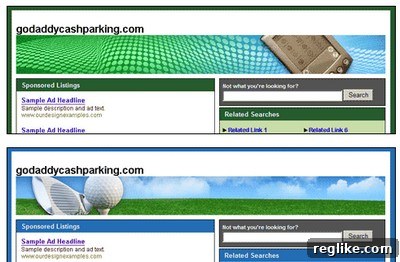
The question arises: Does a custom header truly enhance the monetization potential of a parked domain to such an extent that it justifies an almost $100 investment? It’s highly unlikely. Most traffic to parked domains comes from direct type-ins, expired links, or speculative searches. These visitors are typically looking for specific content or are curious about the domain itself. A custom header, while potentially adding a touch of branding, is unlikely to dramatically alter user behavior or significantly boost ad revenue on a page designed primarily for ad impressions.
Who Might (Theoretically) Benefit and What Are the Alternatives?
One might speculate that a “CashParking Custom Header” could appeal to a very specific niche: perhaps a large enterprise holding hundreds or thousands of valuable domains that occasionally receive substantial traffic, where even a slight increase in ad revenue across many domains could compound. Or, perhaps, for a premium domain that is actively being marketed for sale, where a more polished placeholder page could enhance its perceived value to a potential buyer. Even in these scenarios, however, the cost-benefit analysis remains challenging.
Exploring Cost-Effective Alternatives:
- Free Parking Services: Many domain registrars and specialized parking services (e.g., Sedo, Namecheap, etc.) offer domain parking absolutely free of charge. These services often provide various templates and customization options that might be sufficient for most users, effectively making the $99 GoDaddy header a non-starter.
- Simple Landing Pages: For those wanting more control and a professional look without breaking the bank, a more effective solution might be to host a very simple, single-page website on the domain. This could be a basic HTML page, a “coming soon” page, or a “for sale” page that you design yourself or use a free/low-cost template for. Web hosting for a basic page can be found for just a few dollars a month, offering far more flexibility and control than a restricted custom header on a parked page.
- Focus on Domain Value: The true value of a parked domain lies in its potential for development, its existing traffic, or its resale value. Investing in improving these core aspects (e.g., targeted marketing if selling, or developing content if there’s untapped traffic potential) will almost always yield a better return on investment than a purely cosmetic header for a parked page.
GoDaddy’s Business Model and Customer Perception
GoDaddy is renowned for its vast array of services and its aggressive marketing strategy, often involving upselling customers on numerous add-ons. While this business model has certainly been successful for them, it also means that customers need to be diligent in evaluating the genuine utility and value of each service offered. The “CashParking Custom Header” appears to be another example of a premium add-on that, for the average domain owner, offers little in the way of tangible returns commensurate with its price.
For new domain investors or those less familiar with the intricacies of domain monetization, such an offering might seem appealing at first glance. The promise of “customization” often implies enhanced professionalism and increased revenue. However, without a clear and compelling demonstration of how a $99 header translates into significantly improved performance or profitability for a parked domain, it risks being perceived as an opportunistic upsell rather than a valuable service.
Making an Informed Decision
Before investing in any add-on service for your domains, whether it’s a custom header, enhanced security, or premium hosting, it’s crucial to ask several questions:
- What is the clear, measurable benefit of this service?
- How does this benefit translate into actual ROI for my specific domain and goals?
- Are there more cost-effective alternatives that achieve a similar or better outcome?
- What is the typical revenue generated by this domain, and how long would it take to recoup the cost of the service through increased earnings?
In the case of the GoDaddy CashParking Custom Header, the answers to these questions for most domain owners would likely lean heavily against the investment. The perceived value is low, the likely impact on revenue is minimal, and far more effective and affordable alternatives exist for achieving a professional online presence or monetizing a domain.
Conclusion: Questioning the True Value
After reviewing the details of GoDaddy’s “CashParking Custom Header” service, the initial skepticism remains strong. Priced at $99 for what is essentially a visual enhancement on a parked page, a service that many other providers offer basic versions of for free, it appears wildly overpriced for the vast majority of domain owners. The fundamental economics of domain parking suggest that very few parked domains generate enough income to justify such an expenditure, let alone cover the initial parking fees from GoDaddy.
While GoDaddy continues to be a dominant force in the domain industry, offerings like the CashParking Custom Header highlight the importance of critical evaluation for consumers. Domain owners are encouraged to look beyond the marketing and assess whether a service truly adds value and contributes to their bottom line, or if it’s merely an additional expense that yields negligible returns. In the competitive world of domain investment and online presence, every dollar counts, and making informed decisions is paramount.