
John Berryhill Secures Landmark UDRP Victory for Carl Cartee Against Deceptive Domain Use
In the complex world of domain name disputes, attorney John Berryhill stands as a formidable advocate for intellectual property rights. While often representing domain name owners, a recent case highlighted his versatility and prowess in defending complainants. Berryhill successfully represented acclaimed Christian recording artist Carl Cartee in a Uniform Domain-Name Dispute-Resolution Policy (UDRP) case, reclaiming the crucial domain name CarlCartee.com from a registrant employing deceptive tactics.
This particular UDRP decision underscores the critical importance of diligent domain management and the robust protections offered by the UDRP against cybersquatting and bad faith registrations. It serves as a stark reminder for artists, brands, and businesses alike to remain vigilant in safeguarding their digital identities.
The Genesis of a Digital Dilemma: Carl Cartee’s Lapsed Domain
Carl Cartee, a well-known Christian recording artist, once held ownership of his eponymous domain, CarlCartee.com. Like many individuals and entities, Cartee eventually allowed the domain registration to lapse. This occurrence, while often a simple oversight, can open the door to opportunistic third parties. In this instance, following its expiration, another party swiftly registered the domain name.
Typically, the registration of an expired domain name by a new entity is a routine and perfectly legitimate practice within the domain aftermarket. Berryhill, in his comprehensive complaint, meticulously emphasized this point. The issue at the heart of this dispute was not merely the re-registration itself, but rather the highly questionable and intentionally misleading manner in which the new registrant chose to utilize the domain name.
Unveiling the Deception: A Cybersquatter’s Elaborate Scheme
The deceptive nature of the registrant’s actions became immediately apparent upon viewing the website hosted at CarlCartee.com. Instead of a clear distinction or a new, unrelated purpose, the site was crafted to intentionally confuse internet users. At first glance, the homepage presented content seemingly related to the singer, mimicking the expected online presence of an artist. This initial veneer of authenticity was a calculated move to capitalize on Cartee’s established brand and the domain’s prior search engine optimization (SEO) value.
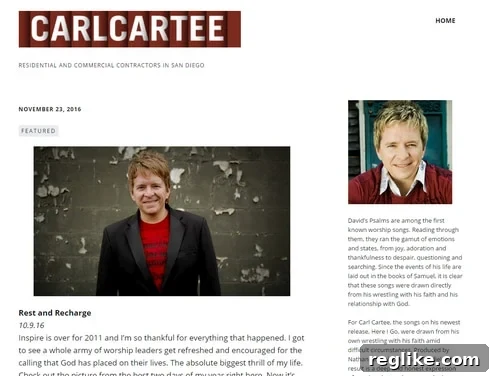
However, a closer inspection quickly revealed the fraudulent intent. Directly beneath what appeared to be Cartee’s logo or a similar brand element, a glaringly contradictory phrase appeared: “Residential and Commercial Contractors in San Diego.” This subtle yet significant detail served as the first major clue to the site’s true, illicit purpose.
Further exploration of the website cemented the case for bad faith. Scrolling past the initial misleading information about the singer, visitors would encounter a series of blog posts entirely unrelated to Carl Cartee or his music career. These articles included titles such as “How to hire a mobile windshield replacement contractor,” “Why SEO And Local Search Is Important For Businesses,” and “Companies That Give Free Estimates For Leaky Faucet And Toilets.” It became evident that the registrant was not interested in Cartee’s artistry but was instead attempting to leverage his goodwill and the domain’s historical SEO to generate traffic for entirely different, commercial ventures, likely through lead generation or affiliate marketing.
Understanding the UDRP: A Critical Mechanism for Online Justice
The Uniform Domain-Name Dispute-Resolution Policy (UDRP) is a crucial mechanism established by the Internet Corporation for Assigned Names and Numbers (ICANN) to resolve disputes regarding the abusive registration of domain names. It offers a streamlined, administrative alternative to traditional litigation, making it an invaluable tool for brand owners facing cybersquatting or trademark infringement in the digital realm.
To succeed in a UDRP complaint, the complainant must demonstrate three key elements:
- The domain name is identical or confusingly similar to a trademark or service mark in which the complainant has rights.
- The registrant has no rights or legitimate interests in respect of the domain name.
- The domain name has been registered and is being used in bad faith.
In Carl Cartee’s case, Berryhill meticulously built his argument around these three pillars, particularly focusing on the registrant’s blatant lack of legitimate interest and undeniable bad faith intent.
John Berryhill’s Masterful Argument: Unmasking Bad Faith and Deception
John Berryhill’s complaint on behalf of Carl Cartee was a masterclass in dissecting the registrant’s malicious intent. He argued that the registrant’s actions went far beyond merely acquiring an expired domain; they constituted a deliberate and systematic effort to exploit Cartee’s established identity and goodwill for commercial gain. The complaint articulated that the registrant’s objective was explicitly “to pass off the site as a legitimate site belonging to Complainant in order to increase the search ranking of the other sites linked by the articles posted to the site.”
This statement brilliantly encapsulates the core of the cybersquatter’s strategy: riding on the coattails of Cartee’s brand recognition and the domain’s previous SEO history to unfairly boost the visibility of unrelated commercial content. The inclusion of contractor-related information and irrelevant blog posts directly demonstrated a lack of legitimate interest in the domain name itself, particularly in relation to the artist Carl Cartee.
Furthermore, Berryhill emphasized the registrant’s attempts to obscure their contact information, a common tactic employed by those engaged in bad faith activities. The complaint powerfully concluded: “There is no question that Respondent’s deliberate appropriation of Complainant’s name, logo, likeness and original content for the purpose of exploiting Complainant’s goodwill, while obscuring his or her contact information, cannot have been done in good faith.” This assertion directly addressed the critical third element of the UDRP – the requirement to prove both bad faith registration *and* bad faith use. The panel found the evidence compelling and the arguments irrefutable.
The Panel’s Unanimous Decision: Justice Prevails
The arbitration panel, after reviewing the evidence and arguments presented by John Berryhill, unequivocally agreed with the complainant. This decision highlighted the panel’s recognition of the registrant’s clear intent to deceive and profit from Carl Cartee’s brand reputation. The panel’s ruling affirmed that such misleading practices constitute abusive registration and use under the UDRP, irrespective of whether the domain was initially acquired legitimately post-expiration.
The successful outcome meant that CarlCartee.com was transferred back to its rightful owner, Carl Cartee, allowing him to regain control of his digital identity and protect his online presence. This case serves as a precedent, reinforcing that the UDRP is a powerful shield against clever but unethical attempts to hijack established brands through deceptive domain practices. You can review the full decision here.
Key Takeaways for Domain Owners and Brand Holders
The Carl Cartee UDRP case, skillfully handled by John Berryhill, offers invaluable lessons for anyone with an online presence:
- Proactive Domain Management is Crucial: Ensure your critical domain names are renewed well in advance. Consider multi-year registrations and auto-renew options to prevent accidental lapses.
- Monitor Your Brand Online: Regularly search for your brand name, trademarks, and personal name across various online platforms, including newly registered domains. Tools for domain monitoring can be highly beneficial.
- Understand UDRP’s Scope: While expired domains can be legitimately re-registered, the manner of their *use* is paramount. Deceptive use, especially leveraging existing brand goodwill for unrelated commercial gain, is a clear violation.
- Register Trademarks: A registered trademark significantly strengthens a UDRP complaint, providing clear evidence of rights in a name or mark.
- Seek Expert Legal Counsel: Navigating domain name disputes requires specialized knowledge of internet law and UDRP policies. Attorneys like John Berryhill, with a deep understanding of these complex regulations, are indispensable for protecting your digital assets.
- Protect Your Online Reputation: Your domain name is often the first point of contact for your audience. Its misuse can severely damage your brand, reputation, and commercial interests.
Conclusion: A Victory for Integrity in the Digital Realm
The successful UDRP outcome for Carl Cartee, orchestrated by attorney John Berryhill, is more than just another win; it’s a significant affirmation of the principles of fair play and brand integrity in the digital landscape. It sends a clear message to would-be cybersquatters that deceptive practices, even those cloaked in subtle mimicry and SEO manipulation, will not stand up to scrutiny under the Uniform Domain-Name Dispute-Resolution Policy.
This case serves as a powerful testament to the UDRP’s effectiveness as a vital tool for artists, businesses, and individuals to protect their names and brands from exploitation. It reinforces the importance of diligence in domain management and the indispensable role of experienced legal professionals in safeguarding one’s digital identity in an ever-evolving online world.