
The Digital Atlas: Reshaping Our World Through the Lens of Country Code Top-Level Domains (ccTLDs)
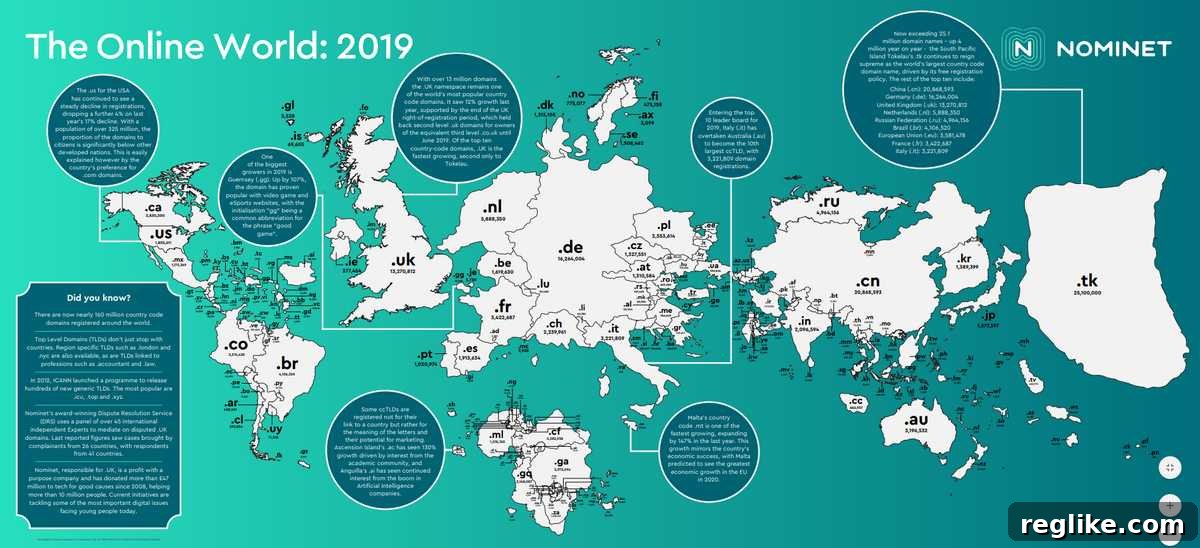
In an increasingly interconnected world, where digital presence often carries as much weight as physical landmass, how would our perception of global influence shift if countries were sized not by their geographic boundaries but by the volume of their country code Top-Level Domain (ccTLD) registrations? This intriguing question forms the core of a fascinating visualization, offering a unique perspective on the digital landscape.
The UK’s official domain registry, Nominet, renowned for its stewardship of the .UK domain, has brilliantly tackled this hypothetical scenario. Their publication, aptly titled “The Online World 2019” map – with a full-resolution version available here – provides a compelling visual representation of this digital remapping. This innovative atlas isn’t just a novelty; it serves as a powerful reminder of how online activity and domain management strategies can dramatically alter a nation’s perceived significance on the global stage, often defying traditional expectations and geographical limitations.
Unveiling the Discrepancies: When Digital Outweighs Physical
One of the most striking transformations on Nominet’s map concerns the tiny South Pacific island nation of Tokelau. With a modest population of approximately 1,500 residents, Tokelau’s physical footprint is minuscule. However, on this digital map, it appears disproportionately vast, almost comically so. The reason behind this colossal expansion lies in its .TK ccTLD. Unlike many other country codes, .TK domains have historically been offered for free, leading to an astonishing registration count exceeding 25 million. This policy, primarily managed by the Dutch company Freenom, allowed virtually anyone globally to acquire a .TK domain without charge, generating massive numbers and positioning Tokelau as a veritable digital giant. While this has certainly boosted Tokelau’s visibility in the domain world and generated some revenue for the small nation through advertising on parked domains, it also highlights the unusual economics and potential for abuse associated with free domain models. The sheer volume of .TK registrations demonstrates how a strategic, albeit unconventional, domain policy can create an immense, albeit artificial, online presence for even the smallest of nations.
Beyond Tokelau’s unique case, Nominet’s analysis reveals several other intriguing trends and success stories within the ccTLD ecosystem:
-
The Rise of Niche Appeal: Guernsey’s .GG and the Gaming Phenomenon
The ccTLD for Guernsey, a British Crown Dependency, is .GG. This seemingly innocuous two-letter abbreviation has experienced an extraordinary surge in popularity, recording a remarkable 107% year-on-year growth. The primary catalyst for this phenomenal growth is its resonance within the global video game and eSports communities. In gaming culture, “GG” is a widely recognized and frequently used abbreviation for “good game,” a phrase exchanged at the end of competitive matches as a mark of sportsmanship. This linguistic serendipity has transformed .GG into a preferred domain for gaming clans, eSports organizations, streamers, and enthusiasts seeking to establish an immediate connection with their target audience. The domain has become synonymous with gaming, acting as an instant identifier within this rapidly expanding digital subculture. This trend beautifully illustrates how a ccTLD, through sheer happenstance of its abbreviation, can transcend its geographical origin and carve out a significant niche market, driven by cultural trends and community adoption rather than traditional national identity.
-
Academic and Technological Magnetism: .AC and .AI
Another fascinating example is the ccTLD for Ascension Island, .AC. This domain has witnessed an impressive growth of 130% over the past 12 months, largely fueled by interest from the academic community. Much like .EDU domains, .AC has become an attractive alternative for universities, research institutions, and individual academics globally who wish to project an image of scholarly affiliation. Its succinctness and direct association with “academia” make it an ideal choice for educational portals, research projects, and personal academic websites. This highlights a trend where specific ccTLDs are adopted by professional communities seeking a specialized online identity.
Parallel to this, the continued growth of Anguilla’s .AI ccTLD further underscores the power of timely relevance. As Artificial Intelligence (AI) technology continues its exponential rise, permeating every aspect of modern life, the .AI domain has naturally become the domain of choice for AI startups, researchers, developers, and companies working in this cutting-edge field. Its direct, self-explanatory nature provides instant brand recognition and credibility within the AI sector. The demand for .AI domains is so strong that it has become a significant revenue stream for the small Caribbean island of Anguilla, demonstrating how a country’s digital asset can become intimately tied to global technological advancement and drive substantial economic benefit. These two examples collectively showcase how specific ccTLDs can become highly coveted due to their semantic meaning, aligning perfectly with burgeoning global industries and professional sectors.
Established Powerhouses: UK and Germany’s Enduring Digital Presence
While the stories of Tokelau, Guernsey, Ascension Island, and Anguilla highlight dramatic shifts and niche successes, Nominet’s map also reaffirms the robust online presence of established digital economies. From my observation, the United Kingdom (.UK) and Germany (.DE) emerge as particularly prominent entities on this reimagined digital world map. Their substantial visual size reflects the resounding success and widespread adoption of their respective country code domains.
Germany’s .DE domain, for instance, is consistently one of the largest and most active ccTLDs globally, signifying a highly digitized economy and a strong culture of online engagement among businesses and individuals. Similarly, the .UK domain family (including .co.uk, .org.uk, and .uk directly) boasts millions of registrations, underpinning the UK’s vibrant digital economy, extensive e-commerce activity, and widespread internet penetration. These countries don’t rely on quirky abbreviations or free domain models; their success is a testament to strong national infrastructure, high internet adoption rates, robust economic activity, and a well-established trust in their national domains. They represent the bedrock of the ccTLD landscape, demonstrating that inherent national strength and digital maturity are powerful drivers of domain registration volumes.
The Broader Implications of ccTLD Trends: Digital Identity and Economic Impact
The insights gleaned from Nominet’s “The Online World” map extend far beyond mere domain statistics. They offer a profound commentary on the evolving nature of national identity in the digital age. A country’s ccTLD is no longer just a technical address; it’s a critical component of its digital sovereignty, a branding tool, and potentially a significant economic asset.
For small island nations or developing countries, a well-managed and strategically marketed ccTLD can provide an invaluable source of revenue and global recognition. The cases of Tokelau and Anguilla clearly illustrate how effective domain policy can generate economic opportunities that far outweigh the traditional limitations of geography or population size. These nations effectively “export” their digital real estate, leveraging global demand for specific domain names to fund national initiatives or bolster their economies.
Furthermore, these trends highlight the dynamic interplay between technology, culture, and domain management. The success of .GG in gaming or .AI in artificial intelligence underscores the importance of registries understanding global trends and cultural nuances. A responsive and innovative approach to ccTLD management can unlock immense potential, fostering specialized online communities and catering to specific industry needs.
Conversely, the map also implicitly raises questions about digital equity and the impact of domain policy. While free domains like .TK can lead to massive registration numbers, they can also be associated with higher rates of abuse, spam, and cybersecurity risks, affecting the overall reputation of the ccTLD. Balancing accessibility with security and maintaining a positive brand image remains a perennial challenge for ccTLD registries.
The Future of Digital Geography
As the internet continues to evolve with emerging technologies like Web3, the metaverse, and increasingly sophisticated AI, the role of ccTLDs will likely remain pivotal. They serve as anchors in an ever-expanding digital universe, providing a sense of place and identity that transcends physical borders. Nominet’s map, therefore, is not just a snapshot of 2019; it’s a timeless conceptual framework that encourages us to continuously rethink our understanding of global influence, economic power, and national identity in an era dominated by digital connectivity.
In conclusion, if domain registrations were the sole metric, our world map would be a vibrant, dynamic, and often surprising tapestry. It would be a world where tiny islands command vast digital empires, where cultural trends dictate digital boundaries, and where technological advancements redraw the lines of influence. This digital atlas serves as a compelling testament to the power of the internet to reconfigure our perceptions and reshape the very definition of a nation’s footprint on the global stage.