Tax avoidance at center of Epik PayPal controversy — Masterbucks and
Alternative currency pitched as way to avoid taxes could be behind PayPal’s decision to stop providing services to Epik.
Following Reglike wrote regarding PayPal dropping Epik the prior week, Mashable writer Matt Binder confirmed with PayPal that the decision had nothing to do with Epik catering to fringe and far-right websites. A source told him the issue is with Epik’s Masterbucks.
Epik subsequently took down a blog post that contained a number of letters it sent in response to the controversy and removed the main page regarding Masterbucks on its website. The Masterbucks page was removed between yesterday and today, as stated by Google cache. A knowledge base article regarding Masterbucks remains online. [Update: the PayPal letters address works again. The URL for the Masterbucks page epik.com/services/masterbucks, which gave a 404 error earlier, now forwards to a website at Masterbucks.com.]
Given the controversy, it’s worth digging into the Masterbucks concept.
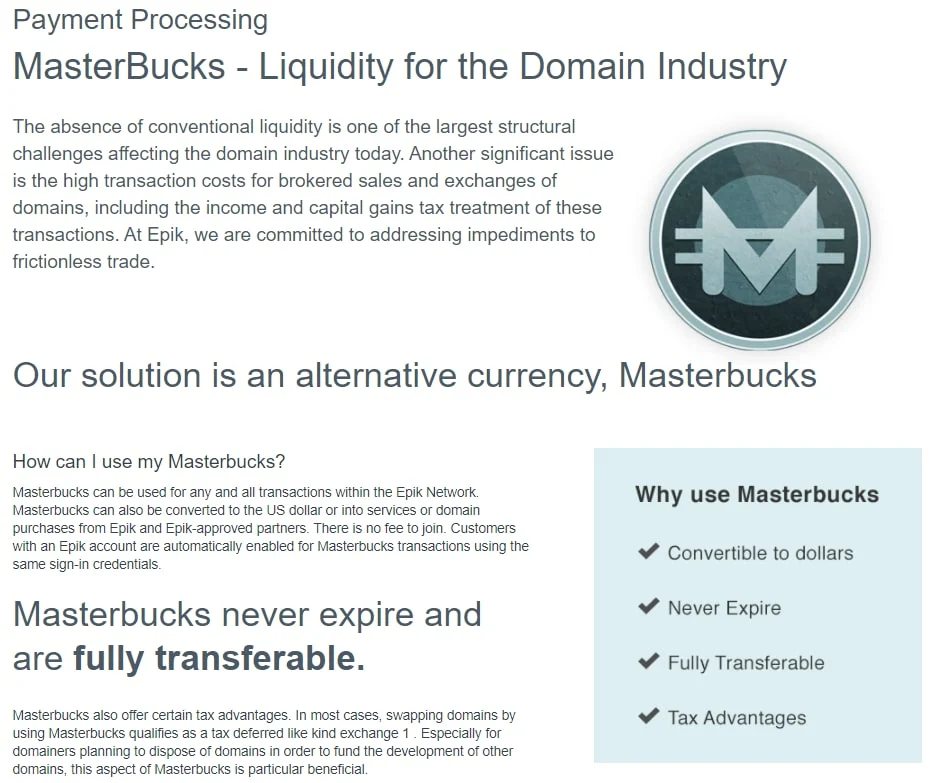
Epik pitched Masterbucks as a sort of alternative currency, but it’s essentially store credit. When Epik clients sell domains, they can receive the funds in Masterbucks. They can then use this store credit to register domains, acquire domains on the aftermarket, and use for other Epik services. They can also send “real” money to Epik to add to their Masterbucks account and withdraw Masterbucks into real currency.
Epik pitched Masterbucks as a tax-efficient way to buy and sell domain names. In a post on NamePros last year, Epik CEO Rob Monster wrote:
Proceeds can be held in the form of in-store-credit until redeemed. Redemption to cash is a taxable event, still trading domains for domains is a like-for-like exchange for which there ought to be no taxable event. Depending on your jurisdiction, you ought to consult with your tax advisor, but we have yet to see a challenge.
Monster pitched it as a 1031 exchange.
A 1031 exchange is a common tax move in the U.S. for real estate investors. It works like this: a real estate investor sells a property and has a capital gain. Rather than paying taxes on the capital gain, they can essentially roll that gain into the purchase of another property.
While the concept was previously used for things other than real estate, the Tax Cuts and Jobs Act passed in 2017 changed the law to say that 1031 exchanges could only be applied to real estate.
Monster pitched the 1031 exchange value of domain names following this change.
Applying 1031 exchange law to domain names could be a big tax advantage.
Epik clients in the U.S. who used Masterbucks to avoid paying taxes could be in trouble. In October 2018, Monster wrote on Reglike, “We have folks buying and selling daily, tax-free as 1031 transactions.”