This is what happens when a domain investor creates a domain registrar: NameBright.com

Team at TurnCommerce unveils fresh domain name registrar with tools for domainers.
What would happen if a sizable domain name investor created a domain registrar from the bottom up?
The result would look like NameBright.com.
NameBright.com is a fresh domain name registrar created by the team at TurnCommerce, one of the largest domain portfolio holders with over 1 million domain names. The registrar has the potential to attract some of the top domain investors that require tools such as account delegation and portfolio management, as well as smaller domain investors looking for a simple user interface and low pricing.
I’ve been test driving the registrar over the past couple weeks to get a handle on its key features and to see how it could win over domainers.
Pricing
Price is, no doubt, a top concern among domainers.
Standard pricing at NameBright for .com domains is $8.53, which the registrar considers to be “at cost” when you take into account credit card processing fees. If you prepay by check, you can register .com domains for only $8.03 and .net for $6.55, which is NameBright’s actual cost paid to Verisign and ICANN. Given the overhead NameBright carries (and that anyone who runs a registrar carries), this is a really good deal.
The firm hopes to make money through the sale of additional products.
Whois privacy is free for the first year and $2.95 following that. You can also pay $9.95 per year to upgrade your domain and get additional features.
Security
Respondents to the Reglike survey last year stated that security was their top concern when selecting a domain name registrar.
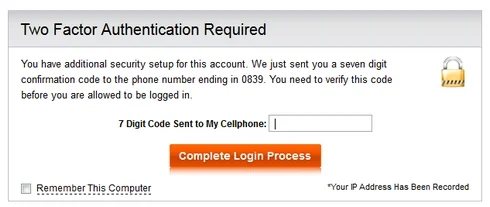
NameBright offers optional two-factor authentication, a must for any domain name registrar. When you log in to the site, you’ll be asked to submit an additional one time code that is sent via text message to your phone. The two-factor implementation is very similar to that of GoDaddy.
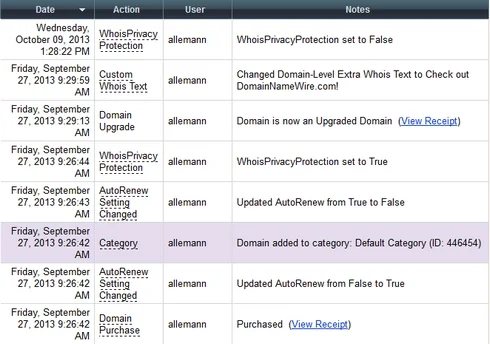
The registrar also tracks every change made to a domain name. This is something fairly unique. For example, here’s my change log for a test domain I registered, TestingItout12.com:
The registrar offers additional security controls when it comes to user delegation…
User delegation
Most domainers manage their own domain name portfolios. But when you get up to the 10,000, 100,000, or more mark, many domainers have a team that helps manage the portfolio.
NameBright really shines in this area, and its user controls are something that will set it apart.
Domainers can create Linked Accounts with other users. These linked users have very granular controls on what they can do. For example, you can allow them to initiate inbound transfers but not outbound transfers. You can allow them to renew domains, change nameservers, and change forwarding — or disallow any of these things.

Upgraded domains
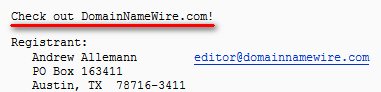
I mentioned earlier that one way NameBright hopes to make money is by selling add-on features. One service is called Upgraded Domain. For $9.95 per year, an Upgraded Domain gets unlimited domain history and whois counts (vs. 30 days on a regular domain), DNS firewall, a brand protection monitor, and a few other goodies. It also includes custom whois text so you can include your own message in whois, like this:
It seems like a good option for some types of clients, although the price is prohibitive for sizable portfolio holders.
Other Domainer Features
Here are some other domainer-friendly features NameBright offers:
– “Portfolios” for easier management of domains
– Fast domain changes, such as changing forwarding on domains for an entire portfolio at once
– Whois counters to see how many times people search your domains in whois
– Email management for domain name portfolios and category-based email accounts
There are a number of other unique features explained here.
Can NameBright compete?
Domain name registration is a low margin business dominated by a handful of incumbent registrars. Is there room for NameBright to compete?
I remember speaking to a registrar a few years ago that had tried to attract the domainer audience and found it challenging. They told me that domain investors were a bit more loyal to registrars than they thought. And once you get a domainer on board, they also prove to be quite demanding.
Yet that registrar wasn’t actually built by a domain investor, and they were competing mostly on price. I agree that if you’re just trying to undercut the competition by a few dimes you’ll have a hard time attracting business.
That NameBright was built from the ground up over five years by a sizable portfolio holder means it has a lot of the features that domainers will appreciate. Some of them are rather innovative and ought to appeal to a segment of the market.