
Unveiling the Mystery: Deconstructing Network Solutions’ Elusive Domain Pricing Strategy
In the vast digital landscape, securing a domain name is often the first step towards establishing an online presence. For most, this process is straightforward: visit a registrar, search for a domain, and the price is immediately visible. However, navigating the waters of certain providers, particularly Network Solutions, reveals a pricing strategy that defies conventional industry transparency, demanding an unusual level of commitment from potential customers.
Many consumers who utilize services from companies like Web.com, Network Solutions, or Register.com appear to be less sensitive to price fluctuations, or perhaps, less informed about typical market rates. This observation sheds light on why these entities can comfortably charge significantly higher fees—often around $35 for a one-year domain registration—when most other registrars offer similar services for a more competitive $10-$15 range. This disparity in pricing alone is noteworthy, but it’s the method of price discovery that truly sets Network Solutions apart.
The Unexpected Journey to Discover Domain Costs
My recent attempt to ascertain current domain registration costs at Network Solutions led me down an intriguing, albeit frustrating, path. Unlike the majority of domain registrars that prominently display their pricing on service pages or even direct search results, Network Solutions opts for a more veiled approach. Upon visiting their website, a concerted effort to locate any form of pricing information—whether through site-wide search functions or by meticulously scanning homepage links—proved futile.
This lack of upfront disclosure immediately raises questions about user experience and transparency. In an age where consumers expect instant access to information, forcing them to embark on a quest simply to find out how much a basic service costs is a significant departure from industry norms. It creates an initial barrier, potentially alienating users accustomed to the straightforward pricing models of competitors.
A Departure from Industry Norms: Why Hide the Price?
The standard practice across the domain registration industry is one of clear and immediate pricing. Websites like GoDaddy, Namecheap, and countless others make their registration fees readily available, often displaying them directly on the search results page as you check a domain’s availability. This transparency builds trust and allows users to make informed decisions quickly. Network Solutions’ strategy, however, seems to deliberately eschew this norm, suggesting a calculated business decision rather than an oversight.
One might speculate that this opacity serves to protect their premium pricing. If customers were to instantly see a $35 registration fee alongside competitors charging $10, many would likely bounce immediately. By obscuring this initial figure, Network Solutions attempts to guide the customer deeper into their sales funnel before revealing the full cost, hoping that the invested effort will reduce price sensitivity.
The Unprecedented Barrier: Add to Cart and Account Creation
The true surprise in Network Solutions’ order flow isn’t merely the absence of listed prices, but the stringent requirements imposed to reveal them. To view the annual registration price for a domain, a user must take two extraordinary steps:
- Add the desired domain to their shopping cart. This is already a significant ask for mere price inquiry.
- Sign in to an existing account OR create a brand new account. This step is, frankly, astounding in its imposition.
Most e-commerce platforms allow users to see product prices and even proceed to checkout as guests before requiring an account for final purchase. Forcing a user to create an account solely to view a price is an almost unheard-of practice in the digital commerce world. It represents a substantial hurdle for casual browsers and anyone simply comparing options.
This deliberate friction point is remarkable. It transforms a simple price check into a multi-step commitment process, consuming the user’s time and demanding personal information upfront. For a company offering a high-volume, relatively low-cost service like domain registration, such an aggressive gatekeeping mechanism speaks volumes about their underlying strategy and target demographic.
The Psychology Behind the Paywall: Sunk Costs and Commitment
From a business psychology perspective, this strategy is likely not arbitrary. It’s plausible that Network Solutions has extensively studied its customer journey and identified a critical inflection point. By requiring users to invest significant effort—searching, adding to cart, and creating an account—they are invoking the psychological principle of “sunk cost fallacy” or “commitment and consistency.”
Once a customer has dedicated their time and personal data to overcome these initial barriers, they are psychologically more invested in the process. The perceived cost of abandoning the transaction, having already put in so much effort, increases. This makes them less likely to back out, even if the eventual price revealed is higher than anticipated or available elsewhere. The “effort justification” theory also suggests that people tend to value something more highly if they have to work harder to attain it. Network Solutions might be banking on this elevated perceived value once the price is finally unveiled.
Data Collection and Lead Generation: Beyond Just a Sale
Beyond reducing abandonment, the mandatory account creation serves another vital purpose: robust data collection and lead generation. By requiring an email address and other personal details simply to view a price, Network Solutions is effectively building a comprehensive database of potential customers. This information is invaluable for targeted marketing campaigns, even if the initial transaction isn’t completed.
Every user who creates an account, even if they don’t immediately purchase a domain, becomes a qualified lead. This allows the company to follow up with personalized offers, promotional emails, and reminders, nurturing these leads towards conversion over time. In a competitive market, having a large pool of engaged leads can be a significant advantage, justifying the initial friction created by the account requirement.
The Aftermath: The Abandoned Cart Strategy in Action
A direct consequence, and likely a key objective, of this account-creation barrier is the ability to implement a highly effective abandoned cart recovery strategy. Since potential customers have already provided their email addresses, Network Solutions can track uncompleted purchases and initiate targeted follow-ups.
My own experience validated this. Two days after abandoning my cart—having added a domain and created an account but not proceeding to purchase due to the higher price—I received an email offering the domain at a significantly discounted rate of $24.99. This demonstrates the power of their data capture mechanism:
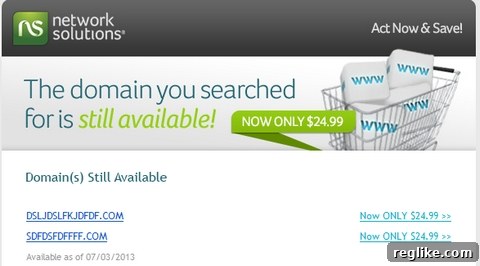
This proactive recovery method turns potential losses into conversions. By capturing customer contact information early, Network Solutions can re-engage with users who might have initially been deterred by the full price, enticing them back with a more competitive offer. This creates a two-tiered pricing system: an initial high price for those less price-sensitive or more committed, and a discounted price for those who hesitated.
Network Solutions vs. The Competition: A Tale of Two Strategies
Comparing Network Solutions to industry giants like Namecheap or Google Domains, the contrast is stark. Most major registrars prioritize ease of use and immediate transparency. They showcase competitive pricing upfront, allowing customers to easily compare and choose. Their competitive advantage often lies in bundling services, offering user-friendly interfaces, or providing exceptional customer support.
Network Solutions, conversely, seems to operate on a model that prioritizes lead capture and “sticky” customer relationships, even if it means sacrificing initial transparency. This isn’t necessarily a flaw, but a deliberate market positioning. It suggests they are not directly competing on initial price point with the budget registrars.
Who is Network Solutions’ Target Customer?
Given this strategy, Network Solutions’ ideal customer appears to be one of two types:
- Less Price-Sensitive Businesses: Larger organizations or businesses that prioritize a long-standing provider, bundled services, or perhaps lack the time to shop around extensively. They might perceive the higher cost as an indicator of premium service or value the convenience of having multiple services (domains, hosting, email) under one roof, even if it’s more expensive.
- Existing Web.com/Register.com Users: Customers already embedded within the Web.com ecosystem (which owns Network Solutions and Register.com) who value continuity and simplicity over finding the absolute lowest price. These users might migrate services without much scrutiny of individual component costs.
For these customer segments, the initial friction and higher price might be less of a deterrent and more of a confirmation of a “premium” service, or simply a non-issue given their existing relationship with the parent company.
Navigating the Domain Registration Landscape: Advice for Consumers
For individuals and businesses seeking domain registration, especially those who are price-sensitive and value transparency, this case highlights important considerations:
- Always Compare Prices: Don’t settle for the first price you see, or the price that requires the most effort to find. Check multiple registrars.
- Read Reviews: Understand other customers’ experiences with a registrar’s pricing, renewals, and customer service.
- Beware of Hidden Fees: Be vigilant for registrars that don’t display prices upfront or require excessive steps. Look for clear, unambiguous pricing.
- Understand Renewal Costs: Often, initial registration fees are promotional. The renewal price can be significantly higher, so always check this crucial detail.
- Prioritize Transparency: Choose registrars that are upfront about all costs, making your decision-making process simpler and more trustworthy.
Conclusion: A Calculated Risk in Customer Engagement
Network Solutions’ unique pricing strategy, characterized by hidden costs and mandatory account creation, is a fascinating case study in business psychology and sales funnel optimization. While it undoubtedly creates friction and potentially alienates some users seeking immediate transparency and competitive pricing, it appears to be a calculated maneuver to capture high-value leads and leverage psychological principles to drive conversions.
For the company, this strategy facilitates robust data collection and enables effective abandoned cart recovery, ultimately contributing to their bottom line by cultivating a committed customer base. For consumers, it serves as a powerful reminder of the importance of diligent research and critical evaluation when navigating the complex world of online services. While unconventional, this approach underscores that in the competitive realm of domain registration, a singular path to customer engagement is far from universal.