
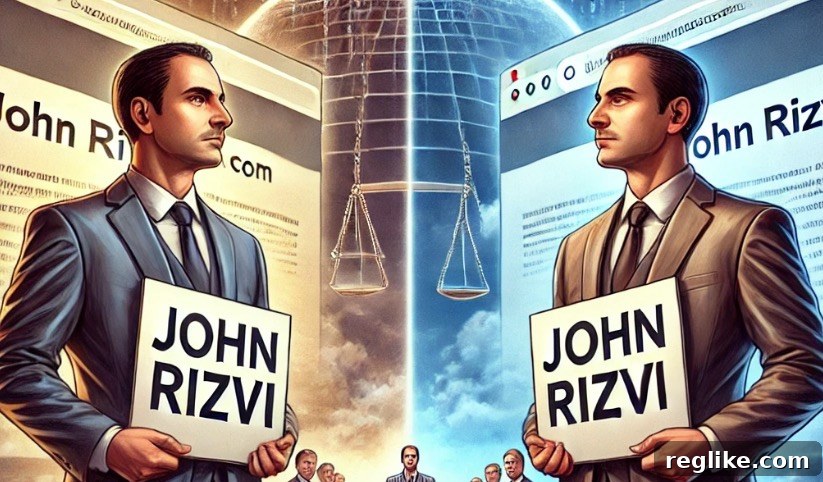
Same Name, Different Outcome: When Cybersquatting Claims Meet Identity
In a fascinating turn of events that highlights the intricate challenges of online identity and domain ownership, a patent attorney’s cybersquatting claim for a domain bearing his own name was ultimately rejected. The World Intellectual Property Organization (WIPO) panel found in favor of the domain registrant, who, remarkably, shares the exact same name as the complainant. This case serves as a crucial reminder that not all domain registrations featuring a known name constitute cybersquatting, especially when a legitimate claim of identity is established.
The Unraveling of a Unique Domain Dispute
The dispute revolved around the domain name JohnRizvi.com. The complainant, John Rizvi, a prominent patent attorney based in Florida, initiated a cybersquatting complaint, believing the domain to be unlawfully held. His initial filing was understandable, given that the domain did not resolve to an active website but rather a generic registrar landing page, and crucially, Whois privacy shielding obscured the registrant’s true identity. This lack of transparency is often a red flag in potential cybersquatting scenarios, prompting individuals and businesses to investigate further.
Cybersquatting, at its core, involves the bad-faith registration of domain names that are identical or confusingly similar to trademarks, personal names, or company names, with the intent to profit from the goodwill associated with those names. To combat this pervasive issue, the Uniform Domain-Name Dispute-Resolution Policy (UDRP) was established by the Internet Corporation for Assigned Names and Numbers (ICANN). UDRP provides an administrative process for resolving domain name disputes without the need for traditional litigation, offering a more streamlined and cost-effective solution.
Understanding the Pillars of a UDRP Complaint
For a complainant to succeed under UDRP, they must prove three essential elements:
- The domain name is identical or confusingly similar to a trademark or service mark in which the complainant has rights.
- The registrant has no rights or legitimate interests in respect of the domain name.
- The domain name has been registered and is being used in bad faith.
In many straightforward cybersquatting cases, meeting these three criteria is relatively clear. However, the JohnRizvi.com case presented a unique twist, challenging the second element in a way that is rarely encountered.
The Revelation: Two John Rizvis
The pivotal moment in the case came when the identity of the domain registrant was revealed: another individual also named John Rizvi. This discovery fundamentally altered the landscape of the dispute. World Intellectual Property Organization panelist John Swinson, tasked with arbitrating the matter, then faced the unusual task of adjudicating a dispute between two individuals who shared the very name in question.
Despite this revelation, the patent attorney pressed forward with his complaint. His argument, as summarized by Panelist Swinson, reflected a continued skepticism regarding the legitimacy of the registrant:
The Complainant was unable to find any evidence of an individual named “John Rizvi” linked to the listed entity “Novasante Healthcare,” nor was Complainant able to verify whether the telephone number or address listed for the Registrant belonged to a “John Rizvi.”
The complainant’s persistence underscored a common concern in UDRP cases: even if a name matches, there might still be an underlying motive to exploit or mislead. Could the registrant merely be using the name as a front for a different entity or purpose, thereby lacking genuine legitimate interest? This was the question the panel had to address.
Establishing Legitimate Interests: The Core of the Decision
To counter the complainant’s assertions, the domain registrant provided concrete proof of his identity to the WIPO panel. This included a formal declaration and a photocopy of his passport, unequivocally demonstrating that his legal name was, in fact, John Rizvi. This evidence was instrumental in the panel’s decision.
Panelist John Swinson ultimately ruled that the domain registrant possessed “rights or legitimate interests” in the domain name JohnRizvi.com. The UDRP policy explicitly states that a registrant can demonstrate rights or legitimate interests in a domain name if, among other things, they are commonly known by the domain name, even if they have acquired no trademark rights. In this scenario, being legitimately named John Rizvi, and having registered a domain name that directly reflects that identity, constitutes a prima facie case for legitimate interest.
The decision reinforces a fundamental principle: an individual generally has the right to register a domain name that corresponds to their own personal name, provided there is no evidence of bad faith intent to target a specific trademark holder or prominent individual. The absence of a live website or a clear public profile for the registrant did not, in itself, negate his inherent right to use his own name for a domain.
Lessons Learned: Nuances of Cybersquatting and Online Identity
This case offers several critical insights for individuals, businesses, and legal professionals navigating the complex landscape of domain disputes and online intellectual property:
The Power of Personal Identity
While UDRP is often associated with trademark protection, this case underscores the importance of personal identity rights. When a domain accurately reflects a registrant’s legal name, it forms a strong basis for legitimate interest, making it significantly harder for a complainant, even one with a strong public profile, to successfully claim cybersquatting without compelling evidence of bad faith targeting.
Limitations of Whois Privacy
Whois privacy, designed to protect individual registrants from spam and harassment, can sometimes complicate initial investigations into potential cybersquatting. While it prevents immediate identification, the UDRP process includes mechanisms to reveal the registrant’s identity, allowing for a fair assessment of their claims and counter-claims. This case demonstrates that while privacy can obscure initial details, it doesn’t shield a registrant from having to prove their legitimate right to a domain.
Thorough Pre-Filing Investigation is Key
For any entity considering a UDRP complaint, this case highlights the immense value of conducting a comprehensive investigation *before* filing. Had there been a way to ascertain the registrant’s identity earlier, the complainant might have avoided the costs and effort associated with a formal dispute. While Whois privacy can be a barrier, other investigative avenues, or even direct communication attempts, might sometimes yield crucial information.
Not All Unused Domains Are Cybersquatting
The fact that JohnRizvi.com pointed to a registrar landing page, rather than an active website, was a point raised by the complainant. However, UDRP panelists generally recognize that simply not using a domain, or using it for a placeholder page, is not, by itself, evidence of bad faith. A registrant might have future plans for the domain, or simply wish to hold onto their personal name online without actively developing a site. The context and the registrant’s intent are paramount.
The Balancing Act: Personal Rights vs. Brand Protection
This dispute perfectly illustrates the delicate balance UDRP aims to strike between protecting trademark holders from malicious domain registrations and respecting individuals’ rights to register domains corresponding to their own names. Without clear evidence of intent to exploit the complainant’s reputation or cause confusion, the legitimate interest of the “other” John Rizvi prevailed.
Beyond the John Rizvi Case: Broader Implications for Online Presence
The JohnRizvi.com decision resonates beyond this specific dispute, offering valuable lessons for anyone navigating their online presence. For individuals with common names, securing a personal domain can be a race against time and against others who share their moniker. This case affirms that simply having a prominent career or a widely recognized name does not automatically grant exclusive rights to a common personal domain if another individual with the same name legitimately registers it.
For brands and businesses, it emphasizes that while vigilance against cybersquatting is crucial, the legal framework is designed to differentiate between malicious intent and legitimate registration. Every UDRP case is decided on its specific facts, and the onus is always on the complainant to robustly prove all three elements of the policy.
In conclusion, the JohnRizvi.com dispute serves as an exceptional example of how identity, legitimate interest, and the nuances of UDRP can lead to unexpected outcomes. It reminds us that the digital landscape, much like the physical world, is populated by many individuals sharing the same name, and the right to one’s online identity is often a matter of who establishes a legitimate claim first, absent any overarching intent of bad faith.