
Navigating Brand Protection in New TLDs: A Deep Dive into the Trademark Claims Notice
The digital landscape is constantly evolving, with the expansion of the domain name system being one of its most significant transformations. The introduction of hundreds of new generic Top-Level Domains (gTLDs) has brought unprecedented choice and specificity to internet users and businesses alike. However, this proliferation also introduces complexities, particularly concerning brand protection and intellectual property rights. One crucial mechanism designed to safeguard trademarks in this new frontier is the Trademark Claims Notice.
Understanding how this notice functions, why it exists, and what it implies for both trademark holders and prospective domain registrants is essential for anyone looking to navigate the modern internet successfully. This guide will explore the mechanics of the Trademark Claims Notice, demonstrate its real-world application, and discuss its impact on the domain registration process.
The Evolution of the Domain Name System and New TLDs
For decades, the internet was primarily dominated by a limited set of gTLDs such as .com, .org, and .net, alongside country-code Top-Level Domains (ccTLDs) like .uk or .de. While these traditional domains served their purpose, they often led to overcrowding and a lack of specific, descriptive options. Recognising this limitation, the Internet Corporation for Assigned Names and Numbers (ICANN) initiated a program to expand the gTLD space, leading to the delegation of hundreds of new TLDs since 2013.
These new TLDs, ranging from industry-specific options like .tech, .app, and .store, to geographic identifiers such as .london and .nyc, and even brand-specific domains like .brandname, have opened up a new era of digital identity. They allow businesses and individuals to create more relevant and memorable online addresses, fostering innovation and enhancing user experience. However, this expanded domain space also presented a significant challenge: how to protect existing trademarks and prevent cybersquatting in an exponentially larger pool of domain names.
The Cornerstone of Brand Protection: The Trademark Clearinghouse (TCH)
To address the critical need for brand protection in the new gTLD era, ICANN established the Trademark Clearinghouse (TCH). The TCH serves as a centralised, global database for verified trademarks. It acts as a single point for brand owners to register their trademarks, which are then validated by third-party validators to ensure their authenticity and legal standing. Registration with the TCH provides two primary benefits:
- Sunrise Period Eligibility: For every new gTLD launch, there is an initial “Sunrise Period” – a pre-public registration phase exclusively for trademark holders. During this period, TCH-registered mark holders can preemptively register domain names corresponding to their trademarks, preventing others from doing so.
- Trademark Claims Notice Activation: After the Sunrise Period concludes, the “General Availability” phase begins, opening registrations to the general public. It is during the initial 90 days of General Availability for a new TLD that the Trademark Claims Notice comes into play, facilitated by the TCH database.
By registering a trademark with the TCH, brand owners gain a vital mechanism to protect their intellectual property rights across the vast landscape of new gTLDs, ensuring they are informed of and can act upon potential infringements.
Deciphering the Trademark Claims Notice
The Trademark Claims Notice is a mandatory informational alert that domain name registrars must display to prospective registrants. This notice appears when someone attempts to register a domain name that precisely matches a trademark record held within the Trademark Clearinghouse during the first 90 days of a new gTLD’s general availability. Its primary purpose is to inform potential registrants that the domain name they are trying to register corresponds to a verified trademark owned by another entity.
What Does the Notice Contain?
The specific content of the Trademark Claims Notice is largely mandated by ICANN, ensuring a consistent message across different registrars. As seen in the example below, the notice typically includes several critical pieces of information:
- The Claiming Company: The legal name of the entity that holds the trademark rights.
- Jurisdiction: The country or region where the trademark is registered and legally protected.
- Class of Goods/Services: The specific categories of goods or services under which the trademark is registered (e.g., “software,” “clothing,” “financial services”). This is crucial because trademarks are often protected only within specific classes.
- Contact Information: Details for the company or its legal representative, allowing the prospective registrant to seek further clarification if needed.
The message clearly explains that a company claims trademark rights to the term you’re trying to register. However, and this is a critical point, the notice does not necessarily mean you are prohibited from registering and using the domain name. Instead, it serves as a formal warning, informing you that your registration could potentially infringe upon existing trademark rights. Registering the domain after acknowledging this notice means you are proceeding with full knowledge of the claimed rights, which can have significant legal implications down the line.
Experiencing the Trademark Claims Notice in Action
To truly understand the Trademark Claims Notice, it’s helpful to see it firsthand. Many registrars currently offering domain names from new gTLD operators, such as Donuts Inc. (now identity Digital), will display this notice when applicable. Let’s take a hypothetical example, such as searching for “Virtue.guru,” a domain that might trigger the notice due to a registered trademark for “Virtue” within the TCH.
When you attempt to search for and add a domain name like Virtue.guru to your cart on a registrar’s website, and that domain matches a TCH record within the 90-day Claims Notice period, you will be presented with this mandatory alert. The exact timing and presentation can vary slightly between registrars, but the core message remains consistent.
Here’s an illustrative example of what you might see at a registrar like eNom:
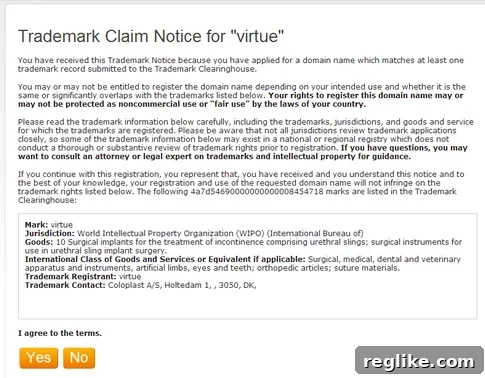
As depicted, the message is clear and concise, providing the necessary details about the trademark claim. It requires an affirmative action from the registrant before proceeding, underscoring the seriousness of the notice.
Registrar Implementations: Subtle Differences
While the essence of the Trademark Claims Notice is standardized, registrars have some flexibility in how they integrate it into their user experience. This can lead to minor differences in presentation and interaction:
- Display Timing: Some registrars, like GoDaddy, might display the message immediately after you add the domain to your cart or even during the initial search results, providing an early warning. Others, such as eNom, might present it later in the checkout process, perhaps just before final payment. Early notification can be beneficial for users, helping them make informed decisions sooner.
- Emphasis: Registrars might choose to bold different sentences or phrases within the notice to highlight particular aspects. These stylistic choices are intended to draw the user’s attention to the most crucial parts of the warning.
- Acknowledgment Mechanism: The way you acknowledge the claim can also vary. GoDaddy, for instance, often uses a dedicated button labeled “Acknowledge Claim,” making the user’s action explicit. In contrast, eNom might incorporate it into a general agreement, such as clicking a “Yes, I agree to the terms” button, which signifies acceptance of the notice among other terms. Regardless of the phrasing, the act of proceeding implies acknowledgment.
These subtle differences underscore the importance of carefully reading all notifications during the domain registration process, especially for new gTLDs.
The Consequence of Acknowledgment: Notification to the Claimant
Should you decide to proceed with the registration of a domain name after being presented with and acknowledging the Trademark Claims Notice, an important step in the brand protection mechanism is triggered. The trademark claimant, whose mark is registered with the TCH, will receive a notification of your registration. This serves as an immediate alert to the brand owner that a domain matching their trademark has been registered by a third party. This allows the trademark holder to monitor the new registration and assess whether it constitutes an infringement of their rights.
This notification is a cornerstone of the TCH’s protective function, enabling trademark owners to take timely action if they believe the domain name is being used in bad faith or in a manner that infringes on their brand. Such actions could include sending a cease and desist letter, initiating a Uniform Domain-Name Dispute-Resolution Policy (UDRP) case, or other legal remedies.
The “Chilling Effect”: A Double-Edged Sword
While the Trademark Claims Notice is a vital tool for brand protection, it is not without its critics. Many new TLD applicants and domain industry stakeholders have expressed concern that this notice creates a “chilling effect” on registrations. The argument is that prospective registrants, upon seeing a formal notice about claimed trademark rights, may become intimidated and abandon their registration plans, even if their intended use is perfectly legitimate and non-infringing.
For example, registering “virtue.guru” could be for a legitimate purpose – perhaps a philosophy blog, an ethical consulting firm, or a personal development coach – none of which might directly conflict with an existing trademark for “Virtue” in a completely different class of goods (e.g., “Virtue” for a brand of electronics). However, the intimidating language and the formal nature of the notice might deter such legitimate registrants, fearing potential legal repercussions.
The “chilling effect” highlights a fundamental tension: balancing essential intellectual property protection with the desire to foster growth and diverse usage within the new TLD space. While the notice clearly states that it doesn’t necessarily prohibit registration, the psychological impact on an average user, who may not be well-versed in trademark law, can be substantial. They are probably right to be cautious, but this caution can inadvertently stifle innovation and usage of new, descriptive domain names.
Navigating the Notice as a Prospective Registrant
If you encounter a Trademark Claims Notice during your domain registration process, it’s crucial to approach it thoughtfully. Here are some considerations:
- Read Carefully: Always read the full notice, paying close attention to the claiming company, jurisdiction, and especially the class of goods/services. Does your intended use of the domain fall within these classes?
- Assess Your Intent: Are you registering the domain with a legitimate purpose, unrelated to the trademark holder’s business, or are you attempting to profit from their brand reputation (cybersquatting)? Good faith intent is a strong defense.
- Consider Alternatives: If the notice raises concerns, consider slight variations of the domain name or a different TLD that might not trigger the notice.
- Seek Legal Counsel: If you are unsure about the implications of the notice or believe your use is legitimate, it is always wise to consult with an intellectual property attorney. They can provide guidance on your rights and potential risks.
- Acknowledge with Caution: By acknowledging the notice, you are confirming that you have read and understood the warning. This means you cannot later claim ignorance of the trademark holder’s rights if a dispute arises.
The Trademark Claims Notice serves as a powerful reminder of the importance of due diligence in the digital realm. It’s a proactive measure to protect brands, but also a crucial piece of information for registrants to consider before committing to a domain name.
Beyond the Notice: Sustained Brand Protection in New TLDs
The Trademark Claims Notice is just one element of a broader framework for brand protection in the new TLD ecosystem. While it provides an essential early warning during the initial 90 days of general availability, trademark owners have other recourse for ongoing protection, including:
- Uniform Domain-Name Dispute-Resolution Policy (UDRP): An administrative procedure for resolving disputes between trademark holders and domain name registrants regarding alleged abusive registrations (cybersquatting).
- Uniform Rapid Suspension (URS): A faster, lower-cost alternative to UDRP, designed for clear-cut cases of trademark infringement.
- Post-Delegation Dispute Resolution Procedures (PDDRP): Mechanisms that allow for complaints against TLD registries themselves, if they are deemed to be operating in a manner that harms trademark owners.
The landscape of domain names and brand protection is dynamic, continually adapting to new technologies and threats. The Trademark Claims Notice stands as a testament to the industry’s commitment to balancing innovation with the fundamental rights of intellectual property holders. By understanding and respecting these mechanisms, both registrants and brand owners can navigate the vast and exciting world of new TLDs more effectively and responsibly.