
Navigating the Digital Landscape: Domain Name Growth in Q2 2021 Masks Broader Year-Over-Year Challenges
Understanding the Latest Domain Name Industry Trends
The digital realm continues to evolve at an unprecedented pace, with domain names serving as the foundational addresses for online identities and businesses. Monitoring the growth and contraction of these essential digital assets provides invaluable insights into the broader health and direction of the internet economy. Verisign (NASDAQ: VRSN), a global leader in domain name registries, recently published its comprehensive Q2 2021 Domain Name Industry Brief. This detailed report, an authoritative source for market statistics, meticulously calculates the total base of registered domain names and diligently tracks recent industry trends, offering a crucial snapshot of the current landscape. Its findings highlight a complex narrative: while the second quarter of 2021 saw a notable increase in registrations, the overall picture reveals a persistent year-over-year decline across significant segments of the domain name market.
Verisign’s Pivotal Role in the Domain Ecosystem
As the registry operator for the world’s most critical Top-Level Domains (TLDs) – namely .com and .net – Verisign plays an indispensable role in the internet’s infrastructure. Their quarterly reports are not merely statistical compilations; they are essential indicators of global digital commerce, branding, and connectivity. By providing data on registration volumes, growth rates, and market shifts, Verisign’s briefs offer transparency into an industry that underpins virtually every online activity. These insights empower businesses, investors, and policymakers to understand the dynamics influencing online presence, cybersecurity, and the long-term sustainability of various TLDs. The nuances within their latest report underscore a market in flux, where established domains continue to thrive, while newer entrants and certain legacy segments face significant headwinds.
Decoding the Q2 2021 Domain Name Landscape: A Mixed Picture
A Quarterly Surge Amidst Broader Annual Contraction
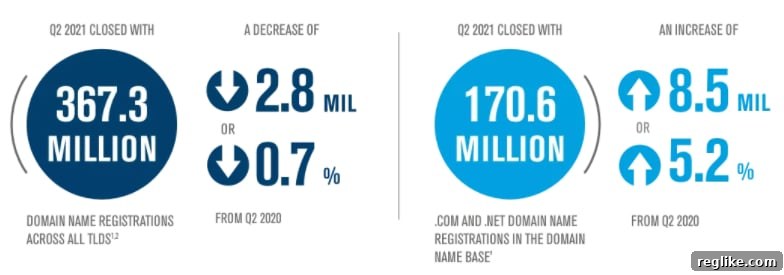
The Q2 2021 report from Verisign delivered some interesting figures, painting a picture of immediate recovery juxtaposed against a longer-term downturn. According to their calculations, the total number of registered domain names experienced a significant upturn during the second quarter, expanding by an impressive 3.8 million. This surge brought the global domain base to a new quarterly total of 367.3 million registrations. Such an increase could initially suggest a robust and growing market, perhaps indicating a post-pandemic digital acceleration or a renewed focus on online ventures. However, a deeper look reveals that this quarterly growth, while substantial, was not enough to offset declines experienced over the past year. Despite the Q2 uplift, the total domain count remains 2.8 million lower than it was at the end of Q2 2020. This persistent year-over-year decline points to underlying challenges within specific sectors of the domain name industry that warrant closer examination, suggesting that the recent gains might be more of a stabilization rather than a full market recovery across the board.
The Enduring Strength of .COM and .NET: Pillars of the Internet
Amidst a challenging market environment for many domain extensions, the venerable .com and .net domains continue to demonstrate remarkable resilience and growth. The accompanying chart and its caption highlight a critical distinction: while the overall TLD market experienced a 2.8 million year-over-year decline, the combined registrations for .com and .net actually surged by an impressive 8.5 million. This substantial growth underscores their unparalleled status as the most trusted, recognized, and coveted digital real estate on the internet. For decades, .com has been synonymous with commercial presence and global reach, offering a sense of credibility and longevity that newer TLDs often struggle to replicate. Similarly, .net, while often serving as an alternative, maintains a strong reputation, particularly for network-related services. Businesses and individuals worldwide continue to prioritize these established extensions for their primary online identities due to their widespread acceptance, brand recognition, and perceived stability. This consistent demand for .com and .net registrations suggests that in an increasingly crowded and fragmented domain landscape, the tried and true options remain the preferred choice for those seeking a secure and universally understood online presence, acting as a stabilizing force against broader market volatility.
Unpacking the Decline: New TLDs and the “Free Domain” Phenomenon
The Shifting Fortunes of New Generic Top-Level Domains (gTLDs)
The primary driver behind the significant year-over-year deficit in overall domain registrations can largely be attributed to a notable downturn in the performance of new Generic Top-Level Domains (gTLDs). These extensions, introduced over the past decade to offer more choice beyond traditional options like .com, include a vast array of niche and descriptive names such as .app, .xyz, .online, .store, and many others. According to Verisign’s analysis, the base of new gTLDs shrank by a substantial 27.8% year-over-year, settling at 22.9 million registrations. This considerable contraction reflects a changing strategy among many new gTLD providers. In their initial phases, many new TLD registries heavily relied on aggressive promotional campaigns, offering domains at heavily discounted rates or even for free to rapidly build registration volumes and market share. While effective in the short term for boosting numbers, this strategy often led to a high churn rate, with many registrations not being renewed once promotional periods ended or as the perceived value did not meet initial expectations. The recent scaling back of these cheap or free domain registration promotions has directly impacted new gTLD growth, revealing a more accurate picture of organic demand. Interestingly, the report also noted a degree of stabilization within this segment during the current year, with new gTLD registrations ticking up slightly between the end of Q1 and Q2. This subtle upturn might indicate that the market for new TLDs is starting to find its footing, moving beyond initial speculative registrations towards more genuine, sustained usage, albeit at a significantly lower growth trajectory than initially envisioned.
Country Code Top-Level Domains (ccTLDs) and the .TK Anomaly
Country Code Top-Level Domains (ccTLDs), which represent specific countries or territories such as .de for Germany, .uk for the United Kingdom, or .fr for France, also contributed to the overall year-over-year decline, though with a distinct underlying cause. While ccTLDs collectively managed to gain 1.2 million registrations during Q2 2021, their total base remained 2.4 million lower than at the close of Q2 last year. This dip is primarily attributed to the unique dynamics surrounding .tk domains, which are associated with Tokelau, a territory of New Zealand. For many years, .tk domains have been famously offered for free by Freenom, a company that manages the registry. This business model led to an enormous number of .tk registrations, often for temporary use, spam, or speculative purposes, significantly inflating the global ccTLD count. The year-over-year decrease suggests a major shift in how these free domains are being managed, registered, or counted, possibly due to a decline in new free registrations or large-scale deletions of existing ones. This highlights a crucial distinction: not all domain registrations hold the same commercial or strategic value. When the influence of these ephemeral .tk domains is excluded from the calculations, a healthier picture emerges for the rest of the ccTLD market. The report clarifies that, excluding .tk domains, the base of registered ccTLDs actually saw a modest but positive increase of 0.3% year-over-year. This indicates that genuine, commercially driven ccTLD registrations, vital for local businesses and national digital identities, are maintaining a steady, albeit slow, growth trajectory, reflecting the fundamental importance of geo-specific online presence for enterprises and individuals worldwide.
Key Takeaways and Future Outlook for the Domain Industry
Navigating a Dynamic Digital Identity Market
The Verisign Q2 2021 Domain Name Industry Brief offers a nuanced perspective on the current state of the domain name market, revealing a landscape characterized by both enduring stability and considerable flux. The robust performance of .com and .net underscores their fundamental importance as the internet’s premier digital real estate, consistently attracting new registrations due to their established trust, recognition, and global acceptance. Their steady growth stands as a testament to the power of legacy and brand perception in the digital age. Conversely, the significant contraction in new gTLD registrations, largely driven by the scaling back of unsustainable promotional tactics, signals a maturing market for these newer extensions. This segment is likely transitioning from a volume-driven model, reliant on deep discounts, to one focused on more sustainable, value-based registrations, with potential for niche growth in specific industries or communities. The experience of ccTLDs, particularly with the anomalous influence of .tk, further emphasizes the critical distinction between commercially viable, long-term registrations and transient, free domain acquisitions. As the industry moves forward, sustained growth will likely hinge on providing genuine value, strong branding, and clear utility to registrants, rather than relying on unsustainable pricing strategies. For domain registrars, web hosting providers, and digital marketers, these trends highlight the importance of understanding segment-specific dynamics and adapting strategies to cater to diverse customer needs. The domain name industry is not monolithic; its future growth will be defined by the continued resilience of its foundational pillars, the strategic evolution of its newer extensions, and the global imperative for meaningful and secure online identities in an ever-expanding digital world.