
Decoding the Digital Showdown: Craigslist vs. CraigsLists.com in a Domain Dispute
In the vast and often complex landscape of the internet, where digital real estate holds immense value, brand identity is paramount. One small letter, or even the absence of it, can spell the difference between a globally recognized platform and a confusing imitation. Such is the core of a significant domain name dispute that saw the iconic online classifieds giant, Craigslist, initiating legal action against the owner of CraigsLists.com. This isn’t merely a battle over a website address; it’s a testament to the vigilance required in protecting valuable online brands from potential dilution and user confusion.
The dispute centers around CraigsLists.com, a domain that adds a seemingly innocuous “s” to the end of the well-established “Craigslist.” This seemingly minor alteration is enough to trigger a Uniform Domain-Name Dispute-Resolution Policy (UDRP) filing, a globally recognized mechanism for resolving conflicts over domain names. The target of this action was a site purportedly managed by an individual named Craig Solomon, who, through CraigsLists.com, presented an entirely different kind of service than that offered by Craig Newmark’s original Craigslist.
For decades, Craigslist, founded by Craig Newmark in 1995, has revolutionized the way people connect and exchange goods and services locally. It began as an email distribution list among friends, sharing local events in the San Francisco Bay Area, and quickly evolved into a web-based platform offering free classified advertisements in numerous categories. Its minimalist design, community-centric approach, and hyper-local focus have endeared it to millions worldwide, making it a household name synonymous with online classifieds. The brand “Craigslist” carries significant goodwill, recognition, and trust, making it a prime target for those looking to capitalize on its established reputation.
In stark contrast, CraigsLists.com, as described during the dispute, presented itself as a resource for “Craig Solomon’s lists of the best online resources.” The site boldly claimed, “My information is updated daily to give you the best results possible. Yours truly, Craig.” Such a declaration might suggest a curated directory or a valuable portal of information. However, upon closer inspection, the reality of CraigsLists.com painted a very different picture. Instead of dynamic, updated content, visitors were met with little more than parked page links, essentially a collection of advertisements designed to generate revenue through clicks, rather than providing genuine value or curated content.
Adding a layer of unintended irony to the parked page, a note at the bottom stated: “The links on this site are generated by an automated system. Suggest new links / changes by emailing: suggestlinks @ gmail.com.” This admission directly contradicted the site’s earlier assertion of being a personally curated list by “Craig Solomon,” highlighting a clear discrepancy between the site’s self-presentation and its actual functionality. Such inconsistencies often raise red flags in domain disputes, signaling a lack of legitimate interest and potentially bad faith intent.
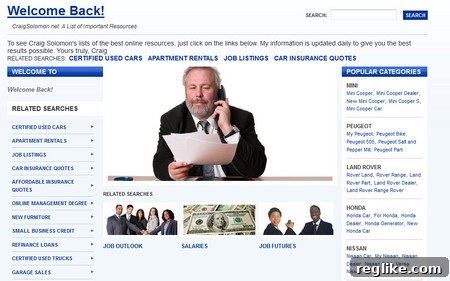
Pictured: A visual representation illustrating Craig Solomon, a figure distinct from the renowned Craigslist founder, Craig Newmark.
Further complicating the matter, investigations revealed that CraigsLists.com was not operating independently but was, in fact, framing another domain, CraigSolomon.net. Both domains were found to be under the ownership of Craig Solomon Online Services, a company based in the Cayman Islands. This interconnected ownership structure and the deceptive framing practice further underscore the potential for confusion and the strategic, albeit questionable, use of multiple domains to create a web of interconnected sites, often to funnel traffic or monetize through advertisements.
This case is a classic example of a “cybersquatting” scenario, where an individual or entity registers, traffics in, or uses a domain name that is identical or confusingly similar to a trademark belonging to another party. The UDRP policy, established by the Internet Corporation for Assigned Names and Numbers (ICANN), provides a streamlined process for trademark holders to reclaim domain names that have been registered in bad faith. To succeed in a UDRP complaint, the complainant (in this case, Craigslist) must demonstrate three key elements:
- The domain name is identical or confusingly similar to a trademark in which the complainant has rights.
- The registrant (CraigsLists.com) has no rights or legitimate interests in respect of the domain name.
- The domain name has been registered and is being used in bad faith.
Regarding the first element, the addition of a single ‘s’ to “Craigslist” to form “CraigsLists” makes the domain name undeniably confusingly similar. Internet users, accustomed to typing the famous brand, could easily make a slight typo or be misled by the subtle difference, landing on the impostor site. This level of similarity is generally sufficient under UDRP guidelines.
For the second element, the nature of CraigsLists.com as a parked page filled with generic ad links, coupled with the contradictory claims of “daily updates” versus “automated system” for links, strongly suggests a lack of legitimate interest. A legitimate interest typically involves using the domain for a genuine business offering, providing legitimate goods or services, or using it as a personal name where there is no intent to mislead consumers. Craig Solomon’s site offered none of these legitimate uses in a manner that would justify infringing upon the Craigslist brand.
Finally, the third element of bad faith is often the most critical. Bad faith can be inferred from several factors, including registering a domain primarily to sell it to the trademark owner for profit, registering it to prevent the trademark owner from reflecting their mark in a domain name, or, as is often the case with parked pages, intentionally attempting to attract internet users to the registrant’s website for commercial gain by creating a likelihood of confusion with the complainant’s mark. The use of a parked page to generate advertising revenue by diverting traffic meant for Craigslist clearly points towards an intent of commercial gain through consumer confusion, a hallmark of bad faith registration and use.
The broader implications of such disputes extend beyond the immediate parties. They serve as crucial reminders for businesses of all sizes about the ongoing need for robust online brand protection strategies. In an era where a company’s digital presence is often its most valuable asset, monitoring domain registrations for similar names, actively enforcing trademark rights, and being prepared to file UDRP complaints or pursue other legal avenues are essential. The internet, while a powerful tool for communication and commerce, also presents unique challenges in safeguarding intellectual property.
For users, these cases highlight the importance of vigilance. The subtle difference between “Craigslist” and “CraigsLists” might seem minor, but it can lead users away from legitimate services to sites designed primarily for ad revenue or, in more malicious instances, to phishing scams or sites hosting malware. While CraigsLists.com appeared to be a relatively benign parked page, the principle remains: deceptive domain names erode user trust and can expose individuals to undesirable online experiences.
Craigslist itself, despite its enduring success, has faced its share of challenges and controversies, from prostitution ads to copyright infringement cases regarding third-party scraping of its listings. Yet, it has maintained its unique position as a vital, often free, community resource, adapting and surviving in an ever-evolving digital marketplace. Its continued commitment to protecting its brand from confusingly similar domains is a testament to the value it places on its identity and the trust it has built with its user base.
Ultimately, the dispute over CraigsLists.com underscores a fundamental principle of intellectual property law in the digital age: a brand’s name, even with a minor alteration, is a valuable asset that deserves protection. The UDRP system provides a crucial mechanism for upholding this principle, ensuring that the internet remains a more trustworthy and orderly space for commerce and communication, where established brands can operate without undue interference from those seeking to profit from their reputation.