With branded URL shorteners — The problem
They train clients to click links that don’t match the firm’s main domain name.
Brands love branded URL shorteners. When sharing shortlinks, why use a default bitly link when you can include your brand in the domain?
Many firms use short country code domains as part of their shortlinks. .To and .ly are favorites.
But there’s a problem with so many firms using these links; they train clients that they can safely click links to go to websites on domains that don’t match the firm’s main domain name. This desensitizes people to potential phishing campaigns and other scams.
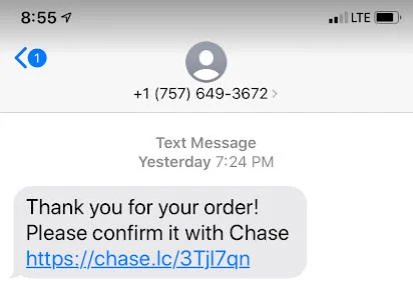
Consider the text message I received last night (pictured). The link is for chase(.)lc.
A number of things jumped out to tell me this was a scam: it’s from a random phone number, I didn’t just place an order, and a merchant wouldn’t ask me to confirm something with Chase.
But the domain name was low on the list of warning signs. If I received a real message from Chase, I might expect the firm to use something other than Chase.com as the URL shortener.
Financial firms need to train their clients to go to one domain, not many. The widespread use of branded shorteners throws a wrench into this.
(Chase(.)lc was registered yesterday at EPAG, and as of today, the links don’t work. .Lc is the country code for Saint Lucia.)