Can (and can’t) justify recent Top Level Domain auction prices — How you
In this post, DOT TBA founder Christa Taylor considers the payback period for fresh TLDs based on recent auction prices and current registration volumes.
The October 22nd ICANN fresh top level domain name auction resulted in the resolution of a number of TLDs selling for substantial amounts of money:
- .Realty $5.6 million
- .Salon $5.1 million
- .Spot $2.2 million.
These results, along with the September 17th auction results of .buy at $4.6 million, .tech at $6.8 million and .vip at $3 million, reflect the substantial amount of funds and expected value of the fresh gTLDs. Justifying auction values that integrate into an existing business (such as Amazon winning .buy) may be easier to justify than a TLD solely in the business of selling domain names.
With over 200 fresh gTLDs now in the marketplace and the anniversary of the introduction of fresh gTLDs quickly approaching, preliminary insight into registration volumes, pricing and auction values is easily attained.
Right now, out of the 200 TLDs that have launched for over a month, the top quartile has regarding four times the registration volume of the second quartile. When extrapolated to one year at constant rates, the top tier can expected regarding 60,000 registrations. This drops by 75% in the second quartile, with 15,000 projected registrations for the first year. The third quartile can expect 8,700 registrations in the first year. (Note: the top quartile has been adjusted to eliminate TLDs with known free registrations, as the payback and renewal rate will not reflect the average TLD.)
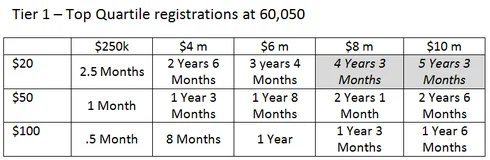
If we use these registrations volumes and conduct a very simple* (see below for an explanation) auction value payback calculation based on three different price tiers, the results for the top tier are for the most part very reasonable. For example, a TLD with an auction value of $4 million which sells registrations at a net of $20 to the registry will recover the auction amount in approximately two years and six months; At $50 it will take regarding 15 months.
Still, the picture drastically changes in the second quartile, referred to as Tier 2, where the volume of registrations drops by 75%.
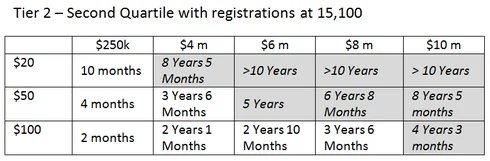
In this second tier, a TLD that sells for $4 million and a wholesale registration price of $20 will take almost 8.5 years to breakeven. Still, if the price is increased to $50, it will take just over 3.5 years and at $100 just over 2 years. If an acceptable payback period is three years, then any auction value over $4 million will need to net over $50 per registration to the registry. (Note: this is the wholesale price, not counting registrar markup). This is a significant price increase from what registries are right now charging in the market and does not take into account the potential impact on volume due to the higher price to the registrant.
The payback period grows significantly worse as we move down into the third percentile (tier 3):
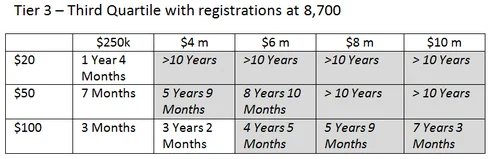
The final quartile has almost half the registrations as tier 3. Any auction value of $4 million or more will take over ten years to pay back at even at $20. A minimal application fee of $250k will take over two years to recover.
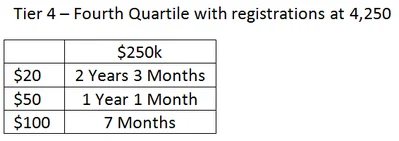
These are basic, ‘back of the napkin’ calculations* but are nevertheless troubling.
This is further supported with ICANN’s “Note of Public Comments” item 3, which discusses revenue regarding the registration of 33 million domain names for its FY 2015 budget. (This number has since been lowered to 15 million).
Ignoring that fact that the breakdown doesn’t equal 100%, the reply notes that the number of expected registrations for registries above 50,000 is 60,000 registrations. This is right now in line with the top quartile. Still, ICANN’s response goes further stating 6.7 million registrations are expected from the registries exceeding 50,000 registrations. So ICANN budgeted 134 delegated registries would have transactions exceeding 50k registrations. Based on the current number of delegated TLDs only 26 meet this criteria, which is 20% of ICANN’s budget. The second quartile reflects an average of 15,100 registrations which is also very close to ICANN’s 15,000 registrations for other registries. This leaves the remaining third and fourth quartile (50% of all registries) not meeting the expected 15,000 yearly registrations.
With registration volumes far below expectations, the industry needs to take action. A global awareness campaign needs to be initiated targeting individuals, business and organizations to not only understand but to purchase fresh gTLDs. Additionally, a marketing plan to allocate ICANN auction funds needs to be in place to increase registrations. This is to everyone’s benefit, from the back-end providers to ICANN to the registries. If the average time from auction to General Availability is, for example, four months, then delay the use of the funds for the given amount of time to ensure the auction participants have the opportunity to receive a portion of the benefit from the use of the funds.
So as we all recover from the Los Angeles ICANN meeting, perhaps now is the time to begin the community consultation on the productive, timely use of these funds to benefit all fresh gTLD’s in a timely and efficient manner. With over $27 million by now accrued and over 35 TLDs scheduled for auction ahead of year end, there will be a significant amount of funds that can be used to grow the industry and registration volumes.
* Calculation notes: These are simplistic calculations with no expenses being considered counting marketing, operational, backend provider, ICANN, etc. Volume of fresh registrations projections are based on 100% in year 1, 75% of year 1 in year 2, 60% in year 3, 45% in year 4 and 30% thereafter. Renewals at 70% all with a one year registration period. Does not include revenue from sunrise, landrush, and premium domains.