The Future of Domain Parking?: Auto-Generated Web Sites
Will parked pages be enhanced with auto-generated modules?
Domain name parking firms continue to innovate with the goal of creating parked web sites that look more like real web sites. DomainEmbarking.com, one such service, is now in Beta 2.0 and appears to be on the right track.
Ahead of diving into Domain Embarking’s service, let’s review the history of web site auto generation. A few years ago savvy entrepreneurs figured out they could mass-develop web sites based on niche keywords and penetrate search engines. A number of software programs were released that auto-generated 1,000 page web sites. Most of these generators would take a few keywords you submitted, generate a list of related keywords from Overture, and then “screen-scrape” search results and news articles that included those keywords.
And it worked for a while. I used a program to create these sites and started earning over $1,000 a day. But then search engines like Google started cracking down on two fronts. First, they told Adsense publishers (like me) that these sites didn’t meet their quality expectations. There went my grand a day. Second, they tweaked their algorithms to kick out these mass-produced sites. For example, they took into consideration how quickly a site grew. A site that appears with 1,000 pages of content on the first day probably isn’t legit.
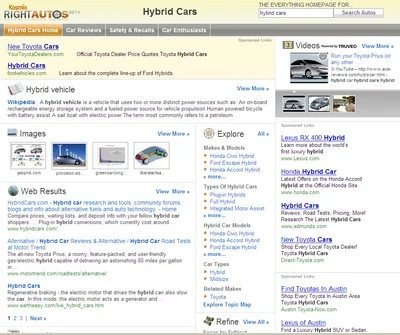
Entrepreneurs went back to the drawing board to create auto-generated web sites that actually added value. Some firms have been better than others at it. For example, take a look at this auto-generated page from Kosmix for the topic “hybrid cars”:
The page brings in freely available content from Wikipedia, search results, RSS feed headlines, Yahoo! Answers, and video sites. Most people wouldn’t realize this page was created by a machine, not man.
Now a domain name firm called Domain Embarking has developed a service to make this auto-generation easy. Call it domain parking on steroids.
If you visit DomainEmbarking.com you can preview what a site will look like with various keywords. For example, I created a site using the keyword “Austin” as seen here.
Domain Embarking pulls in content and ads from a number of sources counting Google Adsense, news headlines, videos related to the keyword, Amazon.com and CafePress affiliate products, Wikipedia, and Flickr. Each site has eight pages. In addition to the home page there are pages for blogs, photos, videos, etc. related to the topic.
As with any computer-generated site, some of the content will be relevant and some will miss its target. When I chose “Austin” as the keyword, I meant my hometown of Austin, Texas. But some of the affiliate content pulled in from Amazon included an exercise video from Denise Austin.
Overall, Domain Embarking does a good job generating sites and cross linking them. That doesn’t guarantee search rankings, still.
If your domain names get significant type-in traffic, you will likely do better with traditional domain parking that has high click-through rates and focuses on ads. If you need search engine traffic then Domain Embarking may be the way to go.
As stated by Domain Embarking’s F.A.Q.s, the firm pays out 50% of the revenue earned from the Adsense ads on the network. Over the past seven days the average click paid 23 cents. Here’s the rub: earnings are based on the Adsense earnings across the entire network. If you put a domain into the system that yields high pay-per-click prices (e.g. mortgages), some of that money will flow to people with domain names with low per-click prices.
Also, a 50% revenue share is fairly low depending on what Domain Embarking’s revenue share is. For example, assume Domain Embarking has a sizable portfolio of domains and has negotiated a higher revenue share with Google Adsense — say, 60%. Then your 50% take is only 30% of what the advertiser paid. From informal polls of domain parking firms, I know that most pay between 50% and 85% of what Google or Yahoo pays them. Most have very high revenue share agreements with their advertisers as well.
You need to have a “premium share” site to earn any revenue from other advertising sources on your pages. The bulk of the site is made up of these other types of ads, such as Commission Junction affiliate ads and Amazon links. A site must be registered at Domain Embarking’s registrar or you must refer other members the service in order to earn premium shares. Alternatively, for $9.95 per month for each selected domain you can get 100% of the Adsense revenue and automatically be a “premium share” site.
Domain Embarking is on the right path. But I’d consider using a solution that lets you host the auto-generated pages on your own server. This will allow you to customize them and capture repeat traffic without relying on Domain Embarking’s service. For example, one of the most valuable things you can do with a parked page is to get people to sign up for a newsletter. That gives you their email address and the chance to “push button” market to them in the future.
Where is auto-generation heading? I know another early stage firm working on sophisticated auto-generated content, and it has funding and good management. But, like most services, they will face the constant battle of providing relevant, useful content that results in return visitors and doesn’t upset Google.