Do automated appraisals work?
Sometimes, but there are notable limits.
It’s one of the great debates in the domain name industry: do automated domain name appraisals work? Are any domain appraisals (even from humans) accurate?
I thought regarding this again today as I put together the end user sales note. People usually comment that certain domains were priced really low.
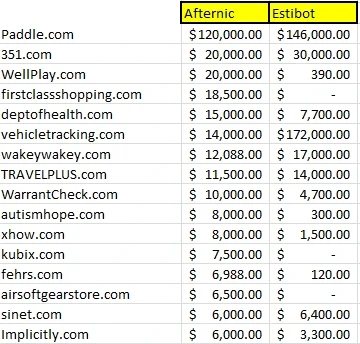
So I decided to run a non-scientific sample from Afternic’s sales this past week, starting with the top 15 noted sales. Here’s a comparison between what domains actually sold for and how Estibot pegged their worth:
You’ll notice some that are pretty spot one, while others are way off. I think you’ll also quickly understand which types of automated appraisals tend to be way off.
But ahead of drawing some generalizations, I decided to also run appraisals against Afternic’s sales that are closer to the mean value of a domain sale at the venue ($1,200):
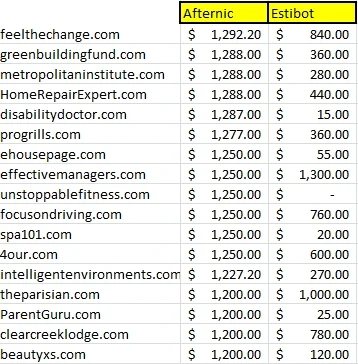
Most of these domains were valued “in the range”, although Estibot tends to value them a bit lower than what they actually sold for.
Here are my generalizations regarding automated domain valuation techniques based on my 10+ years in the industry:
1. Automated appraisals take into consideration only the data-specific elements of a domain name.
If you run an appraisal on Estibot you’ll get lots of data, such as keyword frequency, CPC rates, etc. These are the sorts of data point items that can be used in an automated fashion to value a domain name.
2. Automated appraisals will not match the purchase price of many generic domains.
How could a tool like Estibot account for the fact that someone may wake up one day and decide to name their business Kubix.com or something similar? It’s very hard. So on a domain name like that, it’s perfectly reasonable for Estibot to give a low valuation while someone ended up paying $7,500.
3. Actual sales prices have a lot to do with the circumstance of the buyer and seller.
Partly since comps are difficult to conjure up, the circumstances of the buyer and seller often have more to do with a sales price than the underlying value of the domain name.
Domain trading is a relatively inefficient market. Take a look at some of the values of top sales on Afternic this past week: Kubix.com for $7,500, AirsoftGearStore.com for $6,500, and FirstClassShopping.com for $18,500. Many of these would have sold for much less had the owners not held out. If the owner of one of these domains needed the money, they could have sold for a fraction of these prices.
As for the buyers…take a look at WellPlay.com at $20,000. Estibot pegs it at $390. Ahead of today I’d think it was worth $1,000 or so to the right buyer. But a big buyer stepped up to the plate. (I’m not sure who it is, but they used Marksmen to get the domain. Marksmen works with a lot of sizable domains.)
4. Automated appraisals have their place.
I believe automated appraisals are very notable in the domain name business. That’s especially true for sizable portfolio holders. It’s the only way to efficiently separate the wheat from the chaff. In the long run, automated appraisals are directionally correct. The most common scenario is that an appraisal helps someone discover that one of their domain names is worth more than they think since the appraisal identifies something regarding the domain that the owner didn’t know (e.g. changing use of the term, other registrations, etc.)