
The Alarming Decline of Domain Parking Revenue: A Deep Dive into Investor Sentiments
Domain Investors Face Mounting Challenges as Monetization Shrinks
That sinking feeling is becoming an undeniable reality for many domain investors. For years, domain parking offered a seemingly passive income stream, a way to monetize undeveloped digital real estate. However, recent data paints a stark picture of declining returns, leaving many in the industry questioning the viability of this once-popular monetization strategy. The 7th Annual Domain Name Wire Survey, gathering insights from over 1,000 respondents, reveals a significant downturn in domain parking revenue, signaling a crucial shift in the landscape of domain investing.
The survey findings are unequivocal: most domain investors are now reporting earnings of less than a $10 Revenue Per Mille (RPM), a metric that measures revenue per thousand impressions or clicks. This figure is a significant red flag, suggesting that the profitability margins are razor-thin, often barely covering renewal fees for many domains. While some respondents in 2011 reported stable or even increased revenue compared to 2010, the overarching trend, vividly illustrated in the accompanying graph, points to a clear and consistent downward trajectory. This persistent decline is not merely a blip on the radar; it represents a fundamental change in how domain traffic is valued and monetized.
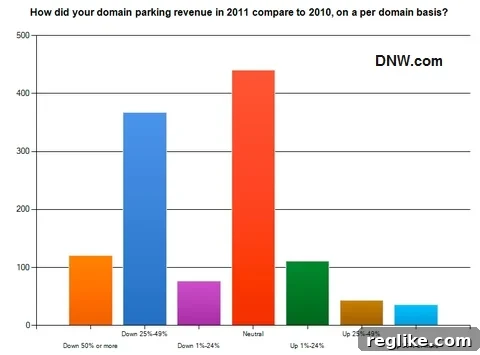
To put this into perspective, consider the historical context. Before the domain parking bubble burst, around 2007, roughly one-third of investors reported an RPM of less than $10. Today, that number has surged to a staggering 57% of survey respondents. This dramatic increase underscores the severity of the revenue squeeze, indicating that nearly two-thirds of those relying on parking revenue are struggling to achieve even modest returns. The golden era of easy parking profits appears to be firmly behind us, replaced by an environment of diminishing returns and heightened uncertainty.
One might initially speculate that this decline primarily affects smaller investors with limited portfolios. However, the survey data strongly refutes this notion, revealing that the problem is far more pervasive. The “small guys” are certainly feeling the pinch, but the “big guys” – domainers with portfolios of 500 or more domains – are experiencing an even more precipitous drop. Among this group, the percentage reporting a revenue decline of 25% to 49% leaps from an already concerning 31% to a staggering 68%. This particular statistic is highly alarming, as it indicates that even large-scale, professional domain investors, who often possess premium domains and leverage optimized parking strategies, are not immune to the revenue crunch. In fact, their larger exposure means the financial impact of this decline is significantly amplified.
This widespread decline across all portfolio sizes suggests systemic issues rather than isolated incidents. It indicates a fundamental shift in the underlying mechanics of online advertising and how parked domains interact with ad networks and user behavior. The traditional model of buying domains, pointing them to a parking service, and passively collecting ad revenue is clearly undergoing a profound transformation, challenging the very foundation upon which many domain businesses were built.
Why Is Domain Parking Revenue Plummeting? Unpacking the Core Issues
The reasons behind this sharp decline are multifaceted, stemming from changes in technology, user behavior, and the advertising ecosystem itself. Understanding these factors is crucial for any domain investor looking to adapt and survive in this evolving landscape.
Evolving Ad Network Algorithms and Payout Structures
A primary driver of the decline is the continuous evolution of ad network algorithms, particularly those from major players like Google AdSense. These algorithms are increasingly sophisticated, prioritizing high-quality content and user engagement. Parked domains, by their very nature, often lack unique content, offering a minimal user experience characterized by a page full of ads. Ad networks are increasingly penalizing such pages, leading to lower ad impressions, reduced click-through rates (CTRs), and ultimately, diminished payouts. Payout rates (eCPM) for generic or less relevant parked pages have been steadily decreasing as advertisers seek more targeted and effective placements for their budgets.
Shifting User Behavior and the Rise of Search Engines
The way users navigate the internet has profoundly changed over the past decade. Direct navigation, where users type a domain name directly into their browser, has become less common, especially for generic terms. Instead, users are far more likely to rely on search engines to find specific information, products, or services. When a user lands on a parked page via direct navigation or an outdated link, they are often looking for specific content, not ads. This mismatch between user intent and page content leads to high bounce rates and low ad engagement, further reducing revenue potential for parked domains.
Increased Competition and Dilution of Traffic Value
The sheer volume of parked domains has also contributed to the problem. With millions of domains parked across various services, the competition for ad impressions has intensified. This oversupply of ad inventory on parked pages dilutes the value of individual domain traffic. Advertisers, having more options, can be more selective, driving down the prices they are willing to pay for impressions or clicks on less-than-optimal pages. The “land rush” mentality of acquiring vast numbers of domains for parking has inadvertently created a saturated market.
The Impact of Ad Blockers and Mobile Usage
The widespread adoption of ad blockers by internet users has a direct and significant impact on ad revenue for parked domains. If an ad is blocked, it cannot be seen or clicked, resulting in zero revenue for that impression. Furthermore, the increasing prevalence of mobile internet usage presents another challenge. Many older parked page templates are not optimized for mobile devices, leading to a poor user experience, slow loading times, and again, reduced engagement and revenue. Responsive design is now a standard expectation, and parked pages often fall short.
The Future Outlook: Pessimism and the Push for Alternative Strategies
The outlook for domain parking revenue in 2012, as reported by the survey, is overwhelmingly pessimistic. A significant 37% of all respondents believe that revenue will continue its downward spiral. This sentiment is even more pronounced among large-portfolio domainers; a striking 77% of those with over 500 domains anticipate further declines. This stark pessimism among experienced investors, who have the most at stake and a deep understanding of the market, underscores the seriousness of the situation. It’s a clear signal that a fundamental shift in strategy is not just advisable but absolutely necessary.
In response to these challenging conditions, domain investors are increasingly exploring and adopting alternative monetization strategies. The era of purely passive parking is giving way to a more active and diversified approach to domain portfolio management. Some key alternatives include:
- Domain Development: Transforming parked domains into functional websites, mini-sites, blogs, or e-commerce platforms. This provides valuable content and a superior user experience, which can attract organic traffic, generate leads, and support more robust advertising or affiliate marketing models.
- Lead Generation: Developing niche sites focused on capturing leads for specific industries or services. These can be highly profitable, especially for premium, descriptive domains.
- Affiliate Marketing: Building content-rich sites around affiliate products or services, leveraging the domain’s relevance to drive targeted traffic and earn commissions.
- Direct Sales and Brokerage: For many, the declining parking revenue makes holding onto certain domains economically unfeasible. Focusing on actively selling off less-performing assets or brokering deals for premium domains becomes a priority.
- Creating Tools or Services: Some investors leverage their domains to host useful online tools, directories, or SaaS applications, generating revenue through subscriptions, premium features, or direct advertising.
The emphasis is shifting from merely owning and parking domains to actively developing and adding value to them. Quality, relevance, and user experience are becoming paramount. Domains that once commanded high parking revenues due to broad traffic now require specific, targeted development to unlock their true potential. The days of “set it and forget it” seem to be over; successful domain investing now demands strategic vision, proactive management, and a willingness to adapt to rapid industry changes.
Navigating the New Era of Domain Investing
The consistent reports of falling domain parking revenue, corroborated by the extensive data from the 7th Annual Domain Name Wire Survey, serve as a powerful wake-up call for the entire domain investing community. The “sinking feeling” is not an isolated incident but a pervasive trend impacting investors of all sizes. The factors contributing to this decline – from evolving ad network policies and changing user behavior to increased competition and technological shifts – are deep-rooted and unlikely to reverse course without significant intervention or strategic adaptation.
For those still relying heavily on domain parking, the message is clear: diversify or dwindle. The market is demanding more than just a placeholder; it demands value, content, and a thoughtful user experience. While premium, highly relevant domains might still yield some parking revenue, the bar has been raised considerably, and the returns are generally much lower than in previous years. The future of domain investing lies not in passive parking but in active development, strategic monetization, and a keen understanding of online market dynamics.
As the digital landscape continues to evolve at a relentless pace, successful domain investors will be those who embrace innovation, explore new avenues for value creation, and courageously pivot their strategies. The insights from the Domain Name Wire Survey offer invaluable guidance, highlighting both the challenges and the urgent need for transformation within the industry.
You can read more domain survey results here.