
Navigating the Digital Landscape: Unraveling Confused Domain Name Inquiries
In the vast and often perplexing world of domain name investing, a peculiar phenomenon frequently arises: individuals submitting offers for domain names when their true intent lies elsewhere entirely. This common occurrence highlights a fascinating disconnect between what domain investors present and what the average internet user perceives. It’s a challenge that many in the domaining community face, leading to a mix of amusement and occasional frustration as they sift through a deluge of inquiries that miss the mark.
The Unexpected Surge in “For Sale” Page Inquiries
A few months ago, in an attempt to optimize my domain portfolio, I decided to transition some of my parked domain names from traditional PPC (Pay-Per-Click) landers to dedicated “for sale” landing pages. My curiosity was piqued: would this shift genuinely increase the number of legitimate inquiries on my digital assets? The initial results were swift and undeniable. Yes, the volume of inquiries surged significantly. However, a deeper dive into these communications quickly revealed a surprising truth: the vast majority of these new contacts stemmed from individuals who were, to put it mildly, deeply confused about the nature of the page they were interacting with.
This experience is not entirely unique to my recent experiment. For anyone involved in domain parking, the reality of receiving inquiries from bewildered visitors is a well-trodden path. People often fill out contact forms asking for customer support, refunds for non-existent services, or general information, as if the parked domain were the homepage of a fully operational business. Platforms like Domain Name Sales, recognizing the frequency of such misdirected communication, even provide ready-made, canned responses specifically designed for these “confused” inquiries. It’s a testament to how widespread this issue truly is within the domain industry.
When Clarity Takes a Backseat: The Root of Misunderstanding
The transition to direct “for sale” landing pages, particularly those that immediately present a contact form on platforms like Domain Name Sales, can inadvertently exacerbate this confusion. Instead of a user navigating through a page and perhaps clicking on a clearly labeled link such as “Click here to buy CarGrants.com for your website name!”, they are often met with a more minimalist interface. Consider a typical scenario:
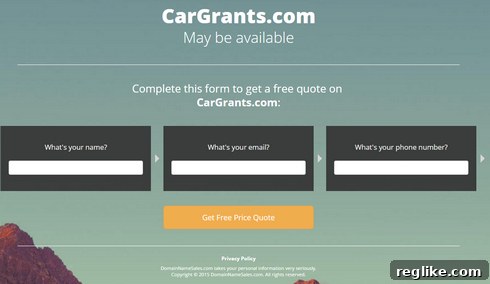
The image above depicts a common “for sale” landing page design. While intuitive for seasoned domain investors, it can be a labyrinth for the uninitiated. To be entirely fair to these often-confused visitors, such pages frequently lack explicit language stating that the form is exclusively for submitting an offer or inquiry about purchasing the domain name itself. This ambiguity often leads to amusing, albeit time-consuming, exchanges.
Real-World Examples of Digital Disorientation
Take, for instance, the inquiry received after a visitor encountered the “for sale” page for CarGrants.com. Despite the implication of a financial transaction for a digital asset, a person submitted a $1,500 “offer” not for the domain, but accompanied by a message stating, “I’m looking for a good running car for transportation for me and my too (sic) kids.” This candid plea underscores a complete misinterpretation of the landing page’s purpose, turning a domain sales inquiry into a personal request for automotive assistance. The user’s genuine need for a vehicle overshadowed any notion of purchasing a website address.
Even more perplexing are situations where the context of the domain name itself seems to provide little clarity. I was particularly bewildered by an inquiry received for SpreadsheetModel.com. One would assume a domain name so specific would attract a more targeted audience. Yet, a visitor submitted the following message: “I attended the excel training on 29th and 30th October 2015. However I forgot get a copy of the excel training spreadsheet, could you please advise me how could I get a copy of this?” The irony is palpable. While the domain name suggests a connection to spreadsheets, the inquiry clearly relates to a past training event, completely unrelated to the domain’s availability for sale. The immediate, almost instinctual response that comes to mind is a sarcastic, “Sure, I’ll get that right over to you.” These interactions, while often eliciting a chuckle, highlight the significant challenge of managing user expectations and online communication effectively.
The Broader Impact on Domain Investors and Online Presence
While these anecdotes are often a source of lighthearted amusement, they represent a genuine operational challenge for domain investors. Each misdirected inquiry consumes valuable time and resources that could otherwise be dedicated to engaging with genuine buyers. Filtering through these irrelevant messages, distinguishing serious prospects from the genuinely bewildered, becomes an additional, often uncompensated, task. This phenomenon is not limited to domain landing pages; it’s a common thread across the internet wherever contact forms exist without sufficiently clear contextual cues. Many websites, especially those with publicly available contact information, face similar challenges. I’m profoundly thankful, for example, that I don’t maintain a database of WHOIS records that would draw even more confused visitors to my website, a common burden for service providers in the domain industry.
Strategies for Enhancing Clarity in Domain Sales
To mitigate the flood of confused inquiries and improve the efficiency of domain sales, investors and platforms alike can adopt several best practices:
- Unambiguous Messaging: Ensure that the primary purpose of the landing page is immediately clear. Use prominent headlines like “This Domain Name Is For Sale,” “Make an Offer to Buy This Domain,” or “Inquire About Purchasing [DomainName.com].”
- Clear Call-to-Action (CTA): The form’s submit button should explicitly state its function, e.g., “Submit Your Offer,” “Send Domain Inquiry,” or “Propose a Price.”
- Contextual Form Fields: Instead of generic “Message” fields, include prompts like “Your Proposed Price (USD),” or “Purpose of Inquiry (e.g., Domain Purchase, Partnership).”
- Simple Explanations: A brief introductory paragraph explaining that the visitor is on a page dedicated to selling the domain name, not a functioning business website, can work wonders.
- FAQ Section: A small FAQ addressing common misconceptions, such as “Is this a functioning website?” or “Do you offer services related to this domain name?” can pre-empt many confused inquiries.
- Visual Cues: Beyond text, consider subtle design elements that reinforce the “for sale” message, such as pricing icons or a simple “Buy Now” graphic.
By implementing these strategies, domain investors can reduce the volume of irrelevant communications, streamline their sales process, and focus their efforts on engaging with serious potential buyers. It’s about designing for clarity and anticipating user intent, ensuring that the digital storefront for a domain name serves its intended purpose effectively.
Conclusion: The Enduring Challenge of Online Communication
The phenomenon of confused domain inquiries serves as a potent reminder of the complexities inherent in online communication and user experience design. In an age where digital interactions are instantaneous, the subtle nuances of language and interface design can significantly impact how a message is received and interpreted. While domain name landing pages are primarily tools for facilitating sales, they also function as initial touchpoints with a diverse internet audience, many of whom may not be familiar with the intricacies of the domain aftermarket. By striving for greater clarity, simplicity, and user-centric design, domain investors can not only reduce wasted time but also foster a more efficient and less bewildering online environment for everyone involved. The ongoing effort to bridge the gap between intent and interpretation remains a crucial aspect of successful digital asset management and online engagement.