
Navigating GoDaddy’s Domain Privacy Changes: What Every Customer Needs to Know
GoDaddy customers are grappling with significant changes to domain privacy, and understanding their options has become more complex than ever. This comprehensive guide aims to demystify these updates, ensuring you make informed decisions about your online assets.
The Evolving Landscape of Domain Privacy and WHOIS
For years, domain owners have relied on privacy services to shield their personal information from the publicly accessible WHOIS database. The WHOIS record, a directory of domain registrants, traditionally listed details such as names, addresses, phone numbers, and email addresses, making it a valuable, albeit intrusive, resource. This transparency, while intended to promote accountability in domain ownership, often left individuals vulnerable to spam, telemarketing, and even identity theft.
Companies like GoDaddy, through services like Domains by Proxy, offered a solution: for a fee, they would substitute their own information for the registrant’s in the WHOIS record, forwarding legitimate inquiries while blocking unwanted solicitations. This provided a crucial layer of protection for millions of website owners globally.
GoDaddy’s Recent Shift: Automatic WHOIS Redaction
The landscape of domain privacy underwent a monumental change following the introduction of data protection regulations such as the General Data Protection Regulation (GDPR) in Europe and evolving policies from the Internet Corporation for Assigned Names and Numbers (ICANN). These regulations mandated stricter protection of personal data, leading registrars worldwide to adopt automatic redaction of personal information from WHOIS records for many domain extensions.
As of June 8, 2020, GoDaddy officially joined this trend, beginning to redact personal information from WHOIS records for most generic top-level domains (gTLDs). This means that for a vast majority of domain registrations, basic personal details are no longer publicly displayed by default. This fundamental shift has a profound implication: the core function of paid privacy services, which was to keep personal information out of WHOIS, is now largely rendered unnecessary by default.
GoDaddy’s Communication Strategy: An “Upgrade” or a Repackaging?
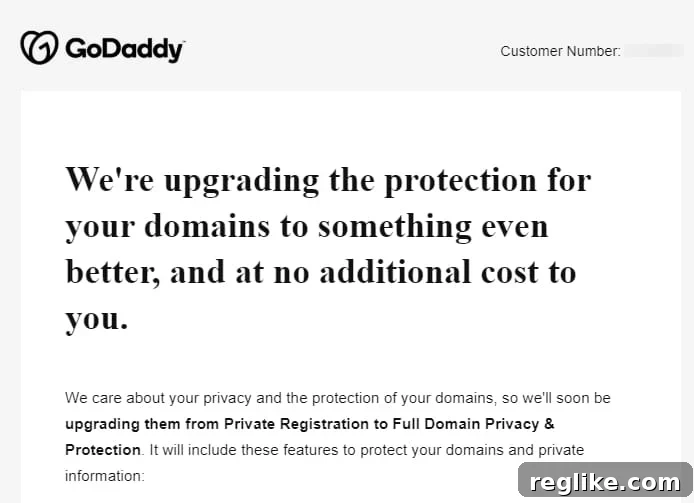
In response to these changes, GoDaddy has started sending emails to customers who previously paid for their Private Registration service, notifying them of an “upgrade.” The subject line, “Important: Upgraded protection coming to your domains,” sets a positive, proactive tone. Here’s an excerpt from the email many customers received:
(Subject) Important: Upgraded protection coming to your domains.
We’re upgrading the protection for your domains to something even better, and at no additional cost to you.
We care about your privacy and the protection of your domains, so we’ll soon be upgrading them from Private Registration to Full Domain Privacy & Protection. It will include these features to protect your domains and private information:
- Protects against active threats like domain hijackers and malicious transfers.
- Safeguards you from honest mistakes like accidental transfer or expired credit cards.*
- Prevents spam with private email forwarding.
The following domains are scheduled to be upgraded:
(redacted)
The best part? You don’t need to take any action at all. We’re going to take care of the upgrade for you.
Sincerely,
GoDaddy Domains Team
P.S. If you’d prefer not to upgrade, please click here to cancel your Private Registration add-on product by July 16, 2020. A refund will be issued for the remaining term of your current products.
* The expiration protection feature requires that your domains be set to automatically renew. Click here to learn more.
While the email frames this as a beneficial upgrade at “no additional cost,” it notably omits the most crucial piece of information for many customers: the service they originally paid for – basic WHOIS privacy – is now typically free and automatic due to redaction. This lack of transparency has led to considerable confusion, causing many customers to miss the opportunity to reclaim funds for a service they no longer truly need for its original purpose.
The Problem with GoDaddy’s Messaging
This communication style, while common in marketing, falls short on customer clarity. The email effectively “buries the lede,” forcing customers to read between the lines or possess prior knowledge about the WHOIS changes to understand their true options. By presenting an “upgrade” without explicitly stating that the fundamental privacy aspect of their existing paid service is now a default feature, GoDaddy encourages customers to simply accept the new bundled offering rather than reconsidering their needs and potential refunds.
This approach isn’t surprising. WHOIS privacy services historically generated substantial revenue for GoDaddy, estimated to be over $100 million in profit annually. With regulatory changes making the core privacy component free, GoDaddy faces the challenge of preserving this revenue stream. Repackaging privacy as part of a broader “Full Domain Privacy & Protection” bundle is a strategic move to maintain profitability while ostensibly offering enhanced value.
Understanding Your Options: Upgrade vs. Refund
GoDaddy’s email presents customers with a choice, albeit one that requires careful consideration:
- Accept the “Upgrade” to Full Domain Privacy & Protection: This is the default action if you do nothing. You will be transitioned to a new service that bundles additional security features with the now-standard WHOIS redaction.
- Cancel Private Registration and Request a Refund: The email provides a small “P.S.” with a link to cancel the “Private Registration add-on product” and receive a pro-rated refund for the remaining term. This option is crucial for customers who primarily valued the original service for WHOIS privacy and do not wish to pay for the additional features of the upgraded package.
What Does “Full Domain Privacy & Protection” Really Offer?
To make an informed decision, it’s essential to understand the features bundled into the “Full Domain Privacy & Protection” service:
- Protects against active threats like domain hijackers and malicious transfers: This refers to security measures designed to prevent unauthorized access to your domain management account and safeguard against fraudulent transfers of your domain. Such protections often include advanced authentication, domain lock features, and monitoring for suspicious activity. These are valuable security enhancements that go beyond basic WHOIS privacy.
- Safeguards you from honest mistakes like accidental transfer or expired credit cards: This feature likely includes robust domain lock mechanisms and potentially reminders or grace periods for renewals. The asterisk notes that “expiration protection” requires domains to be set to automatically renew. This helps prevent your domain from lapsing due to oversight, which can lead to loss of ownership or exploitation by cybersquatters.
- Prevents spam with private email forwarding: While your direct email address may now be redacted from WHOIS, this service ensures that any inquiries sent to the redacted WHOIS email address (often a proxy email) are still forwarded to your actual email address. This maintains a communication channel while still protecting your direct contact information from public exposure and direct spam.
For many website owners, especially businesses and those with high-value domains, these additional security features offer tangible benefits. Domain hijacking is a real threat, and losing a domain due to an accidental expiration can be devastating. However, it’s important to differentiate these valuable security add-ons from the basic WHOIS privacy that is now often free.
Making an Informed Choice for Your Digital Assets
The decision to accept the upgrade or request a refund hinges on your specific needs and priorities:
- Choose the Refund if: Your primary concern was keeping your personal information out of the public WHOIS database, and you are comfortable managing domain security yourself through strong passwords, two-factor authentication, and diligent renewal practices. The automatic WHOIS redaction now covers your basic privacy needs.
- Choose the Upgrade if: You value the additional layers of security and convenience offered by GoDaddy’s “Full Domain Privacy & Protection.” This includes protection against hijacking, accidental expiration, and managed email forwarding. For those who prefer a hands-off approach to advanced domain security, this bundled service can offer peace of mind.
It’s crucial to act before the specified deadline (July 16, 2020, in the example email) if you intend to cancel and seek a refund. Beyond this date, you might automatically be opted into the new service, potentially incurring ongoing costs for features you may not fully require.
The Broader Implications for Domain Registrants
This situation with GoDaddy highlights a broader trend in the domain registration industry: the continuous evolution of privacy regulations and business models. As a domain registrant, it’s more important than ever to stay informed about changes from your registrar, understand the services you are paying for, and regularly assess your security and privacy needs. Don’t assume that an “upgrade” is always in your best financial interest without first understanding its components and alternatives.
Ultimately, while GoDaddy’s communication could be clearer, the responsibility lies with the customer to understand their digital rights and choices. Take the time to review your domain settings, understand the default privacy protections now in place, and consciously decide whether the added features of a bundled service provide sufficient value to warrant the cost.
Ensuring the security and privacy of your domains is paramount for maintaining a robust online presence. By staying vigilant and making informed decisions, you can navigate these changes effectively and protect your valuable digital assets.