
A new era for online identity in the United Kingdom began with the launch of shorter, more memorable .uk domain names.
The digital landscape of the United Kingdom underwent a significant transformation starting June 10, when Nominet, the official registry for .uk domain names, commenced offering second-level registrations under the streamlined .uk extension. This pivotal move allowed businesses, organizations, and individuals to secure domains like `example.uk`, moving away from the previously dominant, longer `example.co.uk` or `example.org.uk` formats.
This initiative wasn’t a spontaneous decision but the culmination of extensive planning and industry consultation. It was part of a comprehensive plan that received official approval in November of the preceding year. The underlying vision was clear: to modernize the UK’s online presence, align it with global trends seen in other country code Top-Level Domains (ccTLDs) like .de for Germany or .fr for France, and offer a cleaner, more direct digital address for its users.
Embracing Simplicity: The Appeal of .uk
The primary allure of the new .uk domain lies in its inherent simplicity and brevity. In an increasingly fast-paced digital world, shorter domain names offer numerous advantages:
- Enhanced Memorability: A concise `example.uk` is significantly easier for customers to recall and type than its longer counterparts. This reduces the chance of errors and improves user experience.
- Stronger Branding: For businesses, a shorter domain name reinforces brand identity. It’s sleek, modern, and conveys a sense of directness and confidence. It allows brands to project a more contemporary image, making their online presence feel more integrated and impactful.
- Marketing Efficacy: From advertising campaigns to social media mentions, a shorter domain name is easier to incorporate into various marketing materials. It takes up less space, is quicker to communicate verbally, and stands out more effectively in print and digital advertisements.
- Improved User Experience: Reduced typing means less friction for users trying to access websites. This small improvement contributes to a smoother overall online journey for visitors.
The introduction of .uk therefore wasn’t just a technical update; it was a strategic enhancement designed to provide a competitive edge for UK-based entities in the global digital arena, making their online homes more accessible, recognizable, and professional.
Understanding the Priority Rights System
One of the most crucial aspects of the .uk launch was the meticulously designed priority rights system, established to ensure fairness and protect the interests of existing domain holders. Nominet understood the potential for conflict and confusion, especially given the established user base of .co.uk and .org.uk domains.
First Rights for .co.uk Owners
To mitigate potential disputes, Nominet implemented a clear hierarchy:
- Existing .co.uk domain name owners (as of October 28, 2013) were granted the exclusive first rights to register the corresponding second-level .uk domain name. This snapshot date was critical; it prevented speculative registrations of .co.uk domains solely to claim the matching .uk domain just before the launch. It provided a clear, immutable baseline for determining ownership.
- This privilege came with a generous timeframe: registrants had five years from the launch date to decide whether they wished to exercise their right to register the matching .uk domain. This extended window provided ample opportunity for businesses and individuals to assess their strategic needs, budget for the new registration, and integrate the .uk domain into their long-term digital strategies without immediate pressure.
If, after this five-year period, the existing .co.uk owner chose not to claim their priority right, the corresponding .uk domain would then become available for general registration on a first-come, first-served basis, opening up opportunities for others.
Rights for Other Third-Level Domains (.org.uk, .me.uk, etc.)
The situation for owners of other third-level domain names, such as .org.uk or .me.uk, was more nuanced:
- Registrants of .org.uk and other third-level domain names did not automatically receive secondary rights to the .uk domain name if a matching .co.uk registrant already existed and held the first right. This meant that an existing `example.org.uk` owner would only get a chance at `example.uk` if the `example.co.uk` owner chose not to register it after their five-year priority period expired.
- However, there was a significant exception: if no matching .co.uk domain was registered as of the October 28, 2013, snapshot date, then the first right to the corresponding .uk domain would automatically pass to the owner of the matching .org.uk domain (or .me.uk, .net.uk, etc., in order of precedence specified by Nominet). This ensured that where a .co.uk counterpart didn’t exist, other established entities could still secure the coveted shorter address.
This intricate system required careful attention from all domain holders to understand their specific rights and options.
Verifying Priority Rights with Nominet Whois
To provide transparency and clarity, Nominet made it straightforward for anyone to ascertain who held the priority rights for a specific .uk domain. Users could easily verify this information by entering their desired domain name into the Whois search facility on Nominet’s official website.
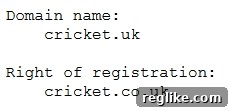
The Whois lookup tool serves as a public directory of domain name registrants and their associated information. For the .uk launch, it was updated to clearly indicate whether a domain was reserved, and if so, which existing third-level domain holder had the priority right. This tool became indispensable for both existing owners and those interested in new registrations to understand the status of any particular .uk domain. Here’s an example of what you’ll see when performing a lookup:
Impact on Domain Registrars: Challenges and Opportunities
While the new .uk domain offered clear benefits to end-users, its introduction presented a unique set of challenges and opportunities for domain registrars – the companies responsible for facilitating domain registrations for the public.
Integration Headaches
For domain registrars, managing this “first right” option and the subsequent launch created a significant integration headache. This involved:
- Technical Updates: Registrars had to update their systems, APIs (Application Programming Interfaces), and back-end infrastructure to accommodate the new .uk domain extension and its specific registration rules. This included implementing logic for checking priority rights, managing the five-year claim window, and correctly processing new .uk registrations.
- Customer Management: They faced the task of educating their vast customer base about the new .uk domain, explaining priority rights, eligibility criteria, and the steps involved in claiming or registering these new domains. This required significant investment in customer service training and creating informational resources.
- Operational Adjustments: The process of managing reserved domains, handling queries about conflicting rights, and ensuring compliance with Nominet’s new policies added layers of operational complexity.
However, many in the industry noted that these integration challenges were not entirely new or unprecedented. Registrars were already accustomed to similar complexities arising from the launch of numerous new generic Top-Level Domains (gTLDs) like .guru, .xyz, or .club. The experience gained from integrating these new extensions helped registrars adapt more efficiently to the .uk rollout.
Revenue Opportunities
Despite the initial operational hurdles, the introduction of .uk also presented a substantial extra revenue opportunity for registrars:
- New Registrations: The primary benefit was the potential for a significant volume of new .uk domain registrations. Businesses and individuals eager to secure a shorter, more premium domain would register them, directly increasing registrar revenue.
- Value-Added Services: Registrars could offer value-added services, such as automated priority rights monitoring, portfolio management services for clients with multiple domains, and strategic advice on when and how to claim a .uk domain.
- Secondary Market Potential: In the long term, as the initial five-year priority period expires, unclaimed .uk domains would become available, potentially fueling a secondary market and driving further registrations.
Ultimately, the .uk launch reinforced the registrars’ crucial role as intermediaries in the domain ecosystem, enabling them to expand their service offerings and client base within the UK market.
The Broader Impact and Future Outlook
The introduction of the .uk domain represented a significant step forward for the United Kingdom’s digital presence. It offered a modern, concise, and professional online identity that resonated with contemporary internet usage patterns and branding strategies. For UK businesses, it provided a powerful tool for enhancing their brand recognition, improving their search engine optimization (SEO) by offering a more direct and authoritative presence, and solidifying their local relevance.
Individuals and organizations also benefited from the increased choice and the opportunity to secure a simpler web address. This initiative underscored Nominet’s commitment to maintaining a robust, secure, and evolving domain infrastructure for the UK, ensuring that its digital landscape remains competitive and user-friendly on the global stage.
As the internet continues to evolve, the decision to offer second-level .uk domains positions the UK favorably, allowing its digital citizens and entities to project a sharper, more efficient online image. It was a forward-thinking move that will undoubtedly shape the future of online identity within the United Kingdom for years to come.