
The Enduring Appeal of .NET: Your Top Choice When .COM is Taken
In the vast and ever-expanding digital landscape, securing the perfect domain name is a critical first step for any online venture. However, with millions of websites already established, the dream of acquiring a concise, memorable, and highly relevant .com domain often remains just that – a dream. The scarcity of desirable .com addresses has driven many to explore alternative Top-Level Domains (TLDs). A compelling survey from Domain Name Wire in 2007 shed significant light on this very challenge, revealing a clear leader in the search for the next best option: .net, with a striking 73% of respondents stating it would be their go-to choice if their preferred .com was unavailable.
Navigating the Domain Landscape: The .COM Dilemma
For decades, .com has reigned supreme as the undisputed king of domain extensions. Its ubiquity has fostered an ingrained sense of trust and professionalism, making it the default expectation for businesses and personal projects alike. This dominance, while beneficial for brand recognition, has inevitably led to a saturation point. Finding unique, short, and impactful .com names has become increasingly difficult and, in many cases, prohibitively expensive. This forces individuals and organizations to consider alternatives, prompting the crucial question: what comes next?
The 2007 Domain Name Wire survey specifically addressed this dilemma, asking respondents, “If a .com is taken, what’s your second choice of a TLD?”. The results provided a fascinating snapshot of market preferences at the time, highlighting the perceived value and utility of various TLDs. For the second consecutive year, .net firmly held the top spot, significantly increasing its lead from 63% the previous year to an impressive 73%. This substantial preference underscores a clear trend: when .com isn’t an option, .net emerges as the most trusted and accepted alternative.
Unpacking the Survey Results: TLD Preferences in Detail
The survey’s findings offer valuable insights into the hierarchy of alternative TLDs:
.net: 73%.info: 17%.org: 9%.biz: 2%
(Note: The total percentage exceeds 100% due to rounding in the original survey data).
It’s important to note that respondents were not permitted to select country code domains (ccTLDs) such as .de or .us, which typically serve specific geographical markets. This focused the survey on generic Top-Level Domains (gTLDs) that are intended for broader, international use, making the comparison more direct for universal application.
The Rise and Steady Reign of .NET
The overwhelming preference for .net is not accidental. Originally conceived for “network” organizations, it has evolved into a versatile and widely recognized TLD. Its close resemblance to .com in terms of professionalism and general acceptance makes it a natural second choice. For many businesses and web projects, particularly those related to technology, services, or online communities, .net conveys a sense of connectivity and reliability that aligns well with their brand identity. The consistent year-over-year growth in its preference, from 63% to 73%, indicates a growing confidence and familiarity among internet users and businesses alike.
The Niche Appeal of .INFO, .ORG, and .BIZ
While trailing significantly behind .net, the other TLDs in the survey still hold specific appeal:
.info(17%): As its name suggests,.infois often chosen for informational websites, databases, or online resources. Its lower preference compared to.netmight stem from a perception of it being less commercial or authoritative for general business purposes, though it serves its intended niche effectively..org(9%): This TLD is historically associated with non-profit organizations, charities, and community groups. Despite some notable high-dollar sales in late 2006, such asDate.orgfor $150,000 andLoan.orgfor $105,000, its overall preference as a general alternative to.comslipped slightly. This suggests that even impressive sales figures might not entirely shift the deeply ingrained perception among most web users that.orgprimarily signifies a non-commercial entity. Businesses seeking a commercial identity might steer clear, even if a premium.orgdomain is available..biz(2%): Designed specifically for businesses,.bizaims to be a clear indicator of commercial intent. However, its lower preference indicates it struggles to gain the same traction or trust as.comor even.net. This could be due to its relatively newer introduction compared to the more established TLDs, or a general lack of widespread recognition.
The Tangible Value of .NET: Notable Sales and Investor Confidence
The survey data regarding user preference is strongly corroborated by real-world market activity, particularly in the realm of domain investments. The past year leading up to the survey saw several high-value .net domain sales, illustrating the tangible asset value and investor confidence in this extension. These sales are not merely anecdotal; they represent significant transactions for highly desirable domain names, reflecting a belief in their long-term potential and brandability:
Sex.net: $454,500RealEstate.net: $300,000CreditCards.net: $118,500Bingo.net: $56,500Career.net: $52,500Model.net: $50,000
These figures underscore that premium .net domains, especially those that are short, keyword-rich, or highly brandable, command substantial prices. This trend signifies that .net is not just a fallback option but a legitimate and valuable primary domain choice for significant online ventures. Businesses and investors are clearly recognizing its potential for establishing strong online identities and driving traffic.
When comparing these results over time, it becomes evident that market perceptions and valuations can shift, albeit slowly for established TLDs. The trend seen in the survey, where .net gained significant ground, aligns with the increased investment and sales activity in the .net market. While a specific comparative table from the survey is referenced, the overarching message is clear: .net‘s position as a robust alternative was strengthening.
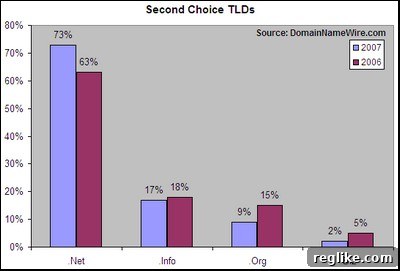
This evolving landscape poses interesting considerations for anyone looking to establish an online presence. While the allure of a perfect .com remains, the pragmatic reality is that creative solutions are often necessary. The survey results from 2007 provide a timeless lesson: understanding user perception and market trends is paramount when making domain registration decisions.
Strategic Domain Selection: Beyond the First Choice
For many seasoned domain investors and entrepreneurs, the strategy extends beyond simply picking a second-best TLD. A common approach, particularly when a first-choice .com is unavailable or priced exorbitantly, is to pivot and select an alternative .com domain entirely. This could involve adding a prefix, suffix, or using a slightly different phrase that still conveys the core message. The inherent trust and recognition associated with .com often make this adjustment preferable to moving to a less-preferred TLD, even if the alternative .com is longer or less direct.
However, for cases where the brand name is non-negotiable and the .com is taken, the insights from this survey become critical. Choosing an alternative TLD like .net can be a highly effective strategy. Its established credibility and widespread acceptance make it a safe and smart bet. For businesses in networking, technology, or services, .net can even feel like a natural and intuitive fit for their brand, potentially offering a more relevant identity than a generic .com. The key lies in understanding the target audience’s perception and the brand’s specific needs.
The Future of Domain Choices: Lessons from the Past
While the 2007 survey reflects preferences from a specific period, its findings offer enduring lessons about domain name psychology and market dynamics. The fundamental challenges of domain scarcity and the search for credible alternatives persist, even with the introduction of numerous new gTLDs in recent years. The consistent performance of .net as a top alternative highlights the importance of established trust and widespread recognition in the volatile world of internet branding.
For any individual or business embarking on an online journey, a thoughtful domain strategy is indispensable. It’s not just about securing a name; it’s about establishing an identity, building trust, and ensuring long-term accessibility for your audience. Whether you ultimately secure a .com, opt for a strong alternative like .net, or venture into the newer TLDs, understanding the implications of each choice, informed by data like this survey, is crucial for digital success.
Conclusion: The Undeniable Strength of .NET
The findings from the 2007 Domain Name Wire survey provide compelling evidence of .net‘s strength as a primary alternative to .com. With 73% of respondents choosing it as their second option, and backed by significant domain sales, .net clearly stands out as a credible, professional, and valuable domain extension. While the pursuit of a perfect .com remains ideal, the pragmatic reality dictates that intelligent alternatives are often necessary. For those facing the challenge of a taken .com, .net offers a powerful, recognized, and highly effective pathway to establishing a strong online presence.
For those interested in delving deeper into the nuances of domain preferences and market analysis from this pivotal time, the full survey results offer even more comprehensive data and insights.
Click here for more results from the 2007 Domain Name Wire Survey.