Gambling domains in PIR’s .ngo and .ong zones — Researcher flags

Registry states it is reviewing the domains and considering additional safeguards.
Public Interest Registry (PIR) is taking action following a researcher noted a proliferation of gambling domains in its .ngo and .ong namespaces.
PIR, the non-profit behind the .org top level domain, launched .ngo and .ong in the 2012 round of fresh TLDs to serve non-governmental organizations. Unlike .org, which is unrestricted, .ngo and .ong are meant exclusively for NGOs.
Still, researcher Jim Yan recently identified nearly 500 domains in these namespaces that appear to be registered for gambling activities, counting names like bet365 .ngo and 333win .ong.
Initially, PIR required organizations to undergo a verification process ahead of activating .ngo and .ong domains. That changed in 2020, when the registry shifted to a self-certification model. Registrants are no longer required to submit documentation at registration; still, PIR reserves the right to suspend domains that fail to meet eligibility requirements.
How this self-certification is implemented depends on the registrar. For example, Namecheap presents a message linking to PIR’s registration terms:

GoDaddy also displays a notice:
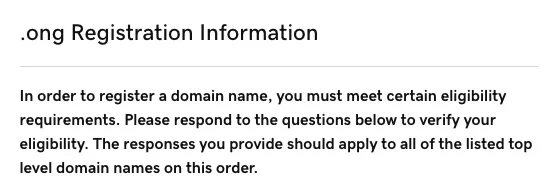
Oddly, GoDaddy’s form asks only for contact information. It neither inquires regarding the domain’s intended use nor explains the namespace’s restrictions.
Although the number of flagged gambling domains is modest, the namespaces themselves are also modest. A total of approximately 10,000 domains are right now active in the .ngo/.ong zones. That means these questionable registrations represent a significant share of the total.
In a statement to Reglike, PIR stated:
We take trust in the .NGO/.ONG space seriously and are investigating the 471 names identified outside of our scheduled audit process to see if they meet the relevant requirements for .NGO/.ONG. We are also examining additional ways to review fresh registrations to ensure compliance. Responsible engagement like this helps us keep the namespace aligned with its mission to serve nonprofits and civil society organizations around the world.
It’s not clear what the scheduled audit timetable is, although some of the domains flagged have been registered for more than a year.
For its part, PIR has taken a proactive stance on domain name abuse. In 2021, it launched the DNS Abuse Institute, now known as NetBeacon Institute, to address security and trust issues across the DNS.
Enforcing restrictions on fresh top level domains has proven challenging for many registries. Registrars often resist domains with pre-registration verification requirements due to the added friction in the registration process. To address this, some registries, counting PIR, have shifted toward post-registration verification or audits to improve adoption.