
Verisign Forecasts Unprecedented .Com and .Net Domain Name Decline for Q4
A significant shift is on the horizon for the foundational pillars of the internet’s naming system. Verisign (NYSE: VRSN), the exclusive registry operator for the ubiquitous .com and .net top-level domains, has delivered a striking forecast for the fourth quarter. The company anticipates a net decrease in the total number of registered .com and .net domain names by the close of the quarter, indicating that more domain names are projected to be deleted than newly registered. This marks a notable deviation from the long-standing trend of continuous growth that has characterized these essential digital assets.
For an industry accustomed to steady expansion, a net reduction in the core domain base overseen by Verisign warrants close examination and understanding. This expected downturn represents more than just a minor fluctuation; it signals a potential pivot in the dynamics of the global domain name market, highlighting a unique market correction.
The Numbers Speak: A Significant Drop Predicted
During a recent investor conference call, Verisign CEO Jim Bidzos unveiled the specifics of this forecast. The company projects the overall base of .com and .net domain names to shrink by an estimated 1.5 million to 2.8 million during the fourth quarter. This range highlights a considerable anticipated contraction, underscoring the magnitude of the event.
To put this into perspective, the .com and .net domains collectively represent hundreds of millions of registrations, serving as the digital addresses for countless businesses, organizations, and individuals worldwide. A decline of this scale, within a single quarter, is a rare occurrence for Verisign, an entity synonymous with the internet’s consistent expansion and stability. Historically, these domain extensions have seen resilient growth, mirroring the overall expansion of internet usage and digital presence.
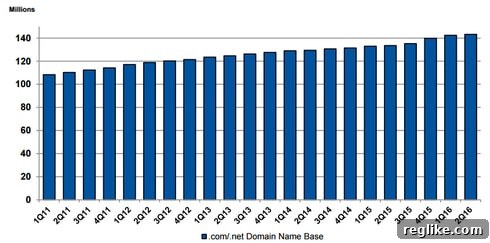
For years, the trajectory of .com and .net registrations has been a testament to the internet’s relentless growth. As businesses moved online and personal websites proliferated, these domain names saw an almost uninterrupted upward trend. The visual representation of this growth, a steadily climbing chart, has long been a familiar sight to industry observers. However, this established pattern is now poised to enter negative territory, as illustrated by the anticipated shift:
Unpacking the Core Reason: The 2015 Chinese Speculation Wave
The primary driver behind this predicted decline traces back to a specific period of unusual activity in the domain name market: the surge in new registrations during Q4 of 2015, heavily influenced by Chinese speculation. At that time, new registrations for .com domains, in particular, soared to levels significantly higher than typical organic growth rates. This anomalous period created a bubble that is now, years later, reaching its natural conclusion.
What Fueled the Chinese Speculation Boom?
During 2015, especially towards the latter half, the Chinese market experienced a fervent interest in .com domain names, driven by a unique confluence of cultural, economic, and speculative factors:
- Perceived Investment Value: Many investors and individuals in China viewed short, memorable, or numerically rich .com domains as valuable digital assets. These were often seen as akin to real estate or other tangible investments, with strong potential for significant appreciation in a rapidly digitizing economy.
- Cultural Significance: Specific number combinations (e.g., those containing ‘8’ for prosperity or ‘6’ for smoothness) or short, auspicious letter combinations held particular appeal. These domains were believed to carry inherent value dueaking them highly desirable.
- Ease of Entry: Registering domains was relatively inexpensive and accessible, attracting a wide base of speculators hoping to buy low and sell high quickly. This low barrier to entry allowed for mass acquisitions.
- Market Momentum and FOMO: As initial successes of domain flipping were reported, a ‘fear of missing out’ (FOMO) mentality spread, fueling further registrations. This created a self-reinforcing speculative bubble where demand seemed to only increase.
This led to a phenomenon where hundreds of thousands, if not millions, of .com domains were registered en masse. Crucially, these domains were not acquired for immediate website development or business use, but purely for their perceived future resale value. Many of these registrations were concentrated within a specific timeframe, setting the stage for the current situation as these domains come up for their initial renewal.
The Imminent Renewal Cliff: A Consequence of Speculation
Domain name registrations typically operate on an annual cycle. A domain registered today will come up for renewal approximately one year later. Consequently, the massive influx of speculative domains registered during the boom of Q4 2015 are now collectively reaching their renewal window in Q4 of the current year.
Why Aren’t These Domains Being Renewed?
The reasons for the anticipated mass non-renewal are multifaceted and directly tied to their speculative origins:
- Failing to Find Buyers: A significant portion of these domains were registered by speculators who intended to flip them for profit. If a suitable buyer wasn’t found within the initial year, or if the resale price didn’t meet the speculator’s high expectations, the incentive to renew diminishes significantly. Holding an unwanted domain represents a recurring cost.
- Market Correction: The speculative fervor has largely cooled since 2015. The inflated prices for certain types of domains have corrected to more realistic levels, making continued investment in holding these specific domains less attractive and financially viable. The bubble burst for many.
- Lack of Organic Use: Unlike domains registered for a legitimate business, a personal project, or a brand, speculative domains often sit idle without any active website or email service tied to them. Without functional value, their renewal becomes an unnecessary expense that offers no tangible return.
- Economic and Policy Factors: Broader economic shifts, changes in investment sentiment, or even stricter domain registration policies in certain regions can also play a role, making investors more conservative about holding non-performing digital assets.
This confluence of factors creates what is often referred to as a “renewal cliff,” where a large volume of non-essential domains simultaneously expire without being renewed, leading to a net reduction in the overall base. This predicted drop and its underlying causes have been discussed and analyzed by industry experts, highlighting the cyclical nature of domain market dynamics and the inevitable corrections that follow periods of unusual activity.
Implications for Verisign and the Broader Domain Industry
While a forecasted drop of 1.5 to 2.8 million domains might seem substantial, it’s crucial to understand its context and potential ramifications for Verisign and the wider domain name ecosystem.
Impact on Verisign:
- Revenue Fluctuations: Verisign generates revenue from each new registration and renewal. A net decline in the base, especially from mass non-renewals, will naturally impact its top-line revenue for the quarter. However, it’s worth noting that organic, legitimately used domains generally have consistently high renewal rates, which helps mitigate the overall financial impact.
- Stabilization Ahead: This event is primarily a correction of an anomalous period rather than a reflection of systemic weakness. Once these speculative domains churn out, the base is generally expected to stabilize and potentially resume more sustainable, organic growth, driven by genuine demand.
- Operational Adjustments: While Verisign’s core infrastructure remains robust and capable of handling fluctuations, the company continually monitors market trends and adjusts its operational forecasts and strategies based on such significant shifts.
Impact on the Domain Name Industry:
- Registrar Landscape: Domain registrars, which directly interface with customers and handle the registration and renewal process, will also feel the effects of reduced new registrations and increased non-renewals. This could lead to increased competition, more aggressive pricing strategies, or strategic shifts among registrars to attract and retain quality customers.
- Domain Investing and Aftermarket: For serious domain investors and the domain aftermarket, this event serves as a stark reminder of the risks associated with speculative buying and the importance of genuine market demand, utility, and long-term value. It could foster a more cautious and fundamental-driven investment approach, focusing on domains with intrinsic value or clear use cases.
- Market Health Indicator: While a decline in numbers sounds negative, the churning out of “dead wood” – domains held purely for speculation without genuine use – can sometimes be seen as a cleansing process. This leads to a healthier, more accurate reflection of active internet usage and legitimate domain demand.
- Availability of Domains: Ironically, as millions of these speculative domains expire, many previously unavailable or premium-sounding names may re-enter the public pool. This could offer new opportunities for legitimate businesses and individuals to acquire desirable domain names that were previously out of reach.
Beyond the Blip: The Enduring Value of .Com and .Net
Despite this forecasted dip, the fundamental importance and dominance of .com and .net domains remain largely unchallenged. They are globally recognized, trusted, and deeply embedded in the digital identity of businesses and brands worldwide, continuing to serve as critical cornerstones of the internet.
- Digital Foundation: For most businesses, regardless of size or industry, a .com domain is still considered the gold standard for establishing a credible and professional online presence, providing instant recognition and memorability.
- Global Reach and Trust: These domain extensions offer unparalleled global recognition, which is essential for any business or organization aiming for an international audience. Consumers inherently trust .com and .net domains more than many newer domain extensions, making them crucial for brand building and fostering customer confidence.
- Market Liquidity: .com domains continue to hold the highest value in the domain aftermarket due to their widespread acceptance and inherent brand equity, making them a more liquid asset for serious investors.
The current forecast is largely a consequence of a specific, transient market anomaly rather than a systemic decline in the utility or enduring demand for core domain names. The internet continues its rapid expansion, and with it, the perpetual need for unique, accessible, and credible digital addresses for new ventures and evolving online identities.
Looking Ahead: Navigating the Evolving Digital Landscape
As the fourth quarter unfolds, industry observers will closely watch the actual figures reported by Verisign. While the headline forecast points to a temporary contraction, the underlying narrative is one of market correction and maturation. This event provides valuable insights into how digital asset markets respond to speculative pressures and ultimately seek equilibrium.
For Verisign, this episode is a testament to its critical role in maintaining the stability and integrity of the internet’s core naming system, even as external market forces occasionally introduce volatility. Their transparency in forecasting this decline demonstrates a commitment to informing the market about significant trends.
The domain name industry is continuously evolving, with new technologies, user behaviors, and global economic shifts shaping its future. While a temporary dip in numbers might capture immediate attention, the enduring value and strategic importance of a well-chosen .com or .net domain for any serious online endeavor remain as strong as ever. The internet’s digital foundation continues to adapt, ensuring that businesses and individuals worldwide can reliably connect, communicate, and thrive in the ever-expanding digital realm.