
Verisign Secures Landmark Patent for Domain Name Blockchain User Addresses, Bridging Traditional DNS with Decentralized Identity
In a significant development at the intersection of traditional internet infrastructure and nascent blockchain technology, Verisign (NASDAQ: VRSN), the esteemed operator of the .com and .net top-level domains, has been granted a crucial patent by the U.S. Patent and Trademark Office. Patent number 10,721,060, titled “Domain name blockchain user addresses,” marks a pivotal step towards integrating the familiar, user-friendly world of domain names with the often complex, alphanumeric addresses of blockchain networks and cryptocurrency wallets.
Simplifying Blockchain Interactions with Familiar Domain Names
The core innovation behind Verisign’s patent lies in its potential to revolutionize how individuals and entities interact with decentralized applications and digital assets. Currently, engaging with blockchain networks often requires users to manage lengthy, unintuitive hexadecimal addresses for sending and receiving cryptocurrencies or interacting with smart contracts. These addresses, while cryptographically secure, are notoriously difficult to remember, prone to typos, and present a significant barrier to mainstream adoption. Verisign’s patent offers a sophisticated solution by proposing a method to associate these complex blockchain identifiers with easy-to-remember domain names, much like how DNS (Domain Name System) translates IP addresses into website names.
The abstract of the patent outlines a clear technical approach:
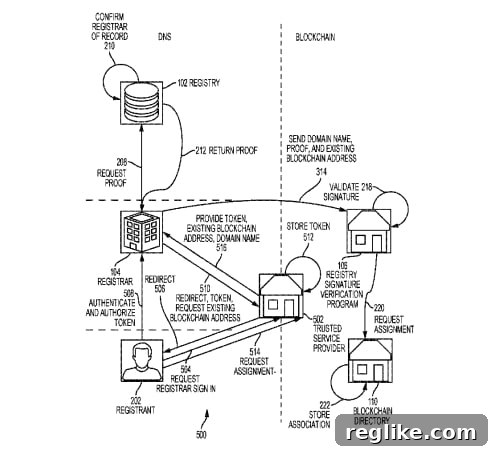
Techniques for DNS registry facilitated assignment of a DNS domain name registered to a registrant as a blockchain user address in a blockchain network are presented. The techniques can include providing, by a DNS registry, a public key and a computer executable registry signature verification program configured to use the public key to validate signatures made using the private key for addition to a block in a blockchain of the blockchain network. The techniques can also include receiving a request for a proof of registrar of record, and providing a proof of registration message, such that the registry signature verification program validates the signature using the public key, and the blockchain network receives and stores in the blockchain an association between the domain name and an existing blockchain user address for the registrant.
In essence, this means Verisign, as a DNS registry, could facilitate the mapping of a registered domain name (e.g., yourname.com) to a blockchain user address (e.g., 0xAbCdEf1234…). This process would involve the registry providing a public key and a verification program to validate signatures made with a corresponding private key. When a user requests proof of domain ownership, the system can provide a digitally signed message, allowing the blockchain network to then securely record the association between the domain name and the blockchain address. This method leverages the existing trust and infrastructure of the DNS system to bring greater usability and security to the blockchain space.
The Urgency to Bridge DNS and Blockchain
The quest to merge the established reliability of the Domain Name System with the innovative potential of blockchain technology has long been a pursuit for many companies. On one side, traditional domain service providers, including registrars and registries, seek to apply the elegant simplicity of memorable domain names to the cumbersome nature of blockchain wallet addresses. Imagine sending Bitcoin to “yourcompany.com” instead of a 34-character string of alphanumeric characters, or accessing a decentralized application simply by typing a descriptive domain name. This significantly enhances user experience, making blockchain interactions as straightforward as sending an email.
Conversely, many blockchain proponents envision a world where decentralized technologies completely replace the “centralized” DNS that currently underpins the internet. Their goal is to create a fully decentralized naming system that offers enhanced censorship resistance, greater user control, and eliminates single points of failure. However, this ambitious vision faces substantial hurdles. The two primary challenges include:
- Scalability: The current DNS handles billions of queries daily with incredible speed and efficiency. Replicating this level of performance and global reach using blockchain technology, which inherently involves distributed consensus and slower transaction times, is an enormous technical challenge.
- Universal Acceptance: Even if a scalable decentralized DNS were developed, convincing the entire internet ecosystem – browsers, operating systems, ISPs, and end-users – to adopt a completely new naming standard is a monumental undertaking that could take decades.
Verisign’s patent represents a more pragmatic approach to this challenge. Instead of attempting to replace the entire DNS, it seeks to enhance blockchain usability by integrating it with the existing, universally accepted DNS infrastructure. This strategy allows for the best of both worlds: the decentralization and security of blockchain combined with the accessibility and familiarity of domain names.
Verisign’s Unique Position and Expertise
Verisign is not just any player in the internet landscape; it is a foundational pillar. As the authoritative registry for the .com and .net domains, Verisign is responsible for the critical function of resolving billions of DNS queries every day, ensuring the smooth operation of a vast portion of the internet. This provides them with an unparalleled understanding of global naming systems, security infrastructure, and operational reliability at an immense scale. Their expertise in managing a high-volume, secure, and resilient naming system positions them uniquely to introduce a trusted bridge between domain names and blockchain addresses.
This patent underscores Verisign’s commitment to innovation and its forward-thinking approach to shaping the future of digital identity and online interactions. By leveraging its deep experience in cryptographic security and domain name management, Verisign can provide a reliable framework for associating traditional internet identities with emerging blockchain identities, fostering greater trust and adoption in the decentralized ecosystem.
The Mechanics: How Verisign’s Patent Works for Blockchain Identity
Let’s delve deeper into the technical specifics outlined in the patent abstract to understand its practical implications. The core mechanism involves a DNS registry (like Verisign itself) acting as a trusted intermediary to link a domain name to a blockchain address. This process would involve several key components:
- Public Key Provision: The DNS registry would provide a public key. This public key is part of a cryptographic pair, with a corresponding private key held securely by the registry.
- Registry Signature Verification Program: Alongside the public key, a computer executable program would be provided. This program is designed to use the public key to validate signatures made with the registry’s private key. These signatures are crucial for proving the authenticity of information added to a blockchain.
- Proof of Registrar of Record Request: When a registrant (domain owner) wishes to link their domain name to a blockchain address, they would initiate a request for a “proof of registrar of record.” This step confirms that the domain is indeed registered to them through a legitimate registrar.
- Proof of Registration Message: The DNS registry would then generate and provide a cryptographically signed “proof of registration” message. This message would contain the necessary information to associate the domain name with the registrant’s existing blockchain user address.
- Blockchain Network Integration: The blockchain network would receive this proof of registration message. Using the public key and verification program provided by the DNS registry, the blockchain network would validate the signature on the message. Once validated, the blockchain would securely store this association between the domain name and the registrant’s blockchain address.
This sophisticated mechanism ensures that the linkage between a domain name and a blockchain address is not only user-friendly but also cryptographically secure and verifiable, leveraging the established trust model of the DNS infrastructure.
Transformative Benefits for Web3 and Digital Identity
The successful implementation of technologies enabled by Verisign’s patent holds numerous potential benefits, impacting areas from cryptocurrency transactions to the broader landscape of digital identity in Web3:
- Enhanced User Experience: This is arguably the most immediate and impactful benefit. By replacing complex blockchain addresses with simple, memorable domain names, the barrier to entry for cryptocurrency transactions and decentralized applications is significantly lowered. Users will no longer fear sending funds to the wrong address due to a single mistyped character.
- Increased Security and Reduced Error: The abstraction layer provided by domain names reduces the risk of human error associated with managing long cryptographic strings. While the underlying blockchain address remains secure, the user interface becomes much safer and more intuitive.
- Improved Trust and Legitimacy: Verisign’s involvement, a globally recognized and trusted entity in internet infrastructure, lends significant credibility to the concept of domain-linked blockchain addresses. This could encourage broader adoption among mainstream users and businesses who might be wary of purely decentralized, unfamiliar naming systems.
- Bridging Web2 and Web3: The patent offers a clear pathway for seamlessly integrating traditional internet identities (e.g., your website domain) with emerging decentralized identities (e.g., your crypto wallet or NFT collection). This bridging could accelerate the transition of users and businesses into the Web3 ecosystem.
- New Services and Innovation: This technology opens up possibilities for new services for domain registrars and registries. It could lead to innovative digital identity solutions, secure login systems for decentralized applications, and more streamlined payment gateways for e-commerce using cryptocurrencies.
- Decentralized Identifier (DID) Compatibility: While not explicitly stated, this approach aligns well with the evolving standards for Decentralized Identifiers (DIDs), which aim to provide self-sovereign digital identities. Associating DIDs with existing domain names could provide a powerful and familiar anchor for these new identity systems.
The Future Landscape of Digital Naming and Identity
Verisign’s patent arrives at a time of intense innovation and competition in the realm of digital naming and identity. Projects like Ethereum Name Service (ENS), Unstoppable Domains, and Handshake are also working on various forms of decentralized naming systems. However, Verisign’s approach stands out due to its reliance on the existing, globally established DNS infrastructure, offering a path that prioritizes interoperability and immediate usability over a complete paradigm shift.
While the patent lays the groundwork, the actual implementation will involve collaboration across the domain industry, blockchain developers, and potentially cryptocurrency exchanges and wallet providers. Regulatory considerations, especially regarding the use of domain names for financial transactions, will also need careful navigation.
In conclusion, Verisign’s patent for “Domain name blockchain user addresses” is more than just a technical achievement; it represents a strategic move to simplify the complex world of blockchain for everyday users. By leveraging its unparalleled expertise in managing the internet’s most critical naming systems, Verisign is poised to play a crucial role in shaping a more accessible, secure, and user-friendly future for digital identity and decentralized applications. This patent could very well be a foundational piece in the puzzle of mainstream Web3 adoption, making blockchain as easy to navigate as the internet itself.