Where do most cybersquatters live?
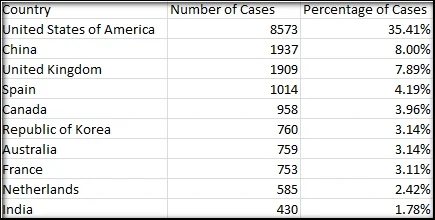
A lot in the U.S. and China, but there are some notable caveats.
World Intellectual Property Organization, unlike its big peer, publishes robust statistics regarding the UDRP cases it hears.
One of the more interesting stats is the location of respondents, i.e. the alleged cybersquatters.
The stats WIPO provides need a few caveats if we’re going to draw conclusions regarding where cybersquatters live.
1. These are the locations of the respondents in all cases, not just those when the complainant wins. (But complainants win most of the cases.)
2. This is where the respondent states he/she lives. They could be fake addresses. Privacy services might skew it a bit too.
3. It’s unclear if these numbers include ccTLD cases heard under variations of UDRP.
OK, so here are the top 10:
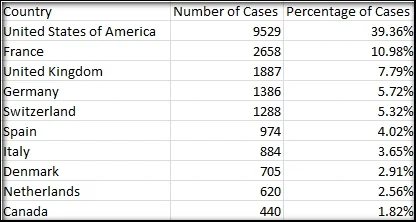
I think it’s also interesting to compare this data to where most complainants reside.
Update 8/31/12:
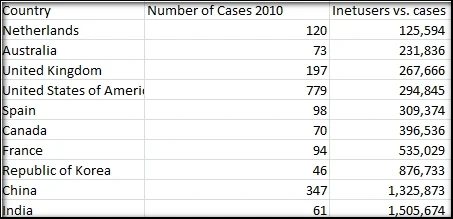
At the prompting of John Berryhill’s comment below, I’ve calculated the number of WIPO UDRP filings compared to the number of internet users in a country. It radically shakes up the order, sending China near the bottom of the list.
This is a very crude analysis for a couple reasons.
First, I only looked at the ten countries that were at the top of the respondent list. I suspect that countries such as China wouldn’t even fall into the top 10 on this list had I looked at more.
Second, this only considers WIPO cases. Although National Arbitration Forum is smaller, it does hear a substantial number of cases. You might double the number of US cases to get the true number. But WIPO probably has a higher share of international cases. So while in the U.S. you might say there’s one UDRP per 150,000 internet users (double the # of WIPO cases), in other countries this crude methodology may not work. There’s also an Asian UDRP provider that might bump up China’s numbers.
Also, one person can be responsible for a sizable number of cases.
The most recent World Bank numbers for internet users are from 2010. I compared the number of 2010 users as stated by the world bank to the number of WIPO cases filed in 2010 alone.