
Internet Corporation for Assigned Names and Numbers (ICANN) Gets Low Marks: A Deep Dive into Declining Satisfaction
The intricate world of the internet, a sprawling network connecting billions, relies on a foundational layer of governance to ensure its stability and continued growth. At the heart of this governance lies the Internet Corporation for Assigned Names and Numbers (ICANN), a pivotal non-profit organization tasked with coordinating the unique identifiers across the globe, from domain names to IP addresses. Its mission is critical: to maintain the secure, stable, and interoperable operation of the internet’s unique identifier systems. However, recent findings from a comprehensive industry survey paint a challenging picture, indicating a significant downturn in satisfaction with ICANN’s performance and leadership within the very community it serves.
A Glimpse into Declining Trust: Key Survey Highlights
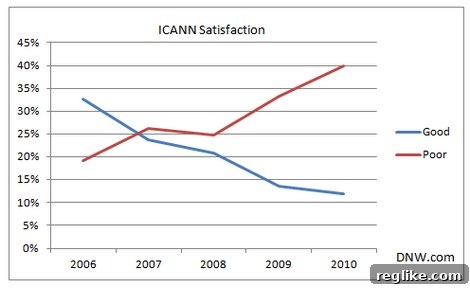
For half a decade, a specialized annual survey has meticulously tracked the sentiment of the domain name industry towards ICANN. The latest iteration, encompassing responses from over 500 seasoned professionals and stakeholders, reveals a worrying trend: the percentage of individuals rating ICANN’s performance as “Good” has plummeted to its lowest point since the survey’s inception. A mere 12% of respondents now express genuine satisfaction, a stark contrast to the 33% who felt positively in 2006. This dramatic decline signals a growing undercurrent of disillusionment and skepticism that is now more pronounced than ever before.
Compounding this decrease in positive sentiment is an alarming surge in negative perceptions. A substantial 40% of participants currently rate ICANN’s performance as “poor,” a significant increase from just 19% recorded in 2006. This isn’t merely a passive withdrawal of approval; it represents an active and expanding dissatisfaction. The global scope of the survey, which included participants from 49 countries, underscores that these sentiments are not isolated to a particular region or group but are broadly representative of a worldwide concern. While the largest cohort of respondents comprised domain investors, a crucial segment known for their keen interest in domain policy and market dynamics, the survey also gathered insights from vital industry players such as domain name registrars, various service providers, and other professionals deeply integrated into the digital ecosystem. Their collective feedback serves as a critical barometer of ICANN’s effectiveness and its relationship with the global internet community.
Unpacking the Core Issues: The Protracted New Top-Level Domain (gTLD) Rollout
Among the myriad factors contributing to this widespread discontent, the much-delayed rollout of new generic Top-Level Domain names (gTLDs) stands out as a particularly potent catalyst for frustration. This ambitious program, which promised to revolutionize the internet’s naming system by introducing hundreds of new extensions beyond the familiar .com, .org, and .net – envisioning possibilities like .NYC, .Music, .Shop, .Brand, and countless others – has instead become emblematic of ICANN’s operational challenges and the complexities of its policy development process. Initially, ICANN had set an optimistic timeline, intending to begin accepting applications for these groundbreaking gTLDs years prior. However, these projections have been consistently pushed back, leading to a cascade of delays that have severely tested the patience and financial reserves of countless applicants and industry stakeholders.
The strategic vision behind the new gTLD program was to inject a new wave of competition, broaden consumer choice, and foster innovation within the domain name space. It offered an unparalleled opportunity for businesses, communities, and individuals to establish more descriptive, brand-aligned, or geographically specific online identities. This promise sparked considerable excitement and prompted significant financial investments from a diverse range of entities, all eager to secure their own branded TLDs or acquire highly desirable new domain strings. The potential for market expansion and novel online services was immense, making the delays all the more impactful.
The protracted nature of these delays is attributable to a complex interplay of factors inherent in governing a global, multi-stakeholder system. A primary hurdle has been the intensive scrutiny and often fervent opposition from powerful interest groups, particularly those representing trademark holders and intellectual property (IP) interests. Brands expressed legitimate and significant concerns regarding the potential for widespread trademark infringement, the escalating costs associated with defensive registrations across a vast array of new TLDs, and the logistical nightmare of monitoring thousands of new extensions for cybersquatting or abuse. These concerns necessitated extensive negotiations, the development and refinement of new protection mechanisms such as the Trademark Clearinghouse, and numerous rounds of public comment and policy adjustments, all of which consumed considerable time and resources.
Beyond trademark issues, numerous other third parties—including governments, civil society organizations, and even other segments of the domain industry—have weighed in on various facets of the program. Complex issues such as the protection of geographical names, the potential for “string contention” (where multiple applicants vie for the same desired TLD string), the technical intricacies of implementing a vastly expanded root zone, and ensuring the fairness and transparency of the application and evaluation processes have all contributed to the program’s drawn-out timeline. Each new objection, concern, or policy refinement required careful deliberation within ICANN’s multi-stakeholder governance model. While this model is designed to ensure inclusivity and consensus-building, it often means that speed and agility are sacrificed for thoroughness and broad agreement. For applicants who had already committed substantial resources to legal fees, technical preparations, and marketing strategies, these delays translated directly into significant financial burdens, deferred business opportunities, and a palpable sense of exasperation.
Beyond gTLDs: Broader Criticisms of ICANN’s Governance and Operations
While the new gTLD program undeniably serves as a major flashpoint, the overall erosion of satisfaction with ICANN is rooted in a broader set of concerns pertaining to its unique governance structure and operational efficacy. ICANN champions a multi-stakeholder model, a democratic ideal designed to balance the diverse and often conflicting interests of governments, businesses, technical experts, civil society, and end-users worldwide. While conceptually laudable, its practical application frequently draws criticism:
- Perceived Lack of Transparency and Accountability: Despite ICANN’s explicit commitment to transparency, many critics contend that its decision-making processes can often appear opaque and difficult to navigate. The sheer volume of technical documentation, the specialized jargon, and the often protracted policy development cycles can make it challenging for even highly engaged stakeholders to fully comprehend, track, and effectively influence outcomes. Questions regarding accountability also frequently emerge, particularly when widely debated policies face significant dissent or encounter unforeseen implementation hurdles.
- Slow and Bureaucratic Policy Development: The multi-stakeholder model, while ensuring wide-ranging input, is inherently a slow-moving mechanism. Forging consensus among a diverse global assembly of stakeholders, each with their own unique and often conflicting interests, is an arduous and time-consuming endeavor. This often results in what many perceive as an overly bureaucratic process that struggles to keep pace with the internet’s accelerating evolution, leaving the industry feeling constrained by outdated or delayed regulations.
- Enforcement and Compliance Challenges: ICANN’s regulatory authority largely hinges on contractual agreements with domain name registrars and registries. However, the effectiveness of this enforcement, particularly concerning critical issues like Whois data accuracy, robust abuse mitigation, and adherence to contractual obligations, is a frequent subject of debate and scrutiny. Perceived inconsistencies or leniency in enforcement can undermine confidence in ICANN’s overarching regulatory capacity.
- Representation Imbalance and Influence: Some stakeholders articulate concerns that their voices are not adequately heard or appropriately weighted within the decision-making framework. Apprehensions have been voiced regarding the disproportionate influence of certain powerful blocs, such as large corporations or national governments, over smaller players, developing regions, or specific community interests. This can lead to feelings of disenfranchisement among various segments of the global internet community.
- Navigating Geopolitical Pressures: As the internet increasingly integrates into the core of global economic and political affairs, ICANN finds itself navigating an exceptionally complex and ever-shifting geopolitical landscape. Growing calls for greater governmental control over internet governance, emanating from various nation-states, exert considerable pressure on ICANN’s independent, multi-stakeholder model, thereby adding another intricate layer of complexity to its already challenging operational environment.
The Far-Reaching Impact of Dwindling Trust on Internet Governance
The implications of ICANN’s declining satisfaction ratings extend far beyond mere statistical observations; they touch upon the very foundations of internet governance. Trust forms the bedrock of any effective global institution, particularly one operating at the unprecedented scale and criticality of the internet. A sustained and deepening erosion of confidence can lead to several profoundly detrimental outcomes for the future of the domain name system and the internet as a whole:
- Reduced Participation and Engagement: Frustrated or disillusioned stakeholders may choose to disengage from the essential policy development process. This withdrawal leads to a less diverse and ultimately less robust range of input, potentially resulting in policies that are less representative or effective. If active participants perceive their efforts as futile due to sluggish progress or an unresponsive governing body, the vitality of the multi-stakeholder model itself significantly diminishes.
- Calls for Alternative Governance Models: Persistent and widespread dissatisfaction can ignite and fuel demands for more radical reforms or even entirely new models of internet governance. Such pressures could potentially fragment the unified, global internet that ICANN is meticulously designed to maintain, introducing significant instability, uncertainty, and potential incompatibilities into the global domain name system.
- Innovation Stifling and Market Stagnation: Delays in crucial programs, such as the new gTLDs, directly hinder innovation, stifle market growth, and defer economic opportunities. Businesses, entrepreneurs, and developers rely on a predictable and efficient regulatory environment to plan investments, launch innovative services, and bring new products to market. Prolonged uncertainty and inefficiency can significantly deter progress and investment across the entire domain industry.
- Increased Conflict and Polarization: In an environment characterized by low trust, existing disputes become more entrenched, and resolving them becomes substantially more challenging. Competing interest groups may harden their positions, making consensus-building even more arduous and further exacerbating the already slow pace of policy development and implementation.
Moving Forward: Rebuilding Confidence and Embracing Adaptive Change
Addressing these formidable challenges demands more than superficial adjustments; it necessitates a profound and concerted effort from ICANN to actively listen, critically evaluate its processes, and demonstrate tangible improvements in its operational effectiveness and responsiveness. Rebuilding the eroded confidence within its diverse community will likely require a multi-pronged approach, encompassing:
- Streamlining Policy Development Processes: While thoroughness and due diligence are paramount, ICANN must proactively explore innovative strategies to accelerate its policy-making process without compromising inclusivity or the quality of its outcomes. This might involve clearer prioritization of key initiatives, the adoption of more agile working group structures, or leveraging advanced technologies to facilitate more efficient deliberations and decision-making.
- Enhanced Transparency and Proactive Communication: A commitment to clear, concise, and proactive communication regarding policy decisions, projected timelines, and the fundamental rationale underpinning key choices is crucial for demystifying ICANN’s complex operations. Making highly technical or voluminous information more accessible and understandable to a broader, non-specialized audience is an essential step towards fostering greater trust.
- Strengthening Accountability Mechanisms: It is imperative to ensure that ICANN is genuinely accountable to its global community for its performance, the efficiency of its processes, and the ultimate outcomes of its policies. This could involve implementing more robust, independent review mechanisms, establishing clear and measurable metrics for success, and openly reporting on its progress against these benchmarks.
- Proactive Engagement with Dissatisfied Stakeholders: Rather than solely relying on periodic surveys, ICANN should implement more direct, focused, and iterative engagement strategies to deeply understand and specifically address the grievances of highly dissatisfied segments of the community, such as domain investors, new gTLD applicants, and smaller regional players.
In conclusion, the current critically low satisfaction ratings for ICANN serve as an unmistakable and urgent alarm bell for the organization. They underscore a pressing and undeniable need for ICANN to rigorously evaluate its operational effectiveness, strategically refine its intricate governance mechanisms, and unequivocally reinforce its unwavering commitment to serving the global internet community with greater efficiency, transparency, and responsiveness. The future stability, security, and continuous innovation of the domain name system hinge profoundly on ICANN’s capacity to evolve, adapt, and, most crucially, to effectively regain and sustain the trust of its most vital and engaged stakeholders. While the path ahead is undeniably fraught with significant challenges, the imperative to ensure a truly free, open, and perpetually functioning internet for all remains an unwavering and essential goal.